Tag: Sydney

Going against the grain

I’ve just begun writing a book chapter about the travels of white wives of Chinese men from Australia/NZ to China in the period 1880 to 1930. It’s a topic that I’ve been gathering material on for years and years, but now it’s down to actually writing something concrete and (hopefully) intelligent, it’s proving difficult to work out how exactly I’m going to frame their stories.

What’s troubling me most right now is the overwhelmingly depressing tales that emerge from the sources, like this one that I found this morning, titled ‘Harbor Bridge Suicide’  from the Barrier Miner (Broken Hill), 17 January 1933:

Sydney, Tuesday.

At the inquest yesterday into the death of Mary Anne Mee Hing (62), who jumped off the Harbor bridge on January 5, it was stated that she was an Australian woman who had married a Chinese store-keeper with whom she went to China.

Her husband’s people disowned her, and she returned to Australia, where her parents refused to have anything to do with her. She returned to China and found her husband married to a young Chinese girl.

The woman thereupon came back to Australia, where she took to drink and subsequently ended her life.

The coroner returned a verdict of suicide.

I will see if I can get the full records of the inquest, in the hope that there are more subtle shades to the story, but The full records of the coroner’s inquest into Mary Anne’s death no longer exist, and from the other little bits and pieces I’ve found about her, it seems quite possible that Mary Anne’s life was as full of disappointment and heartbreak as this short report suggests. So many reports tell of marriages that have broken down, of women returning to Australia in financial and emotional distress, of illness, death or separation from children. The nature of these sources is something that I’ve tackled before, in my work on Agnes Breuer’s visit to China with her husband in 1933, but as I look over the bits and pieces I’ve assembled I now wonder if I’m wrong in wanting to assert that the difficult and unhappy times related in the sources are not a fair representation of how white wives experienced China.

At the heart of my response to the sources is my own response to life in China, most particularly as part of a Chinese family there. I went to China more or less on a whim, and it overwhelmed my life, both personally (I fell in love and married there – a relationship that, like many of my subjects’, has not endured) and intellectually (it sparked my passion for Chinese Australian history). There were and are aspects of life in China that I love, and aspects that I find so very difficult to deal with. It is a place where I have been both my happiest and my most unhappy.

If you caught me in the right mood I could paint a picture of my time as Chinese wife and daughter-in-law that was as sensational or pathetic as any that appear in my 19th and early 20th century sources. From seemingly small things, like not being allowed to wash my hair on feast days or to use a needle and thread while pregnant, to bigger things, like the idea of letting my parents-in-law raise my baby or meeting women in the village who had effectively been bought by their husbands. There were many things that contradicted my own (university-educated, Western, liberal, feminist) sense of how the world should work and ultimately how I wanted my own life to be.

At the same time though, spending time in China both as an independent entity and as part of a family has brought me a richness of experience and knowledge, a strength of character and sense of self, and many memories and stories that I would never had if I had stayed safely home in Australia. So if you asked me on another day, I might rave about how wonderful China is and how much I miss being there.

Couldn’t this also be the case for my white wives of a century ago? I know of wives who made short uneventful trips (happy holidays, even?) to China with their husbands and children. And I have scant detail about perhaps half a dozen white wives who stayed living in their husbands’ south China villages for long periods, like one who was described by New Zealand Presbyterian missionary Alexander Don as being ‘far more important in [the] Chinese village than she would have been in her own country’ (Otago Witness, 11 April 1906).

I don’t want the focus of this chapter to be on the biases and prejudices of the missionaries, newspaper reporters and government officials who recorded the experiences of my white wives, rather I want to think about the lives of the women themselves. But with a growing amount of evidence to suggest that my sources are going to remain weighted to the negative, I’m going to have to think about how or if it might be possible for them to reveal a more balanced account. If ever were a time for reading ‘against the grain’, I think this might be it.

Birth certificate registers

In October 1913 Secretary of the Department of External Affairs, Atlee Hunt, sent a circular to the state Customs departments asking if they kept records of Chinese Australians who used their birth certificates as identity papers when travelling overseas.

Queensland already kept such a register, and Hunt felt that:

Such a register is very desirable to enable a check to be kept on persons claiming admission to Australia on birth certificates, as it is an easy matter for a number of copies of the same certificate to be obtained, and the experience of the past shows that in some instances several Chinese have attempted, sometimes successfully, to land on copies of the same certificate. (NAA: A1, 1913/20069)

An example of the early difficulties that both Chinese Australians and government officials had with using birth certificates as identification can be found in the case of Fred Hong See (see NAA: BP342/1, 13021/357/1903). Fred was born in Sydney in 1885 to Chinese parents who, when he was very young, took their son back to China. Fred’s father later died and, in 1903, Fred returned to live with other relatives in Sydney. When he arrived, Customs officer J.T.T. Donohoe doubted his identity and would not allow him to land. Donohoe’s suspicions were based on the fact that Fred could not speak any English and his feeling that Fred looked older than the age stated on the birth certificate he presented.

Fred was quickly sent on his way back to China, and it was only through the threat of legal action by his well-respected relatives in Sydney and their payment of a deposit of £100 that Fred was permitted to stop at Brisbane for re-examination. With evidence provided by Fred’s relatives, the Brisbane Collector of Customs, W.H. Irving, was satisfied that he was, in fact, telling the truth. After Atlee Hunt’s approval, Fred was allowed to stay.

This is the copy of Fred Hong See’s birth certificate that he presented to officials on his return to Australia in 1903. It can be found with other correspondence about the case in NAA: BP342/1, 13021/357/1903.

In the decade after the introduction of the Immigration Restriction Act, the processes for its administration continued to be refined and tightened, primarily to prevent the fraudulent entry of Chinese into Australia. Hunt’s request for the keeping of birth certificate registers came about from a concern that ‘as other channels of fraudulent entry are being blocked, the Chinese will make a determined effort to utilize birth certificates to that end.’

His Customs circular of 1913 set out the details that Customs officers should record to enable correct identification on a person’s return to Australia:

  • name
  • number of birth certificate
  • date of issue
  • date of birth
  • where born
  • date of departure from Australia
  • remarks concerning departure
  • date of return
  • by whom examined, landed or rejected
  • general remarks

The Collectors of Customs responded thus:

  • Victoria reported that had been keeping a register from the beginning of the year (1913), but without the level of detail requested.
  • New South Wales had not been keeping records, but was now ordering a book for the purpose.
  • Western Australia had no special register, but would immediately open one.
  • South Australia said they had not had any need for a register, as there had been no cases of Chinese being admitted on birth certificates there.
  • Tasmania would begin keeping a record, but had only had four cases to date.
  • And the Northern Territory had been keeping record of Chinese arriving on birth certificates since 1911.

It became the practice for birth certificates to be endorsed by Customs officials on a person’s departure. This usually included taking a handprint and attaching a photograph, as well as recording the details in a register. Some people also went through the formality of applying for a CEDT.

The two remaining registers

To my knowledge, only two of the birth certificate registers still exist, those for Queensland and New South Wales. The Queensland register is held in the Brisbane office of the National Archives, and a digital copy is available through RecordSearch:

The first volume, of 16 double pages, has suffered flood damage and can be difficult to read in parts. The second volume, which has 23 double pages, is much more legible. A sample page from the second volume is shown below – this is a left-hand page, with the remainder of the details about each person completed on the corresponding right-hand page.

The single register for New South Wales, held in the National Archives’ Sydney office, is more substantial than those for Queensland, demonstrating the greater amount of travel that occurred from Sydney. The register contains around 150 double pages and includes an alphabetical index at the front. The entries date from 1904 to 1962; those before 1913 were presumably copied from records elsewhere. It is also fragile and difficult to read in places, but it has recently also been digitised and made available through RecordSearch:

The page reproduced below is a left-hand page, with further details about the travels of each person available on the corresponding right-hand page.

Making use of the registers

These registers are valuable sources of information about Chinese Australian families in Queensland and New South Wales, and can provide missing pieces of information for people who did not apply for CEDTs when they travelled overseas (which many Australian-born Chinese did not).

Having them digitised is great, especially for those of us who can’t easily get to the Brisbane or Sydney reading rooms – but what would be even more useful is if the information contained in the registers was in a form that could be searched and sorted. I’m working on a bigger project relating to Chinese families in New South Wales, based around a database of information sourced from marriage and birth records up to 1918. I’m part-way into transcribing relevant details from the published BDM indexes with 1000 entries (out of an estimated 3000–4000) in the database so far!

The information found in the birth certificate registers obviously relates very strongly to this, so I have another crazy plan to also transcribe the information held in the Sydney register. It’s not going to be a quick job – and it’s one that could easily be shared since the New South Wales register is online. So, if you happen to have some spare time and don’t mind deciphering old handwriting, I’d love to hear from you!

Form 21(i): Certificate of Domicile, 1902

This is the first in a series of five posts that looks at the different iterations of Form 21 over the first decade of the 20th century. Form 21 is better known as a Certificate of Domicile or Certificate Exempting from Dictation Test (CEDT), but there is something reassuringly bureaucratic in it having a number. There is something practical in it too, because there were a bevy of other forms as well (32, 22, 19, 9 etc), including the confusion-causing Certificate of Exemption (Form 2, which was a temporary entry permit rather than a re-entry permit).

I have located what I’m fairly confident are the first examples of each variation of Form 21 between 1902, when the Immigration Restriction Act came into effect, and 1908. After then things settled down a bit and the form remained more or less the same over the following decades. My examples are taken from New South Wales.

You can see these examples and others in my Invisible Australians library in Zotero.

Certificate of Domicile for Ah Shooey

The first Certificate of Domicile issued in New South Wales would have been numbered 02/1 – ’02’ being the year 1902 and ‘1’ being the certificate number. There is a volume of certificates from 1902 in NAA: SP11/6, Box 3 (more about this in an earlier post), and my guess is that the first Certificate of Domicile is probably to be found there. Unfortunately it’s not digitised and I’m not in Sydney, so we’ll have to leave confirmation of that ’til a later time.

The first Certificate of Domicile that I can include here is, therefore, from a year later. It was the first Certificate of Domicile issued in New South Wales in 1903 (no. 03/1) and is the first certificate to be found in series NAA: ST84/1, ‘Certificates of Domicile and Certificates of Exemption from Dictation Test, chronological series’. (Here’s a link to the record item it is held in: NAA: ST84/1, 1903/1-10 – the whole item is digitised.)

The certificate was issued in the name of Ah Shooey, a 47-year-old Chinese man from Canton, who was departing Sydney for China on the Kasuga Maru on 1 January 1903. The certificate notes that Ah Shooey has one son, who is accompanying him. This is presumably 22-year-old labourer Louey Back Keong, whose certificate is no. 03/2.

Two copies of the form were completed; the one pictured above includes the word ‘Duplicate’ handwritten in red on the front. This copy was kept on file in Sydney, while the other copy (also found in NAA: ST84/1, 1903/1-10) would have been given to Ah Shooey to use during his travels, before being collected and filed on his return. Details of Ah Shooey’s arrival were also marked on the used certificate (‘Landed Empire 27/05/05’).

Ah Shooey’s form records the following information:

Duplicate

No. 03/1

COMMONWEALTH OF AUSTRALIA
Immigration Restriction Act 1901 and Regulations.

CERTIFICATE OF DOMICILE

I, Nicholas Lockyer Collector of Customs at the port of Sydney New South Wales in the said Commonwealth, hereby certify that Ah Shooey, hereinafter described, has satisfied me that he is domiciled in the Commonwealth, and is leaving the Commonwealth temporarily.

[Signature of Nicholas Lockyer] Collector of Customs
Date 31st December 1902

DESCRIPTION

Nationality Chinese
Birthplace Canton
Age 47 years
Complexion —
Height 5ft 5 1/2 inch in Boots
Hair Turning grey
Build Stout
Eyes Brown
Particular marks Nail on little finger left hand missing. Top of third finger on right hand off from first joint.

(For impression of hand, see back of this document.)

Family One son
Where resident Accompanying
Date of arrival in Australia Year 1877
Place of residence in Australia Deniliquin
Occupation Storekeeper
Property Value £400 Deniliquin

Date of departure 1st January 1903
Destination China
Ship Kasuga Maru

References in Australia (names and addresses) Police Magistrate Deniliquin. A Fordham Deniliquin. C Hitchin Jerilderie.

Form No. 21.

On the reverse, the form includes the words ‘Impression of Left Hand’ and Ah Shooey’s handprint.

Reverse of Certificate of Domicle for Ah Shooey, 1903. NAA: ST84/1, 1903/1-10

La Perouse market gardens under threat

Chinese community and heritage groups are opposing the planned resumption of heritage-listed market gardens at La Perouse in southern Sydney for use as a cemetery. The land on which the market gardens sit has been used for food production for more than 150 years, and managed by Chinese gardeners for more than a century. They are one of the very few remaining examples of the productive gardens which used to be found all around the Sydney suburbs.

Media release – Chinese Heritage Association of Australia Inc.

Resumption of Heritage-listed Market Gardens alarms community

Chinese community leaders were shocked to learn about a plan to resume 60% of the heritage-listed Chinese Market Gardens at La Perouse, which was presented by representatives from the adjacent Eastern Suburbs Memorial Park Botany Cemetery, at a Chinese Community Consultations meeting on 26 July 2010, organised by the Community Relations Commission and the Land and Property Management Authority.

The cemetery and the market gardens are on Crown land. Two years ago, in response to representations to acquire this land by the Botany Cemetery and Eastern Suburbs Crematorium Trusts, the Department of Lands, prepared a Draft Assessment of Crown Land – Chinese Market Gardens, Phillip Bay and called for submissions. Many submissions (including ones from the National Trust and Randwick Council) were lodged in July 2008 for the retention of these seven (7) hectares to remain as heritage-listed Chinese market gardens.

The Draft Assessment identified three (3) suitable uses for this land:

  • Environmental Protection
  • Agriculture
  • Nature Conservation

It stated that ‘the site currently has a very high capability for agriculture and is functioning very successfully in this purpose’. (p.35)

It further states in relation to the cemetery proposal: ‘The site in its current state would most likely require significant engineering works to overcome the current constraints such as a high water table and flooding issues. Given the current environmental constraints and current state of the subject land, the site is considered not suitable for the establishment of a cemetery. As per the Australasian Cemeteries and Crematoria Association (2004) ‘Guidelines for the Establishment of a Cemetery’, if the water table is too high burials may not be possible.’ (p.36)

Daphne Lowe Kelley, president of the Chinese Heritage Association of Australia says, ‘The community recognises that with a growing population, there is increased demand for burial space but urges the State government not to acquiesce to this demand to turn unsuitable land into burial plots. I am sure that no one wants to have their dearly departed spending their afterlife in a former swamp.’

Contact: Daphne Lowe Kelley – 0417 655 233 – lowekelley@bigpond.com

Media release – Australian Heritage Institute

From Andrew Woodhouse
President, Australian Heritage Institute, a non-profit, Australia-wide group of local heritage societies
Suite 12, 3 McDonald Street Potts Point NSW 2011
Phone: 0415 949 506

Wednesday 28th July, 2010

State Government moves to evict Chinese market gardeners at historic La Perouse site and downgrade heritage based on hidden report. Calls for Kristina Keneally to intervene.

‘NSW Premier, Kristina Keneally, should intervene to provide Sydney with more sustainable food sources and stop her Land Property Management Authority from evicting second-generation Chinese market gardeners from their Bunnerong Road, La Perouse, Crown Lease, just to increase profits and plots for a nearby cemetery,’ Andrew Woodhouse said today.

Mr Woodhouse was invited with about 50–60 members of the Chinese community to a meeting yesterday called by NSW Community Relations Commission to discuss land use changes at the controversial market gardens site.

The scheme, supported by the authority and promoted by the Eastern Suburbs Memorial Cemetery Trust, calls for eviction by 2013 of two of three lease holders, and resumption of 60% of the current market gardens, according to information provided at the meeting (agenda available).

However, no guarantee is provided of any future site for two leaseholders and no guarantee the remaining 40% will be not be resumed at a later date.

Former Labor Party Minister-turned paid lobbyist, Gary Punch, spoke for his clients, the Eastern Suburbs Memorial Trust (ESMT), who aim to purloin public land for their commercial benefit.

The ESMT is owned by the NSW state government and has been the subject of previous public concerns about conflicts of interest. (See ‘State Buys into Funeral Service’, by Paul Bibby, SMH, 27 November 2009, p.9.)

‘The whole rationale of this proposal is a house of cards, with the area’s heritage, dating back to land use by Count La Perouse in 1788 according to the NSW Heritage Council, to be handed over to fill state government coffers depleted by financial mismanagement,’ Woodhouse says.

‘According to Glen Blaxland, a local historian and once a member of the local historical society in the Municipality, Count de La Perouse cleared a piece of land and established a vegetable garden in Phillip Bay to prepare vegetables for his return journey back to France.

The first known name of this suburb area was the Frenchman’s Gardens. It is believed that this vegetable garden was Australia’s first primary industry site and the site was more or less the same site as the Chinese Market Gardens.

According to Randwick – A Social History, published by Randwick Council in 1985, ‘…until 1859, the market gardens were owned and tended by Europeans…’

‘Clearly, the ESMT is guilty of re-writing history to suit itself, claiming in their heritage report there has been no market gardening on the site until after 1904.

‘Show us your evidence,’ Woodhouse says.

‘Claims that heritage plaques or other interpretation will be installed on the site post-resumption are tokenism,’ Woodhouse said.

In yesterday’s one-sided meeting conflicting claims from Gary Punch and George Passas (ESMT) about whether work will begin in 3 or 7 years, the actual costs, perhaps up to $40 million in five $8 million stages, and information contained in a heritage report by an architect, Paul Rappaport, which the ESMT refuses to release, all point to a lack of transparency and accountability.

‘The meeting was presentation, not consultation,’ Woodhouse says. ‘It lacked credibility.’

‘This is not a “public good versus private interests” battle, as Gary Punch claims,’ Woodhouse says, “it’s a 7-hectare land grab based on unknown heritage evidence to remove private, profitable, sustainable businesses to make profits from the dead for the government.’

‘Offers to set aside 20% of new burial plots for Chinese community and a temple are simply bribes,’ Woodhouse says with further comments by Gary Punch that ‘Quite frankly, if you were not Chinese but English Australians there would be no problem with all this’ being not only factually incorrect but prejudiced, perhaps even racist.

Mr Woodhouse has applied under FOI laws for the disputed heritage report.

‘This whole dodgy project should be referred to an Independent Commission of Enquiry,’ Woodhouse says.

For further comments please also phone:

Ms Daphne Lowe-Kelly, President
Chinese Heritage Association of Australia Inc.
Phone: 0417 655 233
Email: lowekelley@bigpond.com

Mr Terry Ha, Chinese market gardener & leaseholder
President, Australian Chinese Growers’ Association of NSW
Phone: 0419 218 794
Email: terry8ha@hotmail.com

Another Fullerton marriage

Further to my recent post about the Rev. Dr James Fullerton’s habit of marrying young white women to Chinese husbands – I’ve found another, somewhat earlier, example.

The San Francisco Daily Evening Bulletin of 30 August 1862 reproduces an article from the Australian and New Zealand Gazette reporting on the increase of marriages between Chinese men and European women. The article says that ‘hitherto the brides have generally been of the lowest class of Irish woman’ – except for the bride of Mr Yung Sing, a merchant from Sydney. She is Emma, daughter of the late John Mann of Parramatta. Emma and Yung Sing were married in the Scotch Presbyterian Church by the Rev. Dr Fullerton.

New South Wales BDM records confirm this: the indexes list the marriage of Emma Mann to Young Siun in Sydney in 1862 (125/1862) and the birth of Adeline M Yung Sing, daughter of Emma and Yung Sing, in 1863 (101/1863). If Emma was the daughter of John and Ellen Mann born in 1843 (V1843702 27A/1843), she too would have been under the age of consent at the time of her marriage.

Strikes me that there is something of a nice little research project here. (Not that I need any more nice little research projects.)

(Information about the Daily Evening Bulletin article taken from the Chinese Australian History Resources Database, item no. 2476.)

An indecipherable name and Rev. Dr Fullerton’s marriage shop

Some recent research I’ve been doing into an Anglo-Chinese family living in Sydney in the 1870s–1880s led me to both an interesting problem and an interesting discovery. I undertook this research for someone else, so I won’t mention any names here – lets just call our couple ‘J’ (the husband) and ‘R’ (the wife).

The problem was thus: the copy of the couple’s marriage registration provided by NSW Registry of Births Deaths & Marriages includes a Chinese signature for ‘J’ the groom, but it is completely indecipherable. So indecipherable, in fact, that it is even difficult to make an educated guess as to what the name might be. Finding a Chinese ancestor’s Chinese signature is one of those Eureka moments, so finding out that no one can make sense of it is rather disappointing.

I began to wonder, therefore, if the original parish marriage register might provide some clues. All the information on the marriage registration is in the same handwriting, so I thought it might be possible that the details, including the ‘signatures’, had been written in by someone else (who could not write Chinese). This had been the case with another later marriage in the same family – by checking a copy of the original church register I was able to see the (English) signatures of the bride and groom and witnesses.

Many early parish registers for Sydney and New South Wales have been microfilmed by the Society of Australian Genealogists – my local copies are in the National Library. Starting out with great hope, in the end I could not locate the appropriate register among the microfilms. This did, however, lead me to my interesting discovery.

My couple, ‘J’ and ‘R’, were married in 1874 by the Rev. Dr James Fullerton LLD, a Presbyterian minister in Sydney during the middle decades of the 19th century. Fullerton was a somewhat controversial figure who was reputed to run a ‘marriage shop’ out of his home – many of his marriages were performed there rather than in his church. In 1851, he was tried in the Supreme Court for ‘illegal solemnization of marriage’. Fullerton was known not to ask too many questions, and on the registrations of marriages he officiated, the personal details are often scanty and incorrect. For my couple, only minimal details are given and the bride’s age has been stated as being 21 (the age of consent) – she was actually only 17.

The original church registers maintained by Rev. James Fullerton up to 1873 are held by the Uniting Church Archives NSW/ACT, those from 1874 are held by the Presbyterian Church’s Ferguson Memorial Library in Surry Hills. Thanks to archivists at both those institutions, I now know that Fullerton’s original register can shine no more light on the Chinese name of my groom ‘J’. It just says that the groom signed ‘in Chinese’. Alas.

In my research into Fullerton, though, and in thinking about the circumstances in which my 17-year-old Irish-Australian bride came to marry her Chinese husband, I came across a fascinating article from 1873 with information about another marriage Fullerton performed between a young white woman and a Chinese man. It’s quite long, but I’ll copy it here because it is a rather cute account of how things might have been. From the Sydney Morning Herald, 11 April 1873, it details a case heard in the Court of Quarter Sessions in Sydney:

KEEPING A BROTHEL

A Chinaman from Canton, calling himself ‘Charles Tuckland,’ was charged with keeping a brothel.

The case was proved for the Crown by a Pagan Chinaman from Canton, names Lau Hawk, who deposed that the house was a brothel, and that he had married his wife Ellen Jones (a young woman aged 19 years, and a native of Sydney) out of his, prisoner’s disorderly house. Lau Hawk’s marriage was celebrated by the Rev. Dr. Fullerton, on the 23rd of January last. The marriage certificate was produced in Court. The witness, Lau Hawk, was sworn, at his own request, by blowing out a match, “not being a Christian.” Law Hawk [sic] swore that Tuckland’s house was a Chinese house of ill-fame, mostly frequented by Chinaman, but that degraded white men sometimes went there. Constable Michael H. Fox also gave evidence as to the extremely disreputable character of the house. A night-watchman, named Brennan, likewise gave similar evidence. This man had been complained to about Tuckland’s house by the people in the neighbourhood. The witness had seen Chinese men and white women – mostly very young – in couples in every room in the house – all smoking opium. The women were white women, and one of them was the woman Ellen Jones or Ellen Hawk. The white prostitutes and the Chinamen used to make a practice of smoking opium together. Brennan had seen the men smoking opium there, and passing on their opium pipes to the young women in whose company they were. Joe Hong, a Chinaman, gave the like evidence. For the defence, Mrs. Hawk (wife of Lau Hawk), gave the prisoner’s house a good character. She said she was drunk with spirits (not opium) when she was married to Lau Hawk. She went with Lau Hawk to Dr. Fullerton’s, to be married to Lau Hawk on an evening at twenty minuted to 10 o’clock. She swore that she was not then married to Lau Hawk, because they were told ‘it was then too late,’ but she did get married to him at the same place on the following morning, and was drunk at the time. Lau Hawk swore that they were married at night. Mrs. Lau Hawk’s bridesmaid was a girl called Emma Jones; one who passes as her sister, and who was living with Ellen Jones at Tuckland’s, but was not related to her. His Honor, in the course of his remarks said that the circumstances of this case were most extraordinary, and would, he trusted, be reported by the Press.

The prisoner’s defence was that his house was a ‘welly good house, and not bad at all.’ He sold opium for people to come and smoke it, and the young women waited on his customers.

The jury, without retiring, returned a verdict of guilty.

Sentence: To be imprisoned in Darlinghurst gaol and there kept to hard labour for six calendar months.

The opium merchant fluently expressed his astonishment at the result of the trial in Chinese, and was promptly removed from the Court in the midst of his disagreeable surprise.

(See the article online: http://nla.gov.au/nla.news-article13321835.)

State Records NSW talk on the Chinese in Australia

On 15 May, State Records NSW is holding an event in association with the Chinese Heritage Association of Australia where you can obtain information to help you put together the pieces of your family’s history in Australia. Speakers include Christine Yeats from State Records and CHAA members.

See the State Records website for more information.

Looking like a pak ah pu ticket

On 19 March 1930, the Sydney Morning Herald reported the arrest of a white girl, two white men and a Chinese man in a ‘suspect “Pak-a-Pu” den’ in Sydney. Along with the suspects, the police took with them ‘a number of squares of rice paper covered with strange Oriental signs’ (Sydney Morning Herald, 19 March 1930).

These little paper squares were pak ah pu tickets and they would have looked something like this:

Pak ah pu ticket

(This ticket was passed on to me through my mum by an amateur local historian from Epping in Sydney. I don’t know where he got it from or what year it dates from – probably early 20th century. The square is about 9.25 by 8.5cm, on a piece of paper that’s 14 by 11.5cm. Here’s another one, from New Zealand, which has been used.)

Pak ah pu was one of the popular forms of gambling that made their way overseas with nineteenth-century Chinese migration to Australia (and New Zealand, the USA and other places). Its name came from the Cantonese baakgaap piu – literally meaning ‘pigeon’s note’ or ‘pigeon’s ticket’ – and it was what was commonly known as the Chinese lottery. Spellings vary, including pak ah pu, pak a poo, pak a pu, with or without spaces and hyphens.

Marlon K Hom provides this explanation of pak ah pu in his book Songs of Gold Mountain (University of California Press, 1987, pp. 25–28):

Baakgaap piu is a lottery game based on the first eighty words of the ‘Thousand Word Prose’ (Qian zi wen), a well-known four-word-per-line prose-poem. No words are duplicated in the prose; hence there are eighty different spots on which the players can bet. A player wins if his choice of words matches the winning word(s)… The game’s popularity was due to the fact that, in addition to being a simple lottery that required no skill but only luck, it did not require presence of the player, who could carry on his usual business while playing the game. Agents in storefronts wrote up the lottery tickets for the players; in addition, couriers for the operators were readily available to pick up or deliver bets and winnings. This game was also well received by non-Chinese players. The Japanese mockingly called it baka (‘foolish’), a play on its Chinese name, baakgap (lit., ‘pigeon’). It was also immensely popular among white players, so much so that, according to Stewart Culin, white casinos later adopted it and turned it into the game of Race Horse Keno, and later, simply Keno. Here, eighty numbers, written from left to right and top to bottom, replace the original Chinese characters, which were arranged from top to bottom and right to left.

The Stewart Culin that Hom refers to was an American ethnographer who, in 1891, wrote a paper entitled The Gambling Games of the Chinese in America. The Elliott Avedon Virtual Museum of Games at the University of Waterloo (Canada) has more information about Stewart Culin and an online transcript of his paper on Chinese gambling.

In Australia, pak a pu was one of those parts of Chinese culture that became so familiar that it entered the vernacular. Eric Partridge’s Dictionary of Slang and Unconventional English lists the expression to ‘look like a pakapu ticket’, meaning to be completely indecipherable (8th edition, edited by Paul Beale, pp. 850–51).

The ABC’s Kel Richards recalled this about the expression:

Any writing that is difficult to decipher was once labelled ‘a pakapoo ticket’…

The origin of the expression is a Chinese gambling game played with slips of paper marked with columns of characters…

…It’s an expression that seems to have died out, but still I remember being told, as a school boy: ‘This exercise book looks like a pakapoo ticket, Richards.’ From that use it was extended to describe anything that was untidy or disorderly. The earliest citation for this sort of use is from Eric Lambert’s novel, based on his wartime experiences, called Twenty Thousand Thieves (1951) in which an officer complains that the platoon’s pay book ‘looks like a pak-a-poo ticket’…

Because of the inability of Aussies to read these Chinese characters, such slips were said to look like untidy scribblings. ‘Pakapoo ticket’ is another distinctively Aussie contribution to the English language. (Kel Richards, ABC NewsRadio website)

And another small reminder of the widespread presence of the Chinese in 19th- and early 20th-century Australia and their influence on colonial life in many ways, large and small.

Discussion on Stan Hunt’s book ‘From Shekki to Sydney’

I’ve already mentioned Stan Hunt’s book From Shekki to Sydney: An Autobiography. Here’s an opportunity to meet the author, editor and publisher.

What: Discussion on Stan Hunt’s book From Shekki to Sydney: An Autobiography
When: Thursday 11 March, 12:15pm
Where: Customs House Library, Circular Quay (Level 2 Meeting Room), Sydney

Blurb: Join Stan Hunt, Diana Giese as editor and Dr Mabel Lee as publisher, to discuss Stan’s new book, From Shekki to Sydney: An Autobiography. It’s an enthralling account of his family story, including his close relationship with his father, and the arrival of his grandfather in Australia in the late 1880s. The book offers a window into vanished worlds such as the villages of interwar southern China and country New South Wales emerging from the Depression. Stan describes setting up a series of successful family businesses in Sydney, as well as contributing to the community through service to Rotary, the Freemasons, the Chung Shan Society and the Australian Chinese Community Association.

Stan will discuss the book with Diana Giese at a free event at Customs House Library, Circular Quay (Level 2 Meeting Room), from 12.15–1.00pm on Thursday 11 March 2010.

Diana Giese has worked with Chinese Australian communities countrywide to produce the Post-War Chinese Australians project for the National Library of Australia, and have written books in the field including Astronauts, Lost Souls and Dragons (University of Queensland Press) and Beyond Chinatown (National Library of Australia). Diana Giese has collaborated on life story books with people of Polish, Hungarian, Slovakian, German, Austrian and Indian background, as well as Stan.

Dr Mabel Lee set up and runs the independent publisher Wild Peony, showcasing new writing and arts, focusing on Chinese-related themes. She has facilitated the careers of many of the most celebrated Chinese writers, artists and performers, including 2000 Nobel Prize-winner Gao Xingjian, whose work she translates. Her academic research is on modern Chinese intellectual history and literature.

Back to school

With school going back this week, here’s an article from the Sydney Morning Herald in 1911 about the Anglo-Chinese and Chinese pupils at the Waterloo public school in Sydney.

It mentions a recently arrived Chinese boy, son of a local butcher – one of hundreds of Chinese-born children of men living in Australia who came to Australia in the early decades of the 20th century to attend school. Most of the children who came were boys. Some, like the boy mentioned in the article, had no English at all. Others had already attended English school in China (this was a later requirement of their being allowed into Australia to study).

The National Archives of Australia holds files on the Chinese students in series A1. You can search for them in RecordSearch using a name, or keywords like ‘Chinese student’, ‘student passport’. A number of them are already digitised, so you can see what sorts of things are in them.

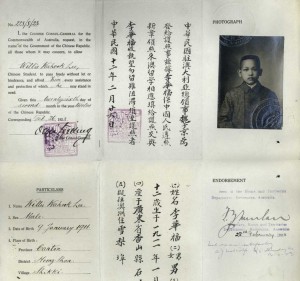
The files generally contain a Chinese student passport, which has a photograph and details in both Chinese and English – including name, date and place of birth, school attended, person responsible for the student. There are also usually school reports and other correspondence about the student’s time in Australia.

Willie Wahlook Lee's Chinese student passport, 1923

The image above is from the Chinese student passport of Willie Wahlook Lee, who attended the Crown Street Public School in Sydney between 1923 and 1926. It is found in NAA: A1, 1923/28341 and the whole file is digitised.

Sometimes the student was allowed to remain in Australia beyond the term of their studies, in which case the file will include more information. It may also then not appear in a search in A1 under ‘student passport’ – in such cases a search by name is more likely to get results. The National Archives might also hold other records, such as those created by the Collectors of Customs in the states, about the students.

The files can be a useful way of finding information about the Chinese name and origin (in characters) of people or families already living in Australia.

Chinese children – At public schools –Waterloo teachers’ troubles

During his visit to the Waterloo Public School on Friday Mr. Beeby (Minister for Education) was struck with the number of enrolled children who had English mothers and Chinese fathers. Surrounding the school are numerous Chinese dwellings. Some of the inhabitants have brought out their wives from China, but others are living with Englishwomen, and the offspring of the latter, the schoolmaster states, prove to be some of the brightest and most intelligent children in the school. In their home life and surroundings these children have a splendid opportunity of learning the Chinese as well as the English language, but in nearly every case they turn from the Chinese, and openly express a desire to become apt pupils in English.

The teachers in the same school have amongst their pupils one or two full-blooded Chinese children, and the headmaster has a problem to solve in trying to impart knowledge to these.

A Chinese boy of 14 years was presented to Mr. Beeby on Friday as an example of what the teaching staff had to content with. He is a fine sturdy boy, with intelligent features, and arrived from China two months ago. He is the son of a local Chinese butcher, and, like his mother and father, is unable to speak a word of English. But he proudly takes his place daily in the school among the infants of six and seven years, and the headmistress of the department is trying hard to impart to him the rudiments of English. The teacher told the Minister on Friday that the boy could not speak a word of English, ‘and of course, I can’t speak Chinese,’ she added. The Minister was interested, but puzzled. However, the headmistress of the infants is going to solve the problem herself. She writes words of two or three letters on the board, and the pupil copies them into his exercise book, and does it too in a very neat way: but he cannot read what he has written. The teachers hope that by mixing in with the other children the newcomer from China will gradually pick up the English language.

Sydney Morning Herald, 5 June 1911