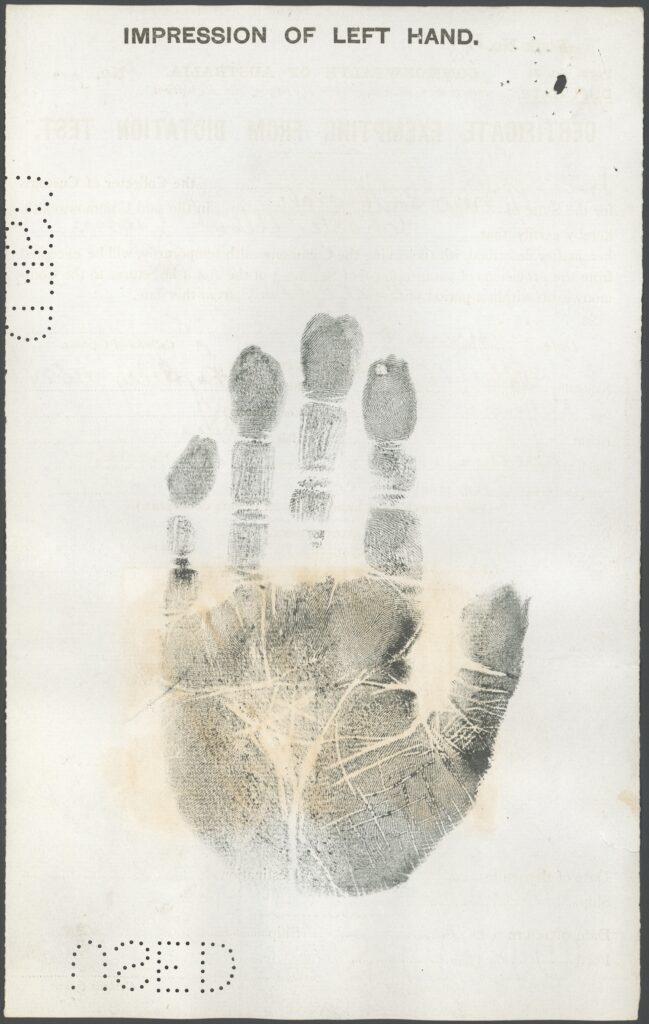
In this post, I tell the story of the boy whose handprint became an emblem for the Everyday Heritage project. The post was originally published on the Everyday Heritage website on 9 July 2024.
Back of Charlie Allen’s Certificate Exempting from the Dictation Test, which was issued before his departure from Sydney for China in June 1909. National Archives of Australia (Sydney): ST84/1, 1909/22/41-50
This handprint belongs to a 12-year-old boy called Charles Albert Allen.
Charlie, as he was known, was born in Surry Hills, Sydney, in 1896. His mother was Frances Allen, his father Charlie Gum.
Charlie was raised by his mother, but in 1909, at the age of 13, he was taken ‘home’ to China by his father.
Charlie Gum returned to Sydney soon after, leaving his son in China. Young Charlie lived with relatives in the Cantonese village of Chuk Sau Yuen for 6 years.
Charlie was homesick, but he had no means of getting back to Australia. His mother attempted to enlist the help of the Australian Government but to no avail.
Charlie finally returned in 1915 at the age of 18.
The following year Charlie enlisted in First AIF, the first of three attempts to serve his country. He was discharged as medically unfit each time.
Charlie married Maud Gordon in Surry Hills in 1917, and they had two daughters soon after. Charlie returned to China in 1922 for 7 months.
Charlie Allen died in 1938 as the result of an industrial accident at the Bunnerong Power Station where he worked. He was 41.
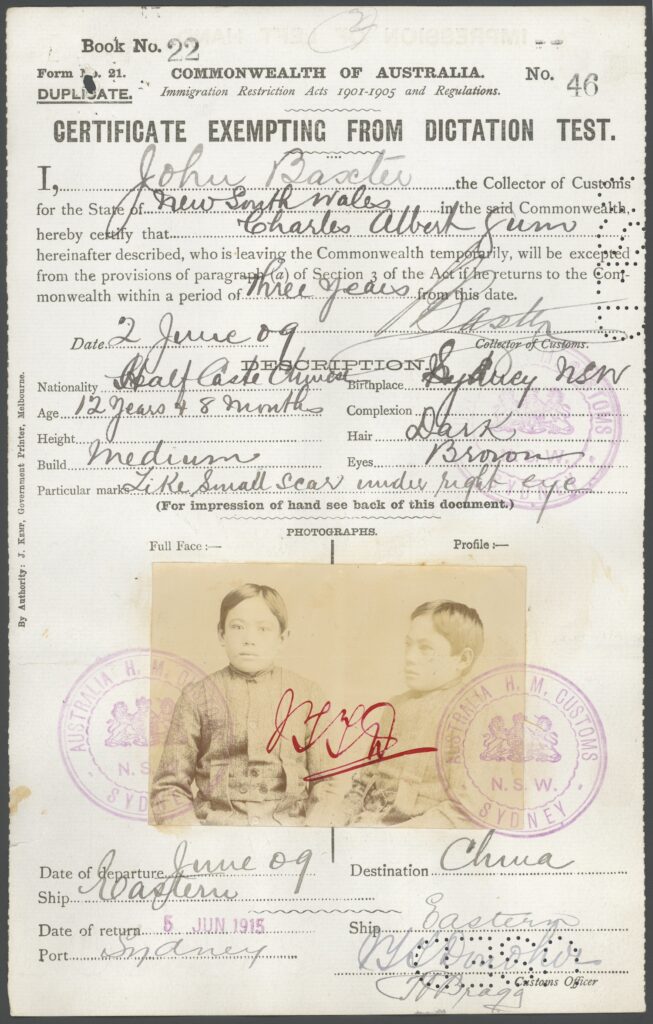
Charlie Allen’s handprint is found on the back of an identification document called a Certificate Exempting from the Dictation Test.
The certificate was issued by the New South Wales Collector of Customs in 1909 under Australia’s infamous Immigration Restriction Act. Today it is held in the National Archives of Australia in Sydney.
Front of Charlie Allen’s Certificate Exempting from the Dictation Test. NAA (Sydney): ST84/1, 1909/22/41-50
Charlie’s certificate, with its photographs and handprint, is one of tens of thousands of similar documents that were issued to ‘non-white’ Australians when they travelled overseas in the early twentieth century. These certificates allowed them to return home to Australia without sitting the infamous Dictation Test.
Every one of these certificates could be used to tell a story of how the everyday lives of Australian were affected by the White Australia Policy.
Among these many possibilities, the story of Charlie and his mother, Frances, particularly struck me, and I’ve written about them in an article that draws on methodologies of biography, microhistory, and family history. As well as his 1909 CEDT, the files in the archives include photographs of Charlie, and handwritten letters from him to his mother and from his mother to the Australian Government.
Charlie’s letters home from China are particularly significant. They provide a rare glimpse into the experiences and emotions of an Australian boy living in his own migrant father’s homeland. While many hundreds of young Australians of Chinese descent spent time in China across the late nineteenth and early twentieth centuries, first-hand accounts like Charlie’s are rare.
In 1910 Charlie was homesick and a long way from home. ‘Every minute I think of you, and long for a piece of bread and butter this tucker is not doing me well’, he wrote to his mother, before signing off with a flurry of kisses.
In 1911 Florence was missing her son dearly but was unable to get him back. In a letter to the Australian Government, she wrote: ‘Try and do your best to get my son returned back, to me, to Australia … do your best for his mother as I am nearly heart broken about him’.
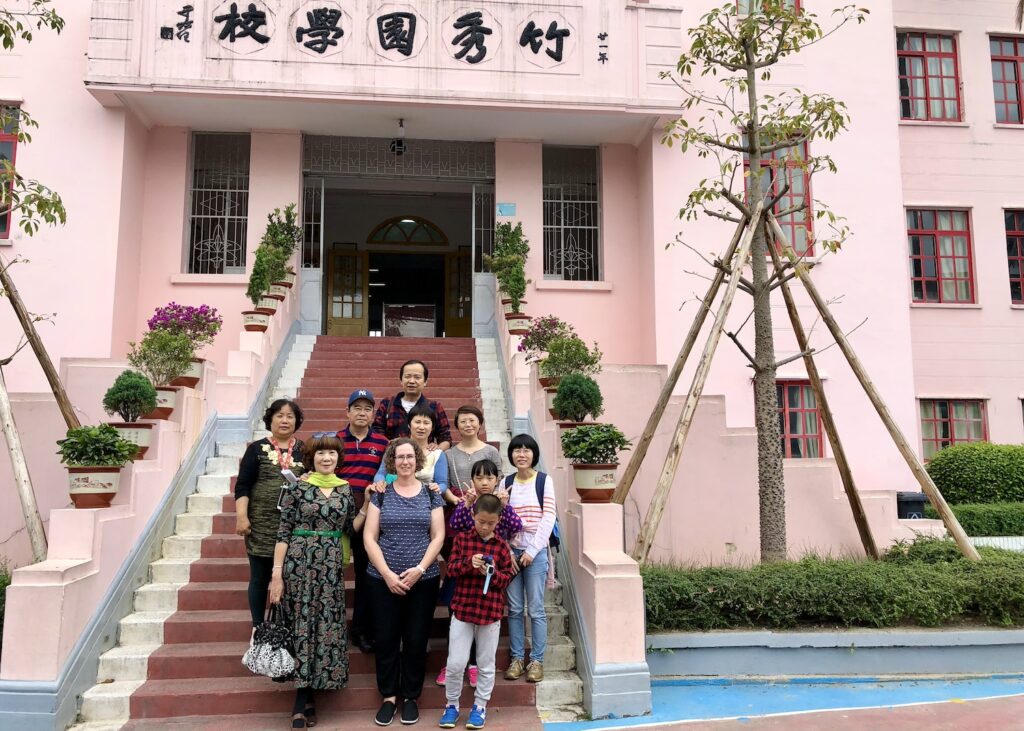
Kate Bagnall and friends on the steps of Chuk Sau Yuen School 竹秀園學校, Chungshan 中山, Kwangtong 廣東, an Australian ‘diaspora-funded school’ built in the early years of the 20th century, March 2019
Beyond the National Archives, I was able to trace the lives of Charlie and his parents, his wife and his children, piecing together fragments of their stories from written records – including birth, death and marriage records; shipping records; war service records; and newspapers – and visiting places significant to their lives, such as Chuk Sau Yuen village where Charlie lived in China, and his grave in Botany Cemetery.
Charlie Allen’s is one of the many ‘small lives’ that can be found in the archives. Telling the stories of lives like his – which are both ordinary and extraordinary – works to counteract dominant narratives – of who belongs and who matters – that continue in our nation’s history and heritage today.
These stories also touch the lives of everyday Australians. Charlie’s great grandson recently told me that memory of Charlie had almost faded within his family. But, having found the archival paper trail and my writing about Charlie’s life, they could now work keep his memory alive.
Kate Bagnall, ‘Writing home from China: Charles Allen’s transnational childhood’, in Paul Longley Arthur (ed.), Migrant Lives: Australian Culture, Society and Identity, Anthem Press, London, 2017. Open access version available at: https://zenodo.org/doi/10.5281/zenodo.10846849.
Kate Bagnall, ‘ “I am nearly heartbroken about him”: Stories of Australian mothers’ separation from their “Chinese” children’, History Australia, vol. 1, no. 1, 2003, pp. 30–40. Available at: https://doi.org/10.1080/14490854.2003.11828254.
Video, transcript and slides of a talk on ‘Uncovering the stories of Chinese Australian families’, presented at Libraries Tasmania in Hobart on 8 August 2023
When I began researching the history of Chinese Australian families more than two decades ago, the sources I first came across, including accounts by politicians and journalists, focused on an absence of ‘real’ family life among the colonial Chinese population.
Despite this, other sources provided tantalising hints at the presence of a small number of Chinese women as well as a significant number of families made up of a Chinese father and white mother.
In this talk, I share how I, alongside a growing number of family historians, have gone about uncovering the stories of Chinese Australian families and consider how their transnational lives are an important part of the history of connection between China and Australia.
You can watch the video, or read the text of my presentation below.
Over the past couple of decades, a number of Australian and New Zealand writers have produced works of historical fiction featuring romances between white women and Chinese men.
One of the best known is the ongoing and somewhat illicit liaison between Kerry Greenwood’s lady detective, Phryne Fisher, and Lin Chung, the Cambridge-educated son of an elite Victorian Chinese family of silk merchants, whose progenitor had first arrived in Australia with the gold rushes.
Lin Chung first appears in the seventh book in the Phryne Fisher series, Ruddy Gore, published in 1995, and while he is an intermittent character across the two dozen novels, he – along with a string of other lovers – is central to the portrayal of Phryne’s liberal attitude towards life and obvious pleasure in flaunting the social mores of respectable 1920s Melbourne.
A few other examples are worth mentioning, too.
There’s Neridah Newton’s The Lambing Flat, published in 2003, which won the Queensland Premier’s Literary Award for an Emerging Author in 2002. It follows the intertwined lives of Ella, born and bred on a Queensland cattle station, and Lok, who arrives in Australia as a boy and experiences the violence of the Lambing Flat anti-Chinese riots of 1861, before heading north to Queensland. He finds work on Ella’s father’s property, and the love story progresses from there.
There’s also As the Earth Turns Silver, by New Zealand author Alison Wong, which won the Janet Frame Fiction Award in 2009. Set against the backdrop of racist white working-class Wellington in the early twentieth century, the book tells the ultimately tragic story of a secret love affair between widow and mother of two, Katherine McKechnie, and Wong Chung-yung, a greengrocer.
Then there’s Deborah O’Brien’s Mr Chen’s Emporium, and its sequel The Jade Widow, which are aimed more at the ‘book club’ market. Mr Chen’s Emporium plots a fairly predictable romantic path to the marriage of Amy Duncan and Charles Chen in a small New South Wales goldfields town in the 1870s – and their relationships, once again, ends tragically. While not great literature, Mr Chen’s Emporium is nonetheless pretty spot-on with its history.
As a historian I’ve spent much of my career looking into the lives of white women and Chinese men who formed intimate relationships in the past, women and men like the protagonists in these novels.
This research has been part of my broader interest in the histories of women, children and families of Australasia’s early Chinese communities – and a caveat here, the ‘Chinese Australian families’ I’ll be talking about today are predominantly those made up of a white mother and Chinese father.
So, it interests me very much to see stories of Chinese-European couples being told again through fiction in the twenty-first century, in television as well as the novels I’ve mentioned – some of you might have watched, for example, the 2021 SBS mini-series New Gold Mountain, which touches on the tangled lives of Chinese men and white women on the Victorian goldfields.
I say ‘again’ because more than a century ago, in the 1880s and 1890s, intimate relationships between white women and Chinese men were not an uncommon subject in popular Australian fiction.
Typified by Edward Dyson’s ‘Mr and Mrs Sin Fat’, published in the Bulletin in 1888, or William Lane’s novella ‘White or Yellow? The Race War of 1908AD’, published as a serial in the Boomerang in 1887, late nineteenth-century stories tell a very different tale of interracial relationships, of their dangers on a personal and societal level. Such stories both drew on and fed accounts that appeared in popular newspapers such as the notoriously salacious Truth.
I want to suggest, however, that the telling of these two very different narratives of love and sex across racial boundaries have something very much in common. And that is that their meaning, their power as stories, comes from their acknowledgement of not just the possibility, but the reality, of intimate relationships between white women and Chinese men in Australia and New Zealand in the late nineteenth and early twentieth centuries.
The scare power of stories like those published in the Bulletin and the Boomerang came from an understanding that all around the Australasian colonies white women and Chinese men were getting together. Yes, in opium dens and brothels, but also through contacts at church, at the store, across the threshold of the home, in the neighbourhood. These stories presented a threatening future of racial mixing in Australia that was made more real by the presence of mixed-race couples and their mixed-race children in colonial communities – they were simply there.
Estimates carefully calculated by historians like myself put the number of legal marriages between Chinese men and white women in the Australasian colonies in the nineteenth century in the thousands – but of course there were many other relationships not formalised through marriage and many children born out of wedlock.
While official statistics are unreliable in giving the true number of children born to white mothers and Chinese fathers, they do give some indication of their significance in the Chinese Australian population overall.
Here, for example, is a breakdown of the birthplaces of Chinese people in New South Wales in 1901, where you can see (in blue) that a total of 1,223 were Australian born (in New South Wales and other Australian states), and of them 1,028 – about 9% of the total Chinese population – were so-called ‘half-castes’, which in this case meant people of mixed white and Chinese heritage.
What about Tasmania, I hear you say!
Looking at 1901 again, the Chinese population of Tasmania was 609, of whom 103 – or about 17% – were of mixed Chinese-European parentage.
Over the course of the twentieth century, though, the obvious presence of Chinese-European couples and their families faded for various reasons – within families themselves, in popular memory, and in historical accounts. The perception that lingered was that interracial relationships between white women and Chinese men were bound up with prostitution, alcoholism, opium addiction and so on, and that only ‘a few illiterate Irish girls’ were desperate enough to marry themselves to Chinese men.
What was forgotten were the thousands of Chinese-European couples who, mostly unremarkably, met, formed relationships of different kinds (for shorter or longer periods of time), had children, and raised them together or apart.
Families like that of Hannah Maria Mason, who was born in Launceston in 1844, and her Amoy-born husband, William Edward Oram Chi.
Hannah and William married in the Wesleyan Parsonage at Newtown, Sydney, in 1865, four years after William was baptised as a Christian. After the stillbirth of their first child in 1866, Hannah and William went on to have another son and five daughters. William was naturalised as a British subject in 1868 and the family became part of the community of Scone, in central New South Wales, where they made their home.
It has only really been in this new century, over the past 25 years or so, that early Chinese-European families like the Chis have been remembered and recognised on a broader scale. The historical novels I mentioned are one manifestation of this.
Alongside the work of academic historians like myself, it has largely been the growing interest in family history that has shifted our understanding, as family researchers have pieced together often-hidden parts of their own histories.
These same family historians, and local and community historians, are increasingly visible online, creating their own blogs and websites, making family trees in Ancestry.com, and participating in family history forums and Facebook groups. They are publishing memoirs and family histories, they are presenting at history conferences, and they are collaborating with researchers in universities and GLAM organisations, particularly museums.
If you’re an avid viewer, you might also have noticed stories of Chinese-European families pop up in the television series Who Do You Think You Are?
In 2018, there was the story of actor John Jarratt’s 2 x great grandparents, Martha Hamilton and Ah Yot, who lived at a little place called Jembaicumbene on the Braidwood goldfields in New South Wales, and more recently, in 2021, there was the story of musician Jeff Fatt’s 2 x great grandparents, Elizabeth Wright and Lee Young, who lived at Ararat and Ballarat on the Victorian goldfields.
When I first began researching Chinese-European couples back in the late 1990s, the most common question I was asked about my work was ‘why?’ In particular, ‘why did these white women choose Chinese partners? – the implication being a slightly different question, I think, and that was ‘Wasn’t there anyone better (i.e. white) for them to marry?’
The decisions made by mixed-race couples in their choice of partner can seem extraordinary for their time, but they may in fact have been very simple ones to make, based around love, sexual attraction, the desire for companionship, or due to circumstance, convenience, or economics.
Despite some failings in historical accuracy, one of the things I like most about seeing Chinese-European relationships portrayed in contemporary fiction is the way that fiction can present historical possibilities that, it seems, are still often hard for many of us to imagine.
Once you start looking for it, though, evidence of Chinese-European couples and families is abundant and, with the digitisation of more and more historical materials, that evidence is increasingly easy to find and access. The historical newspapers available through Trove, from the National Library, are a particularly rich source for Chinese Australian family history, and one that I didn’t have when I started my research way back when!
Here, for instance, is a graph of references to the term ‘half-caste Chinese’ in the digitised newspapers in Trove for the period from 1860 to 1920, created using a nifty app called QueryPic, created by digital historian Tim Sherratt. The articles that come up through this search range from invectives in major city newspapers about opium and smallpox and ‘the Chinese Question’, to reports in small country newspapers on all manner of moments in the everyday lives of Chinese Australian families and individuals.
As a historian, I’m lucky that race was mentioned in such articles, as it marks these articles as immediately of interest to me. But, of course, personal names can also be traced through time in the newspapers, in a way that was near impossible before.
Trove, and its New Zealand counterpart Papers Past, give us the ability to easily uncover small stories of ordinary lives and this helps break through a barrier in thinking about the prevalence and place of Chinese-European couples and families in colonial Australasia.
Our understanding of the history of Chinese Australian families has come a long way in the past twenty-five years.
When I started my research in 1998, the available historical literature said little that was of help to me about Chinese Australian family life, particularly in understanding these families within the context of Chinese migration.
Most histories overlooked the presence of migrant Chinese women and their daughters in colonial and post-Federation Australasia, and those few that discussed Chinese-European families in any detail framed their lives as stories of ‘pioneers’ or of ‘assimilation – unusual exceptions to the dominant story of the sojourning gold-seeker living a lonely life, working to make his fortune and return home to China.
Many Chinese Australian family histories are easily slotted into these sorts of narratives, and it can make sense to tell them in this way – particularly for descendants, community activists, and historians of many kinds struggling to assert Chinese people into a national story that still remains one predominantly about white people. They are keen to stress how people of Chinese heritage, whether migrant or Australian born, have contributed to the building of this nation particularly through agriculture, mining, and business.
However, when I started looking closely into the lives of Chinese-European couples and their children, the pioneer or assimilationist frameworks did not fit so well with evidence I found about the mixing of language and cultural traditions within the home, and about the ongoing connections mixed families fostered and maintained with local Chinese communities and with China itself.
For example, the Australian-born mixed-race daughters of Chinese settlers commonly married migrant Chinese men, sometimes men as old as their own fathers, creating networks of kinship ties and often drawing young Australian-born women towards their Chinese, rather than European, heritage.
This picture, for example, shows Emma Lee Young with her husband, the Rev. Joseph Tear Tack, and four of their children – Elizabeth, Joseph, Laura and Josiah, who born between 1886 and 1892. As featured in Who Do You Think You Are?, Emma was Purple Wiggle Jeff Fatt’s great-grandmother.
She was born in Ararat, Victoria, in 1865, and at the age of 20 married China-born Joseph Tear Tack, who was about 17 years her senior. With Joseph’s church work, the family moved from Ararat in Victoria to the Inverell district in New South Wales, and then to Darwin and eventually to Cairns.
Numbers of Chinese-European children were taken or sent to China to help them to ‘become Chinese’ by receiving a Chinese education and/or being raised within their extended Chinese families.
White wives, too, went to China, where some encountered for the first time the unhappy reality that they were not their husband’s only wife – for according to Chinese custom, men were able to take multiple wives and concubines. Other white wives said goodbye to children and husbands who left for China and never returned.
These practices didn’t fit neatly with the idea that Chinese men who formed relationships with white women, who fathered mixed-race children, were simply assimilating, turning their backs on their own ancestry and heritage and abandoning an identity as Chinese for themselves and their children – even when it might have seemed on the surface that that’s what they were doing.
Quong Tart, the well-known Sydney tea merchant, shown here with his wife Margaret and their three oldest children in Hong Kong in 1894, is an interesting example of this.
We know Quong Tart best as the dapper businessman and philanthropist, anti-opium campaigner and friend to Sydney’s elite (and coincidentally, my great-grandfather, Harry Bagnall), the beloved husband of Lancashire-born Margaret (née Scarlett) and father to a brood of handsome children who were educated at some of Sydney’s finest private schools.
Yet Quong Tart’s business interests were reliant on ongoing contacts with Hong Kong and China, and it seems he remained close to his family, returning to China three times, including in 1894 to introduce his young family to his elderly mother. Research by Chinese historian, Mei Weiqiang, and information gathered within the family, also suggests that Quong Tart was married by proxy, in absentia, to a Chinese woman and that one, perhaps, two sons were adopted to carry on his name in his hometown in Toishan.
How to reconcile all this in a man known as the ultimate ‘assimilated’ Chinese?
An article by US historian Adam McKeown, published in 1999 (nearly 25 years ago now!), on ‘Transnational Chinese Families and Chinese Exclusion‘, suggested to me that there was an alternative way of viewing these relationships, an alternative explanation for why Chinese men ‘outmarried’ (that is, partnered with non-Chinese women), and a real way of understanding these families within the context of Chinese migration.
McKeown was among a number of scholars who have outlined the family strategies used by Cantonese in the sending districts of the Pearl River Delta in Guangdong province in southern China, from where most nineteenth-century Chinese migration took place.
Central to the Cantonese family was the patriline, the ongoing line of descent from father to son, father to son.
Cantonese families in the sending districts of the Pearl River Delta undertook economic strategies to ensure their survival and prosperity – such as establishing sons in different occupations or sending them to different overseas locations, such as Australia, New Zealand, the United States, and Canada. They also developed strategies to ensure the continuation of the family line when more usual patterns of family formation were not possible due to the often long absences of men overseas.
Most common was the ‘split’ family, where a man lived overseas for shorter or longer periods, while his wife remained at home in his ancestral village, often living with her in-laws or other members of her husband’s family. When a man had left unmarried and was not easily able to return, he could be married by proxy in absentia to a woman who then took up residence in her parents-in-law’s home. Sons could be adopted to ensure the patriline continued, even if husband and wife never met due to his continued residence overseas.
Non-Chinese women were drawn into this when they formed relationships with Chinese men – and it was not uncommon for Chinese men to already have a wife, and sometimes children, at home in China when they formed relationships overseas.
Chinese families could be opposed to men taking foreign wives, out of fear that his interests and energies would be redirected away from the ancestral home and his filial obligations there. (In the early decades of the twentieth century, there were also warnings by Chinese community leaders overseas against relationships with non-Chinese women, fearing that patriotic sentiments towards a new China might dissipate).
But children born to non-Chinese women in places like Australia and New Zealand, Hawaii, the United States, Canada, Mexico, Jamaica and Peru still counted as ‘Chinese’ and as part of their Chinese families. Their paternity (biological or adoptive), not their maternity, mattered. The evidence for this is in the number of children of mixed race who went to China, for a period of education or more permanently, a practice that was happening in the Australian colonies from early as the late 1850s.
The National Archives of Australia holds thousands of documents that trace the journeys of young Australians of Chinese and part-Chinese heritage to China and back over the early decades of the twentieth century – after the introduction of the federal Immigration Restriction Act in 1901. Included among those who went to China were a small number of children of mixed Chinese-Aboriginal heritage, as well as a few white stepchildren of Chinese men.
You might, for instance, have heard of Tasmanian Senator Thomas Bakhap – the son of Margaret Hogan and stepson of Gee Bak Hap of Lottah in north-eastern Tasmania. There is debate about whether Thomas Bakhap had Chinese heritage or not, but he became fluent in Cantonese and, according to Adrienne Petty, ‘had spent several years in China, some as a young child and later in his early teens’ (‘Deconstructing the Chinese Sojourner: Case Studies of Early Chinese Migrants to Tasmania’, PhD thesis, UTAS, 2009, p. 124).
Before I conclude, I’d like to share one more family story, that of the Gan family, pictured here in Melbourne in 1917. There is Edward Chung Ah Gan, usually known as ‘Teddy Ah Gan’, who was naturalised as a British subject in Tasmania in 1891, his Victorian-born wife, Annie (née Harris), and their four children – Dorothy, George, Ruby Elizabeth and Frederick.
The family left Australia for Hong Kong in 1917, where Teddy found work at the Hong Kong and Whampoa Dock Company, and Annie was busy with her growing family – she gave birth to three more children in Hong Kong. In 1925 and again in 1933, the family attempted to return to Australia, but this request was denied due to Teddy’s extended absence from the Commonwealth, and there is nothing on file to indicate that they ever did come home.
Placing the history of Chinese-European families within a transnational framework, like that suggested by McKeown’s ‘transnational overseas Chinese family’, allows us to see the parts of the story that took place beyond Australian shores.
Chinese migration to Australia wasn’t a simple one-way trip – economic, cultural and legal factors meant that Australian Chinese were highly mobile, travelling back and forth between Australia and China, and between colonies and states, too. The formation of families followed a similar path, and limiting our definition of ‘family life’ to the ‘geographically localized nuclear family’ (to use McKeown’s phrase, p. 100) ignores a range of experiences and choices made in the process of migration, sojourning and settlement.
So, to conclude let’s go back to those historical novels, where we can also see aspects of the transnational overseas Chinese family:
Lady detective Phryne Fisher sees her lover Lin Chung married to a young Chinese woman, Camellia, in an arrangement that benefits both Chinese families, if not themselves.
In As the Earth Turns Silver, Katherine McKechnie’s Chinese lover has a wife and child in China, while his brother works for years to be able to bring his wife to live in New Zealand too.
In The Lambing Flat, Ella has to confront Lok’s yearning for his homeland and his ultimate decision to return home. He asks her to go too, and some of my favourite passages in the book describe Ella’s feelings as she contemplates whether she could leave her home and go with him. In the end, though, she doesn’t.
What these imagined life stories suggest, and other real life histories demonstrate, is that there is not just one neat framework into which we can place the history of Chinese-European families in Australasia, and beyond that the history of Chinese Australian families. This history is messy and complex and sometimes hard to untangle – but for me, this messiness and complexity is also what makes it so fascinating.
In 1968 and 1969, Maisie Fook from Sydney had three ‘reader’s stories’ published in Australia’s best-read women’s magazine, the Australian Women’s Weekly. The first of these told the story of her recent adoption of two Korean orphans, the second recounted the story of her obstetrician brother Ted’s rise from ‘grocer boy to star doctor’, while the third was a reflection on what it was like to be ‘a Chinese, born and living in White Australia’.
Maisie Fook, 1968. Australian Women’s Weekly, 17 July 1968, http://nla.gov.au/nla.news-article46443217
Maisie Fook was born in Tenterfield in northern New South Wales in 1924, the ninth of eleven children of Cecilia (Cissie) Wong See and Harry Gee Hon. As she noted in her story, Maisie had an ‘Australian’ childhood, growing up in a country town where there were no other Chinese children. ‘At school I lived Australian, spoke Australian, thought Australian, and after the initial contact was accepted as Australian by Australians,’ she wrote.
But life at home was different. Her Cantonese father, ‘a proud Chinese’, had migrated to New South Wales as a young man, ‘determined to improve his lot and that of his impoverished relatives’. Her mother, Cissie, born in Sydney in 1887, was the daughter of Cantonese migrants, Ah Sam (mother) and Wong See (father), and had married Harry Gee Hon in Shekki in 1905. Maisie recalled that as a child at home in Tenterfield her family enjoyed Chinese food eaten with chopsticks, her parents ‘spoke Chinese frequently to each other’, and her father instilled in her ‘his idea of the superiority of the Chinese race’.
Although Maisie’s story was framed as an exploration of her identity as Chinese and Australian, a third element – her Christian faith – was also central to the story. Maisie told of her involvement with a Chinese church, where the congregation was mainly ‘Chinese Chinese (born in China)’, and of the communication difficulties she had. ‘I could understand neither their Chinese nor their Chinese-accented English. They could understand my English, but my attempts at Chinese were hilarious.’
By contrast, she told of spending time with a group of ‘Christian Australians’, women she had never met before but in whose company she ‘felt suddenly “at home”‘. It was through such a lens of language and religion that Maisie also mentioned her mother and maternal grandmother, writing:
Eighty years ago my mother was born in Sydney. Her mother was so Chinese and so heathen that she conducted a joss house. My mother speaks Chinese and English fluently, and has a remarkable understanding of heathenism, but she has been a Christian for 50 years.
As mother to a young and growing family in rural Glen Innes, Cecilia Gee Hon had become interested in the teachings of the Seventh-day Adventist Church through the kindness and friendship of an Adventist neighbour. By the time the family moved to Tenterfield in the early 1920s, Cecilia was a baptised member of the church.
In time, her husband, Harry, and her nine surviving children also became Adventists, and from the late 1930s they closed the family store, Sun Sun & Co., on the usually busy trading day of Saturday to observe the Adventist Sabbath.
Maisie continued her mother’s Christian outreach through her work with the Chinese Adventist Church in Strathfield in Sydney, where she and husband Denis Fook were foundation members, and through the charity Asian Aid, which she founded in the early 1960s. One of Maisie’s outreach activities at the Chinese Church was its weekly ‘Creative Activities’, held on Tuesday morning – my mother taught crochet there for many, many years and I can still taste the vegetarian fried wontons Mum would bring home with her!
In her Women’s Weekly story Maisie Fook concluded that ‘Surely, I am Chinese, but, just as surely, I am also Australian’.
In the lives of Maisie, her mother, Cecilia Gee Hon, and her grandmother, Ah Sam, we see three generations whose lives characterise the history of Chinese Australian women over the nineteenth and early twentieth centuries.
From the mid-1800s, Cantonese women like Ah Sam travelled out from the Pearl River Delta counties in Guangdong through Hong Kong to Australia, usually following paths forged by fathers or husbands. Some of these women, and those born overseas like Cecilia Gee Hon and her daughters, also returned to Hong Kong, Shanghai and the Cantonese home villages. Other women were mobile beyond Australia and China, taking part in the multi-sited networks and circulations of Cantonese across and around the Pacific and of British subjects around the Empire.
For more of their stories, see Kate Bagnall and Julia Martínez (eds), Locating Chinese Women: Historical Mobility between China and Australia, Hong Kong University Press, 2021, https://doi.org/10.2307/j.ctv1wd02mp.
Sources
John Y. Chan, Amazing Stories From My Two Worlds, Palmer Higgs Pty Ltd, 2011 [preview available in Google Books].
Maisie Fook, ‘What is is like to be… a Chinese, born and living in White Australia?’, Australian Women’s Weekly, 12 February 1969, p. 42, http://nla.gov.au/nla-news-article51384523.
In letters that Charlie Allen wrote to his mother from China in 1911, he mentioned his ‘uncle’s wife’, who was, like him, trying to get home to Australia. Charlie had gone to live in Chuk Sau Yuen 竹秀園 near Shekki 石岐 in Heungshan 香山 in mid-1909, at the age of twelve, leaving behind his mother and siblings in Sydney. His father, Charley Gum, had taken him to China but had then returned to work in Sydney. His parents were no longer together and Charlie’s mum, Frances Allen, had not wanted her son to go to China.
I’ve written elsewhere about Charlie, his mum and the letters he wrote to her from China. They are a poignant account of Charlie’s loneliness and homesickness – he was a boy far from home and family, living in an unfamiliar place and learning a new language, with no easy way to leave. One hopeful thread in two of the letters, written in 1911, was the thought of returning to Sydney with his ‘uncles’ wife’ and her children.
He wrote about this idea in a letter dated 11 April 1911:
My uncle’s wife got a letter to-day from her sister say that if she wanted money to write & ask for it so she is going to send for 40 pound & she is going to pay my fare to sydney, & when we get to sydney she wants you to pay her back, & wants to know do you like this or not. so write back & tell me so I am now writing to custom house & sending photo & asking him for my paper to go back.
Extract of a letter from Charlie Allen to his mother, Frances Allen, 11 April 1911, NAA: SP42/1, C1922/4449
In a subsequent letter, written when Charlie had been in Chuk Sau Yuen for nearly two years (so perhaps around June 1911), he wrote:
My uncles’ wife said that she will pay my fare back to Sydney when I get there for you to give back my fare to her, or send Sam for me, & she told me to ask you would you like it or not you can please your self, mother I am very unhappy here.
And later in the same letter:
My uncle is going back to Sydney soon & as soon as he goes his wife is going to sneak away, she has 4 children & she would have a lot of trouble with them so I ask her to pay my fare back to & I would help her with her children & luggage & when we get back for you to pay her back my fare so I am writing this letter to ask you weather you like it or not, when she gets there she will stay at your place until she writs to her parents saying that she is home & tell them what to do.
I have long wondered who Charlie’s ‘uncle’s wife’ and her four children were, but without a name I thought it unlikely that I’d ever be able to establish their identity.
I’ve tried to solve a similar mystery in the case of another Sydney boy in China, Richard Lee, who, in newspaper reports, gave the name of a white Australian woman (‘Mrs Gee Chong’) that he knew and spent time with while living in his father’s village in Heungshan (the village was ‘Chuk-to-in’, which may or may not be the same village Charlie Allen lived in – another long-term, as-yet-unsolved puzzle!). In Richard Lee’s case, despite some substantial digging, I haven’t been able to identify who ‘Mrs Gee Chong’ was, even with a name, and so with Charlie’s ‘uncle’s wife’ I had given up any hope of identifying her.
A serendipitous breakthrough!
Recently, though, I’ve had a serendipitous breakthrough. Tim has been doing some updates to our Real Face of White Australia project, re-harvesting and processing the portrait photographs from NAA: ST84/1. As he does so, we’ve been looking through the images to see if we can spot any ‘new’ women and children – and one of those Tim spotted was this little poppet in her distinctive frilly bonnet:
Alice Yin, 1909, NAA: ST84/1, 1909/33/51-60
The certificate to which the photographs are attached – a 1909 CEDT for Charlie Yin – reveals that she is Alice Yin, aged one year and six months, and that she was leaving Sydney with her father and siblings. Her elder brother, Norman (aged three years and four months), and sister, Alma (aged 5 years and four months), were issued with their own CEDTs. Norman and Alma were both recorded as being ‘half-caste Chinese’ born in Mungindi, New South Wales. The family left Sydney on the Empire in October 1909; Charlie Yin returned to Sydney on the Empire on 16 August 1911 while the children returned three years later, on 30 October 1914 on the Eastern.
Further investigation revealed that a ‘C’ file in series SP42/1 still exists for the family, and it was here that I struck gold.
The file revealed that Alma, Norman and Alice Yin were the children of Charlie and Annie Yin, and had been born at Bumbalar, Mungindi in 1904, 1906 and 1908. Their father Charlie, a gardener, was from Canton while their mother, Annie (née Campbell), was also born at Mungindi. Charlie and Annie had married at Bumbalar on 16 July 1903, when Annie was aged 18 and Charlie was 29.
NSW birth certificate of Alice Yin, 1908, NAA: SP42/1, C1914/6345
Charlie had applied for CEDTS for himself and for the children to travel to China in 1909, and as noted, he had returned to Australia in 1911. In 1912, he wrote to the Collector of Customs, through Wing On & Co., requesting an extension of the children’s CEDTs ‘as they have not yet completed their schooling’. Charlie was then living at Eastern Road, Turramurra in Sydney. The extension was granted, providing the fee of £1 each was paid. Charlie then applied for another CEDT for himself in February 1914, and he departed Sydney for Hong Kong on the Taiyuan on 20 March 1914.
The next document in the file is a two-page letter addressed to the ‘Commissioner of Customs, Sydney’ from the Archdeacon of Hong Kong, dated 8 October 1914, requesting attention to the case of Mrs Yin née Campbell. The letter stated that after travelling together to China:
her husband himself returned to Sydney leaving his wife and family in the Heung Shan district, about one day’s journey from Hongkong. Subsequently he came back to China and died on June 2nd last. … Another son, Hubert (Huey) was born on 11th June 1911.
She holds no papers for this child of three years but as it is impossible for her as an Australian woman to live in China now that her husband is dead without suffering untold hardships, she is most anxious to return to her own people at Moree.
… this woman has been most harshly dealt with since her husband’s death as is unfortunately too often the custom in such cases. By careful manoeuvring she has managed to escape from her husband’s village with the children, and to return there would be fatal.
(On the experiences of Australian wives of Chinese in China, see my ‘Crossing oceans and cultures’ chapter in Australia’s Asia – details in References below.)
When the family arrived back in Sydney at the end of October 1914, Annie Yin and her three Australian-born children were allowed to land without question. Little Huey’s case, however, was referred to the Secretary of the Department of External Affairs for decision, as he was born in China; ten days later, permission was granted for him to remain in the Commonwealth.
Do the facts match?
Alice Yin née Campbell had travelled with her three children and husband to her husband’s village in Heungshan in 1909 and gave birth to a fourth child there in June 1911, after which time her husband returned to Australia (in August that year). Charlie Allen wrote, in around June 1911, that his ‘uncle’s wife’ was keen to return to Australia with her four children and that her husband was soon to return to Australia. So, they were in China at the same time, there were the right number of children, but were they in the same village?
Charlie Allen’s father, Charley Gum was a Gock / Kwok / Goq 郭 from Chuk Sau Yuen, and it was here that Charlie spent his time in China. On Alice Yin’s 1908 birth certificate, her father’s name was given as Charlie Gock Yin, and he corresponded with the Collector of Customs through Wing On & Co., which was run by members of the Gock family. Some poking about in Ancestry.com revealed a family tree (never the best source, but still!) that named Charlie as ‘Charlie Kwok Yin’ and listed his birthplace as ‘Jook So Yuen’.
Based on that, it seems very likely to me that both men, Charley Gum and Charlie Yin, were Gocks from Chuk Sau Yuen, and that it was here they took their children in 1909. And therefore that Annie Yin and Alma, Norman, Alice and Herbert were Charlie Allen’s ‘uncle’s wife’ and four children!
References
NAA: ST84/1, 1909/33/51-60 [7461089], Edward OYoung, Kee Sum, Mar Chin, Ah Mee, Charlie Yet, Charlie Yin, Norman Yin, Alma Yin and Marm Fong [Certificate Exempting from Dictation Test – includes left hand impression and photographs] [box 31], 1909
NAA: SP42/1, C1914/6345 [7537383], Children of Charlie Yin [includes photographs of Charlie Yin and birth certificates of Norman Yin, Alma Yin and Alice Yin; Customs Sydney restricted migration file], 1909–1914
Kate Bagnall, ‘Crossing oceans and cultures’, in Agnieszka Sobocinska and David Walker (eds.), Australia’s Asia: Reviewing Australia’s Asian Pasts, University of Western Australia Press, 2012.
This is the paper I presented at the 2018 Australian Historical Association conference, ‘The Scale of History’, held at the Australian National University on 2–6 July 2018. I spoke alongside Sophie Couchman and Emma Bellino in a panel we put together on ‘National belonging and individual lives’:
Kate Bagnall: Chinese Australian families and the legacies of colonial naturalisation
Sophie Couchman: New questions about the enlistment of Chinese Australians during World War I
Emma Bellino: ‘Australian girl became an alien’: Reporting married women’s nationality.
Sophie spoke about the disconnect between World War I enlistment regulations and practice in relation to Chinese Australians, while Emma spoke about press reports of marital denaturalisation in Australian newspapers from the 1920s to 1940s.
Abstract
In 1888 the Australian colonies came together to implement uniform laws to restrict Chinese immigration, leading eventually to the enactment of the Immigration Restriction Act after Federation in 1901. Alongside immigration restriction, after 1888 four Australian colonies also prohibited Chinese naturalisation, by law in New South Wales and by policy in Victoria, South Australia and Western Australia. The federal Naturalisation Act of 1903 similarly prohibited Chinese naturalisation. Before these restrictions were introduced, however, thousands of Chinese men in Australia became British subjects through naturalisation, nearly 1000 in New South Wales alone. In this paper I consider the legacies of colonial naturalisation in the lives of Chinese migrants and their families in the 1890s and after Federation, particularly concerning mobility and residency rights. I argue that it is through the stories of individual lives, revealed in the press and in government case files, that we can best understand the ways that naturalised Chinese Australians and their children contested discrimination and asserted their rights as citizens.
Introduction
In early January 1889, the Ah Ket children of Wangaratta, Victoria, were stopped at the border of New South Wales. Fourteen-year-old Matilda, together with her three younger siblings aged thirteen, ten and eight, were travelling to the small town of Gerogery, north of Albury, to visit their married sister Rose. On arriving by train at Albury, however, the Ah Ket children were prevented from crossing the border by the Sub-Collector of Customs. The reason? Because they did not hold naturalisation papers. Confronted by the news that they would not be allowed to continue their journey, Matilda stood her ground, declaring that they had been born and educated at Wangaratta; that they were the children of a Chinese interpreter, Mah Ket; and that as ‘native-born children’ they were free to go anywhere in Australia. The Sub-Collector was unconvinced, and so sent them back home to Victoria by the same train. Their father, and the good people of Wangaratta, were appalled by the Customs officer’s actions. Mah Ket put the matter in the hands of a solicitor, and on 19 January 1889, the Wangaratta correspondent to the Melbourne Leader wrote an impasssioned piece on the family’s behalf:
The children whose liberty is so circumscribed are natives of Wangaratta, very intelligent and Christian; and speak better Queen’s English probably than some of the honorable gentlemen who made the law under which they are treated as aliens. It has been determined that for the peace and prosperity of the colony, Chinese immigration shall be restricted. But here were no aliens, but the most peaceful and defenceless of Australians – of like speech, education, religion and affections.
The Act under which the Sub-Collector of Customs stopped the children was the NSW Chinese Restriction and Regulation Act, passed six months earlier, in June 1888. This Act, and others introduced around the Australasian colonies, were the result of growing concerns over Chinese immigration.
One of the children stopped at the NSW border that summer’s day in 1889, thirteen-year-old William Ah Ket, grew up to be Australia’s first Chinese barrister. Educated at Melbourne University and admitted to the bar in 1903, Ah Ket had a distinguished legal career in which he actively campaigned for the rights of Chinese in Australia. He appeared before the High Court, represented Australian Chinese at the opening of the first Chinese parliament in Peking in 1911, and was Acting Consul for China in Australia in 1913–1914 and 1917. He was also a husband and father to two daughters and two sons.
This paper considers nationality, naturalisation and colonial mobility through the lens of Chinese Australian families like the Ah Kets. Mah Ket, the Ah Ket children’s father, was not naturalised, but this should not have mattered when the children tried to cross into New South Wales. Young Matilda was right – as native-born British subjects, the NSW Chinese Restriction Act should not have applied to them. Yet, the fact that they were turned back illustrates the ambiguity with which immigration restriction laws were applied to native-born and naturalised Chinese British subjects in Australia and New Zealand. The law stated what it stated, but it’s truth also lay in the way that it was interpreted and applied – whether that was at the border, in a bureaucrat’s office, in a magistrate’s court or in the High Court.
Prohibition of Chinese naturalisation formed part of the anti-Chinese policies introduced in four Australian colonies (New South Wales, Victoria, South Australia and Western Australia) from the 1880s, and then in the Commonwealth of Australia from 1904 and the Dominion of New Zealand from 1908. Before these prohibitions, however, thousands of Chinese men in Australia and New Zealand became British subjects through naturalisation, nearly 1000 in New South Wales alone. In this paper then I want to think about the legacies of this earlier history of colonial naturalisation in the lives of Chinese settlers and their families in the 1890s and after Federation, particularly concerning mobility and residency rights. I will argue that it is through the stories of individual lives, revealed in the press and in government case files, that we can best understand the ways that naturalised Chinese Australians and their children contested discrimination and asserted their rights as citizens.
Naturalisation and Chinese restriction
The first anti-Chinese legislation was introduced in Australia in 1855 in Victoria, followed by a similar Act in South Australia in 1857. New South Wales then followed suit in 1861. With tonnage restrictions and a poll tax on each Chinese arrival, this legislation was effective in reducing the Chinese population in the colonies, and so, having served its purpose, it was repealed: in South Australia in 1861 (after three years), in Victoria in 1865 (after 10 years) and in New South Wales in 1867 (after 5 years). Between then and 1881, there was no restrictive legislation against Chinese immigration – except in Queensland, which introduced a Chinese Immigration Restriction Act in 1877. In 1881, however, new and more consistent legislation was introduced across the colonies after the 1880–81 intercolonial conferences. This legislation was then tightened following the Intercolonial Conference on the Chinese Question in mid-1888. Laws varied slightly across the seven colonies, but they generally had tonnage restrictions and some a poll tax to limit the number of Chinese migrants. They also included various exemptions, for residents and British subjects.
In New South Wales, Victoria and New Zealand, for instance, the 1881 Acts brought in a £10 poll tax on Chinese arriving by sea or by land and a limit of one Chinese to every 100 tons of shipping. The NSW and Victorian Acts exempted British subjects, while in New South Wales and New Zealand, other Chinese residents could also apply for exemption certificates. In 1888, the tonnage limits increased in each of these colonies, and the NSW poll tax leapt to £100, while it was abolished in Victoria. Each colony exempted Chinese naturalised in that colony, while the NSW Act also explicitly exempted British subjects by birth. Significantly, too, the NSW Act prohibited the naturalisation of Chinese. After Federation, the Australian colonial laws were repealed, although not immediately – in New South Wales, for example, the poll tax remained in place until 1903. The new federal Immigration Restriction Act, which came into force from the beginning of 1902, provided exemptions for those who had formerly been domiciled in the Commonwealth or in any colony which had become a state (s 3n). Australian birth and naturalisation certificates could be used as proof of this domicile, although exemption certificates were also issued.
As mentioned, prohibition of Chinese naturalisation also formed part of the anti-Chinese measures introduced in Australia and New Zealand. New South Wales was the only colony that prohibited Chinese naturalisation by law and it did so twice, in 1861 (repealed in 1867) and again in 1888. Three other colonies (Victoria, South Australia and Western Australia) stopped naturalising Chinese after 1888, while Tasmania and Queensland continued until the federal Naturalization Act came into force in 1904. This new Act prohibited naturalisation of ‘aboriginal natives’ of Asia, Africa and the islands of the Pacific, except New Zealand. In New Zealand, Chinese were naturalised until 1907; and it was stopped after the NZ Cabinet decided in February 1908 to decline naturalisation applications of Chinese from them on.
Colonial Chinese naturalisation
The numbers of Chinese who became naturalised in each colony varied greatly, from about 20 in Western Australia up to nearly 3000 in Victoria. In New Zealand there were around 450. As part of my current project, I am compiling databases of Chinese who became naturalised in New South Wales, New Zealand and British Columbia in Canada. If we look at Chinese naturalisations in New South Wales each year from the late 1850s, when the first one took place, to 1888, when Chinese naturalisation was prohibited for the second time, we can see a gap during the 1860s when it was prohibited the first time, and a very obvious peak in the early 1880s. The highest point on that peak is in 1883, when there were 301 naturalisations of Chinese, making up almost a third of the total for the colony. If we think back to what else was happening in the early 1880s, it is clear that this increase was in response to the 1881 NSW Influx of Chinese Restriction Act – which provided exemptions from the £10 poll tax for Chinese naturalised in the colony.
Applicants for naturalisation in New South Wales were asked to state a reason why they sought naturalisation, and most Chinese stated that it was because they wanted to purchase land, or because they had settled in the colony, or something similar. But eight men stated that they sought naturalisation for the rights of ingress and egress. One of these men, Ah Hi, who was naturalised in 1886, stated, for example, that he was ‘desirous of seeing his parents and relatives & returning to this colony where he has an interest in a market garden’. Although there were only a handful of men who explicity stated they sought naturalisation so they could travel across colonial borders, the rapid increase in numbers of naturalisations after the 1881 Act came into force suggests that mobility was a prime motivation.
Other evidence in the archives also shows that Chinese actively used naturalisation to faciliate mobility, for themselves and for their families. There are, for example, Customs statistics that record the numbers of Chinese entering the colonies using naturalisation certificates, reports of individual cases in the newspapers, and Customs and External Affairs / Internal Affairs files that document the travels of Chinese Australians and Chinese New Zealanders. I want now to turn to some of the individual cases of naturalised Chinese and their families – to consider the ways they used their status as British subjects to negotiate anti-Chinese immigration laws, and also to consider the ambiguous nature of the interpretation and application of those laws.
At the borders
So, to return to the Ah Ket children briefly. Under the NSW 1888 Act, any Chinese who produced satisfactory evidence that they were a British subject by birth was to be allowed to enter the colony, yet the Sub-Collector turned the children away for not having naturalisation papers. Would the situation have been different if Matilda, William, Alberta and Ada had produced their Victorian birth certificates, as many Australian-born Chinese did when they returned by sea? Or what if their father was naturalised and they had produced his naturalisation certificate? Would that have been enough proof?
For Chinese Australians, crossing colonial and later national borders was first contingent on being satisfactorily identified, of convincing officials at the border that you were who you said you were. It was then further contingent on bureaucratic and legal interpretations of the law. Each time the law changed, or new regulations were issued, Customs officers at both sea and land borders had to work out how the new policies worked in practice. In her history of the Chinese in Sydney, Shirley Fitzgerald has noted, for example, that in the early 1880s, administering the 1881 Chinese Restriction Act took up much of the Collector of Customs’ time and energy, and he regularly complained to his superiors that he had inadequate staff to deal with incoming and outgoing Chinese (Shirley Fitzgerald, Red Tape, Gold Scissors, pp. 28–29).
Each time the law changed, Chinese Australians also had to work out what the new requirements meant, and how they could best negotiate them, whether by lawful or unlawful means. The dramatic increase in Chinese naturalisations after the 1881 Act is an example of this, and so too is the fact that by 1885, the Sydney Collector of Customs believed that there was a solid trade in naturalisation certificates, which were ‘sent to China and sold’. Chinese Australians made use of their rights where and how they could, and pushed back where and how they could, particularly where the law left room for negotiation.
Family mobility
Naturalisation allowed Chinese men themselves to come and go from Australia and New Zealand, but it also facilitated the entry of their wives and children. In 1898, Nicholas Lockyer, the NSW Collector of Customs, told Sydney’s Evening News that two ways that Chinese evaded the poll tax were by ‘the transfer of naturalisation papers’ and by ‘Chinese women passing themselves off as wives of men who have been formally naturalised in New South Wales’. Such suspicions resulted in careful investigations and meticulous recordkeeping, particularly after the turn of the century.
One example is the Ah Lum family of Sydney. Mrs Ah Lum (I’m afraid that I haven’t yet identified the names of some of these wives and children) came out to live with her husband in 1895. He was a storekeeper and had been naturalised in 1882, returning to China to visit a few years later. The Ah Lums’ daughter was born in 1887, after Ah Lum had returned to New South Wales, and she had stayed in China with her grandmother after her mother migrated. In 1899, Ah Lum asked for permission for his daughter to come to live with him and his wife, as his mother had died and the child had no one to care for her. After some investigations by the Customs department’s Chinese inspector, a permit was issued so Ah Lum’s daughter could enter without paying the poll tax.
The Ah Lums’ case was a relatively straightforward one, unlike that of George Lee’s family a few years later. Lee had been naturalised in 1884 and returned to China not long after to be married. In August 1902, he brought his wife and two sons, Quong Foo and Quong Jah, to Sydney. Mrs Lee was admitted without question because she was the wife of a naturalised British subject (and a wife’s nationality followed that of her husband), but officials demanded the £100 poll tax be paid for each son. Lee paid up, under protest, and the Presbyterian Church raised the matter with the Premier and Solicitor-General on his behalf. They were told that Lee was only a British subject while in New South Wales and that as soon as he left, he reverted to Chinese nationality, hence his children were not British subjects by birth or descent. When asked about the matter, Prime Minister Edmund Barton stated it was not of his concern – the payment of the poll tax was a matter for the state of New South Wales to decide, and the family had been allowed in properly under the Commonwealth Immigration Restriction Act.
Barton could be so dismissive of his responsibility because, at that moment in time, domiciled Chinese men were able to bring in their wives and minor children under section 3 paragraph m of the Immigration Restriction Act. This provision was suspended by proclamation after only 15 months, and repealed in 1905, but during the time it was in force 88 Chinese family members, mainly wives, were allowed to enter Australia permanently. One of these was the wife of Kok Say, managing partner of the Hong Yuen & Co. store in Inverell. In mid 1902, Kok Say wrote to the government requesting a permit for his wife’s entry and stating his credentials – he had been naturalised in 1884 after arriving in the colony of New South Wales nine years earlier. In his words, ‘I have made my home here & have no intention of returning at any time to China’. His request was granted without issue and Mrs Kok Say arrived at Sydney from Hong Kong in November 1902.
After the repeal of section 3 paragraph m in 1905, the entry of Chinese wives and children was solely at the discretion of the Minister for External Affairs, and over the following years we see naturalised Chinese continuing to try to find ways to bring their families to Australia, including through legal challenges in the courts. In New Zealand, naturalised Chinese similarly tested the limits of the law in their efforts to bring out wives and children without having to pay the poll tax, which continued to be applied until 1934, before finally being repealed in 1944.
Conclusion
Although the prohibition of Chinese naturalisation was part of the suite of anti-Chinese measures introduced in the Australasian colonies from the 1860s through into the 20th century, its history is more than one of simple exclusion. It is important to also consider the times when Chinese could be, and were, naturalised, and the ongoing legacies of this in their and their families lives. As British subjects, naturalised Chinese had legal and political rights that they continually asserted, testing and challenging the limits of policy and law. Sometimes they were successful in these challenges, sometimes they weren’t, but when we look closely at their individual cases we can see how their actions both shaped and were shaped by the law. We can also see inconsistencies and ambiguities in the law and in the ways it was administered and applied.
Next month I will be giving a paper on Chinese women in colonial New South Wales at the International Conference on Chinese Women in World History at Academia Sinica in Taipei. My paper will focus on the early period of Cantonese migration to Australia, from the 1850s to 1880, and present short biographical sketches of four Chinese women who arrived in New South Wales in the 1860s – Ah Happ, Ah Fie, Kim Linn and Sam Kue. Before 1881 there were no legislative limits on the entry of Chinese women to New South Wales.
I was particularly interested in these four women because of their early arrival in the colony, and their rarity among the colonial Chinese population, but there are others I’ve come across whose lives I’d also like to know more about. One of those is Chin Sheng Geong, the wife of the fabulously named missionary and interpreter George Graham Mackie Ah Len.
Chin Sheng Geong (born c. 1856) married George Ah Len (born c. 1837) in Canton in about 1876, while he was on a visit home from Australia. They seem to have arrived back in Australia together in 1877 (along with a female Chinese servant who accompanied Chin Sheng Geong). They lived in the Rocks, which was then Sydney’s Chinatown, in Queen Street, a laneway that ran off Essex Street between George and Harrington streets. There Chin Sheng Geong gave birth to and raised her family of six: Jane (b. 1877), Mary (b. 1879), Ada (b. 1882), James (b. 1886), and twins Peter and Thomas (b. 1888). The children were all baptised. George Ah Len died in 1889, after which time Chin Sheng Geong returned to China with her children.
Birth certificate of James Ah Len, born in Queen Street, Sydney, 1886 (NAA: SP42/1, C1904/71)
George Ah Len coincidentally also features in my naturalisation research. He was naturalised as a British subject in 1878 (No. 78/206), and in 1882 was registered as a ‘person known to Government whose endorsement is considered sufficient’ on applications for naturalisation. From 1882 to 1888 he endorsed the naturalisation applications of more than 60 Chinese in New South Wales.
Typically, there is much more to be found about husband than wife, but within his story we can find traces of her. The following brief chronology about George Ah Len and Chin Sheng Geong in Australia is compiled from historical newspapers, government gazettes, naturalisation records, Sands Directories, BDM records and immigration files.
1868
Early in the year Ah Lin was baptised at Maryborough, Victoria, and later, as George Ah Lin, he began his training as an evangelist under Rev. William Mathew in Melbourne.
In August, George Ah Len, together with several others including Chen Ateak and On Chong, wrote to the Sydney Morning Herald on the ‘Chinese Question’.
In October, three Chinese women (one perhaps being Chin Sheng Geong?) were in the congregation at the baptism of six Chinese men by the Rev. Dr Steel, assisted by George Ah Len, at St Stephen’s Church.
In December, George Ah Len was part of a deputation of Chinese merchants to the Colonial Secretary regarding aggressions against the Chinese in Sydney.
In February, George Ah Len was part of a deputation of Chinese merchants to the Colonial Secretary about vice and immorality among the lower classes of Chinese in the colony.
Birth of Mary Ah Len, to George and Sheen Geong, Sydney (NSW BDM 1907/1879 and 1089/1879 V18791089 46)
1882
On 7 March 1882, birth of Ada Ah Len, to George and Ching Sheeng Chung, Queen Street, Sydney (NSW BDM 1882/1167; NAA: SP42/1, C1902/2210). Birth attended by Mrs Strange (nurse) and Mrs Morrison.
Birth certificate of Ada Ah Len, born in Queen Street, Sydney, 1882 (NAA: SP42/1, C1902/2210)
1883
George ‘Ah Lenn’, ‘Chinese interpreter’, lived at Queen Street.
Sands Sydney Suburban Directory 1876, p. 268 (Ancestry.com, Sands Directories: Sydney and New South Wales, Australia, 1858–1933, 2010.)
1885
In December, George Ah Len was presented to His Excellency Baron Carrington, Governor of New South Wales, at a levée held at Government House.
On 16 June 1886, birth of James Ah Len, to George and Sheng C, 11 Queen Street, Sydney (NSW BDM 2324/1886 and 1314/1886 V18861314 46; NAA: SP42/1, C1904/71). Birth was attended by Mrs Strange (nurse) and Mrs Morrison.
1888
Birth of twins, Peter and Thomas Ah Len, to George and Shenn, Sydney (NSW BDM 1748/1888 and 1356/1888 V18881356 46 and V18881356 47; 1749/1888 and 1357/1888 V18881357 46)
1889
In January, there was an unclaimed letter at the General Post Office, Sydney, for Mr Ah Len, Queen Street.
1889 ‘No. 32. LIST OF LETTERS RETURNED FROM THE BRANCH AND SUBURBAN OFFICES, AND NOW LYING AT THE GENERAL POST OFFICE, UNCLAIMED’, New South Wales Government Gazette, 2 January, p. 25, http://nla.gov.au/nla.news-article224311037
On 23 April, George Ah Len died at 4 Queen Street, Sydney, aged 52 (NSW BDM 717/1889)
Here are my ‘top 3’ suggestions on where to start your Chinese Australian history.
(Note: these suggestions are most relevant for New South Wales, and for tracing Chinese ancestors who arrived in Australia from south China before World War II.)
Wedding of Elsie May Chinn and Kum Mow, Sydney, 1917 (Sun, 18 February 1917, p. 16, http://nla.gov.au/nla.news-article221962375)
Top 3 sources
Look here first!
Birth, death and marriage records – You can search for and purchase copies of BDM certificates through the NSW Registry of Births, Deaths and Marriages, or get transcriptions through an agent. If you can, get copies of more than just your direct ancestral line (e.g. birth certificates for your grandmother’s siblings as well as your grandmother), since certificates often contain different bits of information. Also see if you can find church or parish registers and family notices in the newspaper.
Trove digitised newspapers – Try searching Trove using variations of your ancestors’ names, limit your searches by state or to a particular newspaper, or search more generally using a term like ‘Chinese’ and the place they lived.
National Archives of Australia (NAA) – Search in RecordSearch using variations of your family members’ names. The NAA collection is vast, but here’s an example of what you might find.
Top 3 research tips
Researching your Chinese Australian family is largely like researching any other Australian family. Some of the records you consult might be different (e.g. immigration, naturalisation or alien registration files), but the principles are the same. Contact your local library, historical society or genealogical society for help.
Chinese names were written down in many different ways in Australian records. Few records give people’s real Chinese names. Keep a list of each different spelling of your ancestor’s name you find, to use in keyword or name searches.
To trace your Chinese family back to China, you need to know their real Chinese name (preferably in characters) and their home province and district (‘Canton, China’ isn’t enough). During your research be on the look out for anything written in Chinese characters and make a copy.
Top 3 books
Janis Wilton, Golden Threads: The Chinese in Regional New South Wales, 1850-1950, New England Regional Art Museum in association with Powerhouse Publishing, Armidale, NSW, 2004
John Fitzgerald, Big White Lie: Chinese Australians in White Australia, University of New South Wales Press, Sydney, 2007
Shirley Fitzgerald, Red Tape, Gold Scissors: The Story of Sydney’s Chinese, revised edition, Halstead in association with the City of Sydney, Ultimo, NSW, 2008
Top 3 websites
Chinese Genealogy – a really helpful forum that’s especially useful for tracing your ancestral village
In 2011 I wrote a blog post about a photograph of an unknown Chinese Australian family held in the State Library of Victoria collection. With very few details to go on, in my post I wondered whether I would ever find out the family’s identity. In this guest post, New England local historian Gill Oxley shares with us not only the family’s identity, but more about the interesting lives of Emma Tear Tack, nee Lee Young, and her reverend husband Joseph.
On 22 February 1899, an untitled article appeared on page 2 of the Ballarat Star. It conveyed news of the death of the retired ‘Government interpreter’ for the Ararat and Stawell districts of Victoria, Mr Lee Young. The article also served as an informal obituary, giving details of the life of Mr Lee Young, including his earliest days in Australia (following his immigration from Canton in about 1852) and his life on the goldfields of Victoria in the late 1800s. Towards the end of the article, mention was made of Mr Lee Young’s surviving four daughters and two sons. Two of his daughters were named as Mrs the Rev. James Ah Chue and Mrs the Rev. Joseph Tear Tack.
Mrs the Rev. Joseph Tear Tack was Emma, born at Ararat in Victoria in 1865 (Vic BDM reg. no. 19815), the second youngest child of Lee Young and his wife Elizabeth Wright.
Emma Tear Tack, c.1894 (State Library of Victoria H2005.34/103)
The Victorian Registry of Births, Deaths and Marriages gives Emma’s father’s name as Lee Young and her mother’s maiden name as Elizabeth Lyth. The maiden surname ‘Lyth’ is likely to have been either a mistranscription or else a mispronunciation, as Emma’s mother’s maiden name is given as Elizabeth Wright in official records of the births of most of Emma’s siblings. The record for Emma’s youngest sister, Jessie Lee Young, gives a different name again, with their mother’s maiden name given as Elizabeth Light – quite clearly a misinterpretation of ‘Wright’.
Elizabeth married (‘John’) Lee Young in Victoria in 1856 (Vic BDM reg. no. 3704) and the couple had two sons and four daughters:
William Lee Young, born Ballarat 1859 (Vic BDM reg. no. 7102)
Matilda Lee Young, born Ballarat 1860 (Vic BDM reg. no. 2269)
Henry Lee Young, born Ballarat 1862 (Vic BDM reg. no. 12268)
Alice Lee Young, born Ararat 1864 (Vic BDM reg. no. 6746)
Emma Lee Young, born Ararat 1865 (Vic BDM reg. no. 19815)
Jessie Lee Young, born Ararat 1869 (Vic BDM reg. no. 20004).
At 20 years of age, in 1885, Emma Lee Young married Chinese-born Joseph Tear Tack (Vic BDM reg. no. 4357).
Joseph Tear Tack’s Victorian naturalisation record of July 1883 gives his native place simply as Canton, his age at the time as 35 years and his occupation as minister.
Memorial for letters of naturalisation for Joseph Tear Tack, 1883 (NAA: A712, 1883/Y7207)
From this we can assume that Joseph Tear Tack was born in Canton in or about 1848. He would therefore have been about 17 years older than Emma at the time of their 1885 marriage. Perhaps it was this age difference that caused the ‘little commotion in Chinese circles’ over their impending marriage, as reported in the Ballarat Star, and other Victorian papers, in May 1885.
‘General news’, Riverine Herald, 5 May 1885, p. 3
After their marriage Emma and Joseph left Victoria and set up home in the tin mining district of Inverell in northern New South Wales. Their first child, Elizabeth Edith Tear Tack, was born there in 1886 (NSW BDM reg. no. 24730). From the beginning of the 1870s, the Inverell district had a very large Chinese population, with Chinese workers being drawn to the area for the rich deposits of alluvial tin that were plentiful there, and for the business opportunities that also presented themselves with the need for fresh vegetables and other supplies in the booming mining district.
Joseph Tear Tack had been sent to Inverell (or more precisely to nearby Tingha) in mid-1884 by the Wesleyan Methodist Church to minister to the resident Chinese population in the area. He was one of the ‘success stories’ of the church’s Chinese mission in Victoria (‘Wesleyan Church, West Maitland‘, Maitland Mercury, 5 June 1884, p. 2).
According to the March–April 1891 edition of the NSW Government Gazette (p. 1892), Rev. Tear Tack was registered at the NSW Registrar General’s Office in Sydney for ‘the celebration of marriages at Tingha’ on 6 March 1891. Joseph Tear Tack and his family of four persons – one male (his eldest son) and three females (Emma and two daughters) – appear as living at Tingha in the 1891 Census (1891 New South Wales Census, Australia). Helen Brown, in her book Tin at Tingha (1982, p. 35), makes mention of the Rev. Joseph Tear Tack being appointed to serve as an ‘assistant Methodist preacher’ at Tingha between 1885 and 1893, and he is also mentioned by Ian Welch in his work on the Methodist Chinese Mission in Australia.
[Family group] [picture] (State Library of Victoria H2005.34/103)All available evidence points to this lovely family photograph being the Tear Tack family, taken in the Inverell district some time between the years of 1893 and 1896. Although it is difficult to pinpoint the exact location, the photograph is likely to have been taken either at Inverell, Tingha or perhaps at nearby Bundarra. The Tear Tacks’ youngest daughter, Alice Lucy, who does not appear in the photograph, was born at Bundarra in 1896 (NSW BDM reg. no. 2164). Therefore, we can probably assume that the date of the photograph is either 1894 or, at the very latest, early 1895.
To the best of this writer’s current knowledge, the people appearing in the photograph are (left to right):
Joseph Henry Tear Tack, born Inverell 1888 (NSW BDM reg. no. 26002)
the Rev. Joseph Tear Tack
Josiah William Tear Tack, born Inverell 1892 (NSW BDM reg. no. 17560)
Emma Tear Tack nee Lee Young
Laura Matilda Tear Tack, born Inverell 1890 (NSW BDM reg. no. 16916)
Elizabeth Edith Tear Tack, born Inverell 1886 (NSW BDM reg. no. 24730).
The identity of the younger man standing back right is not known at this stage.
After working for some years in the Inverell/Tingha/Bundarra area, where their five children were born, the Rev. Joseph Tear Tack was sent by the church to Darwin in 1896. While living there he, Emma and their children survived a terrible cyclone that destroyed their house (‘Visit of a Chinese missionary to Lithgow‘, Lithgow Mercury, 5 June 1900, p. 2). Joseph was then sent to Cairns just at the turn of the twentieth century. There he was to establish a new mission and undertake Christian missionary work among the Chinese population in far north Queensland. Emma and children did not initially accompany him to Cairns, but shipping news indicated that ‘Mrs Tear Tack and five children’ sailed to Queensland from Sydney aboard the Aramac in November of 1900.
Tragedy struck the Tear Tack family not long after their arrival in Queensland, with Joseph Tear Tack dying of heart failure at Cairns in August 1901 (Qld BDM reg. no. C697). Joseph would have been approximately 53 years of age at the time of his death. Emma Tear Tack was only about 36 when she was widowed with five children. On 11 January 1902, a letter from Emma appeared in The Methodist under the title ‘Acknowledgement’. In it, Emma Tear Tack paid a moving tribute to her husband, Joseph, and thanked their many friends for their support in what she described as her ‘sore and heavy bereavement’.
Emma did not remarry and so remained a widow for the rest of her life. After her husband’s death, she returned to the support of her family of origin in Ballarat, Victoria, some time in 1903. She appears to have raised her five children there, before moving to Burwood, in the inner western suburbs of Sydney, at around 65 years of age (Sydney and New South Wales, Australia, Sands Street Index, 1861-1930).
Emma Tear Tack nee Lee Young died on 28 October 1948 at 83 years of age at her home in Concord (NSW BDM reg. no. 27301). She is buried in the Field of Mars Cemetery at East Ryde in Sydney. A death notice published in the Sydney Morning Herald on 29 October 1948 noted that she was the loving mother of Elizabeth, Henry, Laura, Josiah, Lucy, and adopted daughters Marjorie and Molly.
Death notices for Emma Tack (Sydney Morning Herald, 29 October 1948, p. 14)
I am very grateful to Kate Bagnall for originally posting the photograph of the Tear Tack family on her blog, to my cousin Etty Doyle Lang for pointing me in the direction of Kate’s post, and to the keen eye of Paul Macgregor who was the first to spot and recognise the Rev. Joseph Tear Tack in the photograph. I am also very much indebted to Paul for his encouragement, mentoring, collaboration and fine detective skills, and to our friend and colleague, Juanita Kwok, whom we also consulted in solving some of the mysteries initially presented by this photograph.
Recently I’ve been looking at a series of NSW naturalisation certificates held in the National Archives of Australia here in Canberra (NAA: A806). The naturalisation certificates in A806 are ones that were ‘cancelled’ by Customs officers after apparently being used by Chinese to attempt fraudulent entry to New South Wales.
In the 1880s and 1890s Chinese who were naturalised British subjects in NSW were exempt from paying the poll tax on entering the colony (£10 after 1881, and £100 after 1888). After the turn of the 20th century, naturalised Chinese used their certificates to prove their Australian domicile and avoid having to sit the Dictation Test on return from overseas. As a consequence, a trade in naturalisation certificates grew up within the Chinese community, as certificates were sold or passed on to others to use after a man had died or gone home to China for good.
Some of the naturalisation certificates in A806 have layers of hand-written notes on them, most of which are undated, which suggest the same certificates were used several times as re-entry documents – perhaps initially by the legitimate holder of the certificate and subsequently by someone else. A number have ‘£10’ written on the front, suggesting that the Chinese passenger was rejected and made to pay the poll tax to enter the colony. Some have Chinese notations (mostly on the back), giving personal details such as name, age, place of origin and length of time in New South Wales.
NAA: A806 (Chow Hock 1884/30)
A806 comprises three boxes and several hundred certificates, which I’ve photographed and am now working my way through in more detail. Eventually I will marry these certificates with other naturalisation records held in State Records NSW and also in immigration case files in the National Archives.
In some of the immigration cases involving naturalisation certificates I’ve looked at, including those in A806, it’s not altogether clear whether fraud was really being attempted or whether Customs officers were just being super cautious in the execution of their duties.
With one certificate in A806, though, the fraud was obvious – and it wasn’t the Customs officers who were duped.
In June 1915, a Chinese man arriving in Sydney on the Eastern from Hong Kong presented an 1896 naturalisation certificate belonging to ‘James Andersen of Kiama, a native of Finland’. The unfortunate fellow, who presumably didn’t read much English, was returned to Hong Kong on the same vessel.
One of my projects over the summer has been to create a small online exhibition using Trove lists and a nifty online exhibition framework built by Tim Sherratt.
The list feature in Trove allows registered users to create their own collections of items. They’re a handy thing if you’re researching a particular topic and want to organise the material that you’ve found in Trove, or even if you just want to go back to random stuff that you like. You can keep your Trove lists private, or make them public and share what you’ve found with others.
Tim, who until recently was part of the Trove management team, thought that it would be good to take that sharing to another level — so he’s created a framework that lets you use your Trove lists to create an online exhibition. You can read more about Tim’s thoughts on this process on his blog.
I was keen to give it a try, and decided to make a pictorial exhibition about the Chinese in New South Wales to 1940. I started by making nine lists in Trove, which would serve as topics in my exhibition. Gradually I added a selection of pictures, objects and illustrated newspapers articles to each of my lists. I gave each of my lists a short description and arranged the items in chronological order. Because I’ve included newspaper articles, it would be best if I took the time to correct the OCR text for each one, but I’m impatient and wanted to get onto building the exhibition itself.
Tim’s DIY Trove Exhibition is pretty straightforward to use, particularly if you have some experience (even very basic experience) with web publishing or coding. He’s written clear, step-by-step instructions. The process first involves getting yourself a GitHub account and a Trove API key, and then customising his code to make your exhibition. Customising the code might look scary, but if you follow the instructions carefully you should be okay! There are further ways that you can customise the exhibition — for example, I changed the fonts — but you don’t need to do anything more if you don’t want to.
Once you’ve made the exhibition, you can easily add or take away items, or change your list descriptions, or change the order items appear in a list. Simply make the change to your list in Trove and it will appear in your exhibition after refreshing your browser.