Category: Research help

From the Archive: Uncovering the Everyday Heritage of Chinese Tasmanians

This post, written by Annaliese Jacobs Claydon and Kate Bagnall, was first published on the Everyday Heritage website on 18 September 2024.
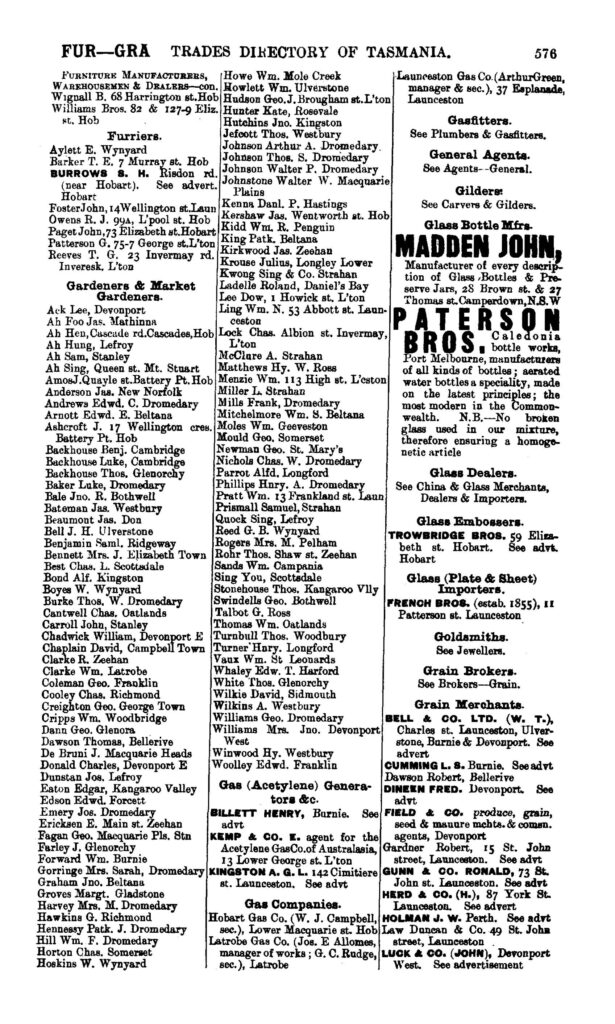
Tasmania’s Post Office Directory (Wise’s) for 1904, Wise’s Directories, Hobart, 1904, page 576

It’s a chilly Friday morning in South Hobart, and Anna is looking for Chinese names in Tasmanian post office directories – the early-twentieth-century equivalent of the telephone book. It might sound like looking for a needle in a haystack, but in fact it’s just one of the steps in our research to uncover the ordinary lives and hidden histories of Chinese individuals, families and businesses in the island state.

For our Tasmanian case study, the Everyday Heritage team in Tasmania is using simple yet powerful, freely available digital tools to help paint a historical picture of Chinese communities in virtually every corner of Tasmania.

While some part of Tasmania’s Chinese history is quite well known, we are focusing on the mundane, the everyday, and the commonplace to tell stories of how ordinary people built their lives in Tasmania at a time when Chinese migration was restricted and anti-Chinese sentiment was common.

Our first step was to figure out who we were looking for – to build a list of names and occupations. We started with a preliminary list of Chinese Tasmanian residents gleaned from archival indexes and databases from the Tasmanian Archives and the National Archives of Australia. Naturalisation and alien registration records provided a rich beginning, but we also want to find people moving in and through the state alongside those who settled long term.

Anna spent several months scouring the digitised newspapers in Trove for articles that could help generate further names and unexpected places. Good search strategies are necessary to weed out Tasmanian stories from mainland articles republished in Tasmanian newspapers, and to identify articles that mention a specific person, event, and/or place (and ideally all three).

Screenshot of the Tasmanian project team’s Zotero Group Library showing one of the articles we’ve found about Ah Foo at Fingal

In order to manage the data, we are using Zotero – a bibliographic software that can grab metadata and images from a wide variety of sources, including Trove’s digitised newspapers and many library and archival collections. Once in Zotero, you can highlight, tag, and annotate the records.

The tags are especially important for our project. They function as a growing, searchable index to the material, but they will also be used in the next stage of the project, in which we will digitally map Chinese Tasmanian individuals, families, communities, and businesses over time.

Our research in the digitised Tasmanian newspapers in Trove has not only found some fascinating stories, it has also generated a long list of names and addresses across the state, from Southport in the south, to Fingal in the north-east, to Strahan on the west coast.

Of course, this list from the newspapers is incomplete and problematic. For example, the English spelling of Chinese names varies widely, and newspaper articles tend to focus on burglaries, assaults, gambling, and alleged opium smuggling, capturing the ‘dog whistles’ of anti-Chinese sentiment but not the texture of everyday life.

How can we both acknowledge and filter out that noise?

One way is through the post office directories, which provide names, businesses, street addresses and dates. Several years ago, Libraries Tasmania digitised their collection of Wise’s Post Office Directories from 1890 to 1948. As part of his GLAM Workbench, project team member Tim Sherratt has created an interface to the Tasmanian Post Office Directories that makes them searchable by keyword.

Directory listing for Ah Foo, market gardener, Mathinna, in Tim Sherratt’s Tasmanian Post Office Directories, GLAM Workbench

Focusing on the post office directories helps to compensate for the prevalence in the newspapers of crime and racial language. In the directories, you find fruiterers, market gardeners, launderers, fancy goods merchants, carpenters, and others, along with their locations.

Anna has been creating records of the ‘Chinese’ post office directory listings in our Zotero Group Library, tagging them with individual names, addresses, and occupations, and anything else that looks fruitful. She also spells out the common abbreviations for occupations and names – so  ‘frtr’ is changed to ‘fruiterer’ and ‘gcr’ to ‘grocer’, while ‘Hy’ is changed to ‘Henry’ and ‘Jas’ to ‘James’.

Going through year by year, directory by directory, allows us to see continuity and change over time, growth and decline of neighbourhoods and discreet populations, and family networks. It can also turn up some quite interesting stories!

One is about ‘James Ah Foo, skin dealer, Fingal’ – who appears in a post office directory in 1921. ‘James Ah Foo’ shows up elsewhere, too – there was also a market gardener in Mathinna between 1904 and 1911 who listed his name as ‘Ah Foo’ but also called himself James Ah Foo.

Was this the same person? We’re not absolutely sure, but Anna thinks it’s likely. Newspaper accounts find James Ah Foo back and forth between Mathinna and nearby Fingal, sometimes the victim of crime, sometimes of circumstance, and sometimes falling afoul of the law himself.

Anna found James Ah Foo involved in a major conflagration in Mathinna in 1901, which started at the rear of C.J. Bailey’s butcher shop and extended to the Bulman Brothers general store. The fire spread and claimed two buildings owned by James Ah Foo, where Miss Fitzgerald ran the newsagency and Mr Dunn had a fruit stand.

Parade at Mathinna, c. 1900–1904, Tasmanian Archives, LPIC 147/5/71. This photograph shows C.J. Bailey’s butcher shop and Bulman Brother’s general store, possibly reconstructed after the fire in 1901 that burned them to the ground, and possibly James Ah Foo’s properties next door?

Three years later, James Ah Foo was splitting his time between Mathinna and Fingal, where he prosecuted two men for stealing his skins. He was burnt out again in Fingal in August 1907 while he was on a visit back to Mathinna, and a year later, he was run over by his own bolting horse. Soon after the introduction of the Game Act, he was prosecuted for having excess kangaroo and possum skins out of season in 1909.

James Ah Foo was also fond of horse racing –  at Avoca in 1918, he told a racing correspondent that:

he was 82 years and four months old, had been in Australia 61 years, during which time he had paid only one visit to China. He has been living at Fingal for 20 years, where he follows the calling of a skin buyer, and says he would sooner live in Tasmania than any other country.

Each of these newspaper articles documents one moment when James Ah Foo came to the attention of the public. The post office directory listings help place him in one of the locations where he lived and worked. Together, they help to illustrate his network of associates – his tenants, neighbours, and business partners, people with whom he had disagreements and with whom he was on good terms. Some were Chinese, but many were not.

Beginning with digitised archives, our research is starting to sketch outlines of dozens of everyday Chinese lives in Tasmania – each of whom left their mark on the island, its communities, and its histories.

Bio

Annaliese Jacobs Claydon is a researcher on the Everyday Heritage project and an Adjunct Researcher in the School of Humanities at the University of Tasmania. A historian of empire and exploration by training, she has also worked for many years as a public historian and an archivist.

Kate Bagnall is a social historian best known for her research on Chinese Australasian history. Kate is a Chief Investigator on the Everyday Heritage project and Senior Lecturer in Humanities (History) at the University of Tasmania.

So you think your ancestor might come from Shunde?

Over the past few years, I’ve been contacted by a number of family historians who believe that their Chinese ancestor came from Shunde, Guangdong. While this is entirely possible, this post issues a word of warning to those who might be relying on a family tree from Ancestry.com as the source of this information.

The Chinese Exchange (Num Pon Soon Society Building), Little Bourke Street, Melbourne, 1863, State Library of Victoria, http://handle.slv.vic.gov.au/10381/74198

The district of Shunde (順德), or Shuntak in Cantonese, is located directly south of the provincial capital of Guangzhou (廣州, Canton, C: Kwangchow) and today is part of the city of Foshan (佛山, C: Fatshan). Together with Nanhai (南海, C: Namhoi) and Panyu (番禺, C: Punyu), Shunde was one of the Three Counties or Sam Yup (三邑, M: Sanyi), from where many early Cantonese emigrants left for destinations in South-East Asia and around the Pacific, including the Australian colonies.

Shunde was known for its silk production and for its wealth, and Sam Yup people were dominant among the merchants of 19th-century overseas Chinese communities. Those of you familiar with Melbourne’s Chinatown might know of the historic Num Pon Soon Society Building in Little Bourke Street – the ‘Soon’ in ‘Num Pon Soon’ refers to the ‘Shun’ (順) in Shunde. The Num Pon Soon Society (南番順公司 or 會館) was the native place association for people from the Sam Yup.

Given the numbers of Sam Yup men in the Australian colonies, we would expect there to be some descendants in Australia today. But here’s where I think some family historians might be coming unstuck re Shunde in their search for their ancestors’ Chinese origins.

We know that many historical records give the place of origin of Chinese immigrants as ‘Canton’ – a somewhat vague term that could mean either the city of Guangzhou or the province of Guangdong (廣東, C: Kwangtung).

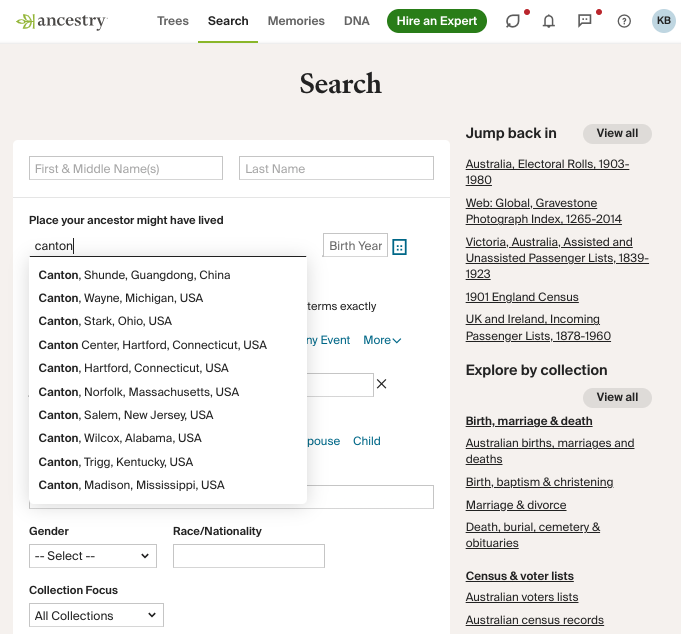
However, Ancestry.com.au, in their standardised list of place names, suggests ‘Canton’ as a city that is part of ‘Shunde’, as shown in the image below: ‘Canton, Shunde, Guangdong, China’. This follows a similar hierarchical format as other places, where it lists City, County, State, Country, or suchlike.

This isn’t such an issue when searching for digitised records, but when you create a family tree and enter ‘Canton, China’ as a place (of birth, for example,) Ancestry prompts you to use their standardised place name, as in the image below.

If you choose this standardised version of the place name, and then view the person’s LifeStory, the place is then given as ‘Guangzhou, Guangdong, China’, as in the second image below.

So, through this process, the vague historical place name ‘Canton, China’ (probably meaning the province) becomes translated to the much more precise place names of Guangzhou (city) and Shunde (county). It is then very easy for an unsuspecting family historian to come across this information and assume that these details are correct, and that the person came from Shunde and/or Guangzhou, when they might have actually come from a very different part of the province of Guangdong.

The moral of my story is the usual one – always check the original source of the information! And unless there is concrete evidence to support it (like a headstone with Chinese characters), I would always be a bit suspicious of an Acnestry family tree or recent family history that says a Chinese ancestor was born in Guangzhou or Shunde.

If you’re interested in knowing more about the Cantonese origins of Australia’s early Chinese communities, have a look at my short article ‘Cantonese connections: The origins of Australia’s early Chinese migrants’ (Traces, issue 6, 
pp. 43–45), which gives a brief overview and includes a glossary of place names. You might also like to read my 2017 blog post on ‘Finding your Chinese roots‘, which includes a map of the Pearl River Delta.

Family history research worksheets

Family history charts and worksheets can help you plan and organise your research process, and record and visualise the information you uncover about your ancestors. They can be used instead of, or alongside, genealogy software or websites to document your research. Charts and worksheets are particularly useful to use as a ‘working copy’, where you add information as you go along.

I developed the charts and worksheets below to use in my family history teaching. You can download them in both Word or PDF format. They are provided with a CC BY-NC 4.0 licence, so you can share and adapt them as you like.

To record information about your ancestors

To plan and keep track of your research

Bibliography on Chinese in Tasmania

Earlier this year I was commissioned by the Tasmanian Museum and Art Gallery (TMAG) to compile a bibliography on Tasmania’s Chinese history and heritage.

The bibliography is intended as a tool to help with the study of Tasmania’s Chinese communities across the nineteenth and twentieth centuries. It documents existing research relating to Chinese people in Tasmania, focusing on history, heritage and community, and provides a survey of publications and other research outputs.

The bibliography was funded as part of TMAG’s Contemporary Migrant Experiences project, with funding from the National Foundation for Australia-China Relations.

On Sunday, 5 June 2022, Kirstie Ross and Grace Williams from TMAG and I presented copies of the bibliography to the Chinese Community Association of Tasmania Inc 澳洲塔省華人聯誼會 at their monthly meeting in Hobart.

Presentation of the bibliography to the Chinese Community Association of Tasmania Inc., North Hobart, 5 June 2022. Pictured L–R: Ruby Lee, Kate Bagnall (UTAS), Grace Williams (TMAG), Daniel Chan (President, CCAT), Brian Chung, Kirstie Ross (TMAG), Hingor Chung, Jan Everett. Photo courtesy Daniel Chan.

The bibliography will be made available in Libraries Tasmania and the National Library through the National edeposit service. I have also made a copy available online in Zenodo.

The compilation of the bibliography marks the beginning of my work on Chinese Tasmanian history and heritage, which I will be pursuing further through the new Everyday Heritage project. Everyday Heritage is an Australian Research Council Linkage project and is a collaboration between researchers at the University of Canberra (Tracy Ireland and Tim Sherratt), University of Western Australia (Jane Lydon), University of Tasmania (me) and GML Heritage in Sydney.

‘A legacy of White Australia’ – Records about the Poon Gooey family in the NAA

Ten years ago, in June 2009, a paper of mine about White Australia records and the Poon Gooey family was published on the National Archives website. I had presented the paper at the Fourth International Conference of Institutes and Libraries for Chinese Overseas Studies at Jinan University in Guangzhou, China, on 10 May 2009. I was then working in the web team at the National Archives and so we put my paper up online, with links to images of documents and to the original archival records, which were all digitised in RecordSearch.

Using the story of Poon Gooey and his family as a case study, the paper discussed the National Archives’ early 20th-century records on Chinese Australians, particularly those created in the administration of the White Australia Policy. The records document many aspects of the lives of Chinese Australians, including immigration and travel, business enterprises, political activities and community life. Publications and finding aids, descriptive work and digitisation projects over the years have made the records easier to access and hopefully encourage their use.

The records are a legacy of the discrimination and marginalisation of the White Australia years, but they can be used by researchers today to recover the lives of Chinese Australians in the past, and also to provide a more nuanced understanding of the contradictions and complications of Australia’s response to its Chinese population.

With the NAA website currently being redeveloped (and the online fate of my paper uncertain), I thought I’d revisit the original version of my paper, which can be found in the Wayback Machine at: https://web.archive.org/web/20090627064642/http://naa.gov.au/collection/issues/bagnall-2009/index.aspx

You can also download a full version of the paper, including images (pdf, 15.1mb): A Legacy of White Australia by Kate Bagnall, 2009

New guide to researching Immigration Restriction Act records

I have produced a short guide to researching Chinese Australians in Immigration (Restriction) Act records in the National Archives of Australia in Sydney.

The guide aims to be a practical introduction to the records, their context and content. It covers the administrative background and processes, how-to steps for researching, a description of the main record series with examples, and copies of various certificates and forms.

Although the examples given in the guide relate to Chinese Australians, information about other ‘non-white’ Australians, such as those of Syrian, Afghan, Indian and Japanese backgrounds, can also be found in the records discussed.

Download the PDF (6.8mb): Chinese Australians and the Immigration Restriction Act by Kate Bagnall


Immigration Restriction Act instructions, 1901 to 1919

I suspect I will never be finished in my quest to understand the workings of the White Australia policy in the early decades of the twentieth century. My most recent work (which I hope will be published in the next year) has focused on the entry and residence of Chinese wives between 1902 and 1920, including the well-known ‘Poon Gooey case’.

While much of what I know about how the Immigration (Restriction) Act was administered comes from individual case files (known as correspondence files), there has been a gap between these files and the legislation itself. Two items in the National Archives (AP214/9 and D3193) help fill this gap. The Collector of Customs in Adelaide – who like Customs officers in the other states administered the Act in accordance with regulations, rules and instructions from the Department of External Affairs – kept a valuable, and seemingly unique, record of this correspondence from External Affairs. I have not come across other similar items for other states (always happy to be corrected though!)

I’ve had D3193 digitised by the National Archives and, while the cost of digitisation of A214/9 was prohibitive because of conservation concerns, I have photographed it and put the images up in Dropbox (link below). There is another series, AP378/37 – ‘Confidential instructions (old system), 1900–45’, listed in RecordSearch as being held in Sydney, but I haven’t looked at this to see if it contains similar material.

AP214/9

AP214/9 is a register containing copies of the Immigration Restriction Act and related correspondence, dating from 1901 to 1913. It was created by the Collector of Customs in Adelaide, South Australia.

The contents of the register includes:

  • copies of the Immigration Restriction Act 1901 and subsequent amendments, as well as related regulations and statutory rules
  • notes for the guidance of officers administering the IRA
  • copies of forms used in administering the IRA
  • instructions from Department of External Affairs to the local Collector of Customs at Port Adelaide.

Much of the content concerns ‘coloured’ arrivals, including ships’ crews, and arriving passengers with physical diseases or disabilities.

It is a large bound volume, with folios marked with page numbers up to 292. The documents (either printed or typsescript carbon copies) are pasted into the register, rather than being written out by hand. Folios 232 to 267 are blank. There is a separate alphabetical index (which doesn’t seem very complete). The last dated document is from 31 December 1913.

AP214/9, VOLUME 1 is held in the National Archives of Australia in Adelaide and is not digitised in RecordSearch (as of 20 June 2017). My images of AP214/9 are available in Dropbox.

National Archives of Australia: AP214/9

D3193

D3193 is a volume containing confidential instructions relating to the Immigration Act (as the Immigration Restriction Act was known after 1912), dating from 1914 to 1919.

The small printed volume has been annotated with handwritten notes and insertions of further documents by the Collector of Customs, Adelaide. The original volume is titled Immigration Act Instructions together with Immigration Act 1901–1912 and Immigration Regulations 1913 and was produced by the Department of External Affairs in 1914.

The contents of D3193 are similar to those in AP214/9.

D3193 is held in the National Archives of Australia in Sydney and is digitised in RecordSearch.

Finding your Chinese roots

For Australians whose Chinese ancestors arrived in the nineteenth and early twentieth centuries, tracing the family history back to China can be a real puzzle.

Whether you’re simply curious about your Chinese origins or are wanting to visit your ancestral village in China, there are two things you need to know – your Chinese ancestor’s name in Chinese characters and their village and county of origin.

Here you will find some suggestions for using Australian records to find these critical pieces of information.

You can also download a printable pdf of this post.

Chinese origins

Most Chinese who arrived in Australia in the nineteenth and early twentieth centuries came from the rural Pearl River Delta region of Guangdong province, south of the provincial capital of Guangzhou, north of Macau and inland from Hong Kong. A smaller number of Chinese migrants came from other parts of Guangdong province and from Fujian province (through the port of Xiamen, known historically as Amoy), as well as from other places such as Shanghai.

This post concentrates on Cantonese migrants who came from the Pearl River Delta.

Cantonese migrants came from a number of different areas in the Pearl River Delta, including:

  • Sam Yup (Sanyi, meaning the ‘three districts’): Namhoi (Nanhai), Poonyu (Panyu) and Shuntak (Shunde)
  • Heungshan (Xiangshan), later known as Chungshan (Zhongshan)
  • Tongkun (Dongguan)
  • Changshing, Tsengshing (Zengcheng)
  • Koyiu (Gaoyao) and Koming (Gaoming)
  • Sze Yup (Siyi, meaning the ‘four districts’): Sunwui (Xinhui), Sunning (Xinning) or Toishan (Taishan), Hoiping (Kaiping) and Yanping (Enping).

The Cantonese migrants spoke a range of dialects including: standard Cantonese, Cantonese variations such as Shekki dialect, Longdu (Zhongshan Min) dialect, Sze Yup dialects such as Taishanese, and Hakka. The earlier Amoy Chinese spoke Hokkien.

Source: Him Mark Lai Digital Archive, https://himmarklai.org/roots-program-lecture-notes/

The big stumbling block

To successfully track your family back to China you ideally need your ancestor’s name and their village and district of origin in Chinese characters. If your family migrated to Australia more recently and this information is known within the family, you have a tremendous advantage. If you don’t have this information, you will need to try and work it out from records available in Australia. This can be very tricky.

Until the twentieth century there was no standard way of romanising the various Chinese languages and dialects. Because of this, and because Chinese in Australia spoke different sorts of Cantonese, there is a lot of variation in how personal and place names are recorded in Australian English-language sources. Only rarely are Chinese characters to be found. The discrepancies in how Chinese names were written down in colonial Australia are not necessarily an indication of racist or uncaring attitudes toward the Chinese, but more a reflection of the fact that nobody, including the Chinese themselves, knew how to spell the names ‘properly’ in English.

Personal names

Chinese personal names usually comprise three characters, with one being the family name and two being the given name – for example, 譚梅玲 Tam Moyling. A few Chinese family names comprise two characters (e.g. O’Young, Seeto), and sometimes a given name comprises only one character.

Although the characters remain the same, the pronunciation of a name changes depending of the dialect spoken. For example, the two-character surname 司徒 is pronounced Situ in Mandarin, Seeto in Cantonese and Soohoo in Sze Yup. The common family name 陳 is pronounced Chen in Mandarin, Chan/Chun in Cantonese, Chin in Hakka, and Tan in Hokkien.

Chinese personal names were recorded in many different ways in Australian records and, in the nineteenth and early twentieth centuries at least, rarely was a name written down ‘correctly’. A person’s name might have been recorded with multiple spelling variations – for example, one early Sydney resident was recorded as Man Sue Bach, Mum Shou Pac, John Ah Shue Bach, John A. Sue Bach, John Ah Sue and John a Shue.

Because of the different word order (surname first in Chinese but last in English), many Chinese given names came to be used as surnames in English – for example, Wong Chun Bun might became known as Jimmy Chun Bun and his children registered under the surname Bun.

Many, many Chinese personal names also include ‘Ah’ or ‘A’. This represents the character 阿, which is a prefix added to a given name as a familiar or informal form of address, much like adding ‘ie’ or ‘y’ to the end of a name in English (Ann to Annie, Tom to Tommy).

Petition of Chinese residents of Melbourne, 1857. Source: PROV VPRS 1189/P0, unit 482, http://wiki.prov.vic.gov.au/index.php/Chinese_Language_Records_at_PROV

While sometimes confusing, romanised versions of personal and place names can tell us helpful things. For example, personal names written with a ‘sl’ or ‘shl’ or ‘thl’ sound at the beginning (like Dang Bown Sluey or Slit Schin) suggest that these people were likely to be from Taishan, as this sound is particular to Sze Yup sub-dialects rather than standard Cantonese.

Or, a woman’s name that includes a ‘See’ or ‘Shee’ (氏) usually gives her father’s family name and indicates that the woman was married – a bit like the term née. Ham See, for example, would be a married woman who was born into the Ham (譚) family – Ham would be her father’s, not her husband’s, surname.

Emma Woo Louie has written on Chinese American names, much of which applies in the Australian context. Her book is Chinese American Names: Tradition and Transition (McFarland & Company, 2008). A preview of the book is available from Google Books. She has also published articles on the subject in the Chinese Historical Society of America’s journal Chinese America: History and Perspectives.

For more on overseas Chinese names see:

  • ‘Chinese names’ on the Chinese-Canadian Genealogy website: http://www.vpl.ca/ccg/Chinese_Names.html
  • Kate Bagnall, Golden Shadows on a White Land, PhD thesis, University of Sydney, 2006 – Section 4: Belonging (starts on
    196): http://ses.library.usyd.edu.au/bitstream/2123/1412/4/04sections3%264.pdf
  • Kate Bagnall, ‘The trouble with spelling Chinese names’, Tiger’s Mouth [blog], 12 February 2013: https://chineseaustralia.org/the-trouble-with-spelling-chinese-names/
  • Janis Wilton, Golden Threads: The Chinese in Regional New South Wales 1850–1950, New England Regional Art Museum, 2004
  • Jon Kehrer, ‘Who was “John Chinaman”’, The Ancestral Searcher, vol. 24, no. 4, December 2001, pp. 201–205
  • Jon Kehrer, ‘Honourable ancestors: My search for the Chinese connection’, The Ancestral Searcher, vol. 27, no. 4 December 2004, pp. 328–333
  • Gary Presland, ‘Some difficulties in researching Chinese ancestry’, in From Gold to Federation: Papers from the Fourth Victoria Family State Conference, ed. Noelle Oke, Penfolk Publishing, Melbourne, 2001.

Place names

The native place of many Chinese is recorded in Australian sources as Canton – which variably refers to the province of Guangdong or the capital city of Guangzhou. However, most migrants came from the rural counties outside the capital, rather than the city itself. Unfortunately if ‘Canton’ is all the information you can find about your ancestor’s origins you will probably not be able to progress your research much further.

More occasionally county, city, town or even village names are recorded: Sunning, Sun Wui, Heung Shan, Amoy, Shekki, Kongmoon, Lee Yuan, Chuk Sau Yuen or Bak Shek, for example. Sometimes it’s easy to identify these places, sometimes it’s not. The smaller the place, the harder it can be to identify, but the more useful it will be if you eventually work out where it is.

The trick is to be able to translate from the old romanised version of a place name to how it is known today. The Cantonese city known in Mandarin today as Jiangmen (江門), for instance, might have been written Quong Moon, Kong Mun, or Kongmoon.

There are several words that often appear as the last syllable in village names that it can be useful to recognise:

  • choon or toon – 村 cun, meaning ‘village’
    g. 南潮村 Nam Chew Toon
  • lee or lay – 里 li, meaning ‘village’
    g. 南勝里 Nam Sing Lay
  • yuen – 園 yuan, meaning ‘garden’
    g. 竹秀園 Chuk Sau Yuen.

You can use clues you find in other records, such as distance from a larger town or physical characteristics of the place, to help narrow down your search for your particular village. If you know your ancestor’s surname you can also cross-check village names with the surname. The following database of village names is useful for this purpose:

The ‘Location, location, location’ section of the Chinese Genealogy forum (http://siyigenealogy.proboards.com/) is an excellent place to read up how others have gone about identifying and locating their ancestral villages.

If your ancestor came from Taishan, Xinhui or Zhongshan counties, you might find relevant information in the material produced by a project undertaken by the Asian Library at the University of British Columbia that identified the village and town of origin of Chinese migrants to Canada. Many migrants to Australia came from the same places as those who went to Canada. See:

Australian sources to consult

The following records are places where you are more likely to find personal names and village origins in Chinese characters.

Gravestones

A headstone in Chinese often provides the person’s name and place of birth in China. See:

Chinese graves in the old Chiltern cemetery, Victoria

Birth, death and marriage records

You should obtain Australian marriage and death certificates for the original Chinese ancestor, as well as birth certificates for their children and death certificates if the children died young. Sometimes a Chinese groom or father will have signed his name in Chinese characters and the birthplace will be more specific than just ‘Canton’ or ‘China’.

Immigration, travel and alien registration records

Immigration and travel records, as well as alien registration records, might contain details of people’s place of origin and their name in Chinese. Twentieth-century travel documents issued to Chinese Australians under the Immigration Restriction Act and related records are held by the National Archives of Australia. ‘Aliens’ (people who were not British subjects) were required to register with the government from World War I. These records are also held by the National Archives and can contain Chinese signatures, information about place of birth and so on.

See:

Naturalisation records

Some Chinese migrants became naturalised British subjects in the colonial period, and their application forms and certificates can include details such as place of origin and their original signature in Chinese. Naturalisation applications, rejected applications and cancelled and confiscated naturalisation certificates are found in state archives and in the National Archives of Australia.

Chinese newspapers

From the 1890s, Australia’s Chinese communities had their own Chinese-language newspapers, including the Chinese Australian Herald and the Tung Wah Times. The Tung Wah Times has been indexed in English, which allows you to search without knowing Chinese. The index can be helpful in identifying articles that might include an ancestor’s name in Chinese.

The major early Australian Chinese-language newspapers are also available through the National Library of Australia’s discovery service, Trove. If you have located names in Chinese characters you can search the newspapers even if you only have basic Chinese language skills. See:

Chinese student records

In the early twentieth century, young Chinese were allowed to come to Australia to study. Most who came were the children or relatives of people already living here. These students were issued with special Chinese student passports that included their name and place of origin in Chinese characters as well as in English. Many of these passports are held in immigration files in the National Archives of Australia. On how you might be able to use these passports to identify your ancestor’s village of origin, see:

Application for a Chinese student passport for Wong Ching Hung, 1923. NAA: A1, 1927/2279, http://recordsearch.naa.gov.au/scripts/AutoSearch.asp?O=I&Number=1506455

Top 3 tips for Chinese Australian family history research

Here are my ‘top 3’ suggestions on where to start your Chinese Australian history.

(Note: these suggestions are most relevant for New South Wales, and for tracing Chinese ancestors who arrived in Australia from south China before World War II.)

Wedding of Elsie May Chinn and Kum Mow, Sydney, 1917 (Sun, 18 February 1917, p. 16, http://nla.gov.au/nla.news-article221962375)

Top 3 sources

Look here first!

  • Birth, death and marriage records – You can search for and purchase copies of BDM certificates through the NSW Registry of Births, Deaths and Marriages, or get transcriptions through an agent. If you can, get copies of more than just your direct ancestral line (e.g. birth certificates for your grandmother’s siblings as well as your grandmother), since certificates often contain different bits of information. Also see if you can find church or parish registers and family notices in the newspaper.
  • Trove digitised newspapers – Try searching Trove using variations of your ancestors’ names, limit your searches by state or to a particular newspaper, or search more generally using a term like ‘Chinese’ and the place they lived.
  • National Archives of Australia (NAA) – Search in RecordSearch using variations of your family members’ names. The NAA collection is vast, but here’s an example of what you might find.

Top 3 research tips

  • Researching your Chinese Australian family is largely like researching any other Australian family. Some of the records you consult might be different (e.g. immigration, naturalisation or alien registration files), but the principles are the same. Contact your local library, historical society or genealogical society for help.
  • Chinese names were written down in many different ways in Australian records. Few records give people’s real Chinese names. Keep a list of each different spelling of your ancestor’s name you find, to use in keyword or name searches.
  • To trace your Chinese family back to China, you need to know their real Chinese name (preferably in characters) and their home province and district (‘Canton, China’ isn’t enough). During your research be on the look out for anything written in Chinese characters and make a copy.

Top 3 books

  • Janis Wilton, Golden Threads: The Chinese in Regional New South Wales, 1850-1950, New England Regional Art Museum in association with Powerhouse Publishing, Armidale, NSW, 2004
  • John Fitzgerald, Big White Lie: Chinese Australians in White Australia, University of New South Wales Press, Sydney, 2007
  • Shirley Fitzgerald, Red Tape, Gold Scissors: The Story of Sydney’s Chinese, revised edition, Halstead in association with the City of Sydney, Ultimo, NSW, 2008

Top 3 websites

  • Chinese Genealogy – a really helpful forum that’s especially useful for tracing your ancestral village
  • Chinese-Canadian Genealogy – the specifics are Canadian, but this site provides many ideas that can be applied to Australian research

Quong not Zuong, Quay not Zuay

A little note about searching for Chinese names in the National Archives’ RecordSearch database, specifically in early 20th records of the NSW Collector of Customs. There is a consistent transcription error in item descriptions where capital Q has been transcribed as capital Z. This means that names like Quoy, Quan, Quay, Quock have been entered as Zuoy, Zuan, Zuay, Zuock. The examples I’ve come across are in ST84/1, where Customs Inspector J.T.T. Donohoe’s rather lovely handwriting seems to be the problem. Something to remember if you can’t find records under the correct spelling.

Quong Quay's Certificate Exempting from Dictation Test, 1907
NAA: ST84/1, 1907/471-480