Tag: Photographs

Who was Tie Cum Ah Chung?

If you have wandered past the library on the corner of Murray and Bathurst streets, Hobart, you might have noticed a billboard featuring arresting black-and-white portraits of a young Asian woman in Edwardian dress.

Across the front and side portraits of the woman is an annotation that reads, ‘Tie Cum Ah Chung — 11–9–03 —’.

The caption below the photographs tells us that these 1903 images of Tie Cum Ah Chung come from Hobart Gaol’s Prisoners Records Books, held by Tasmanian Archives.
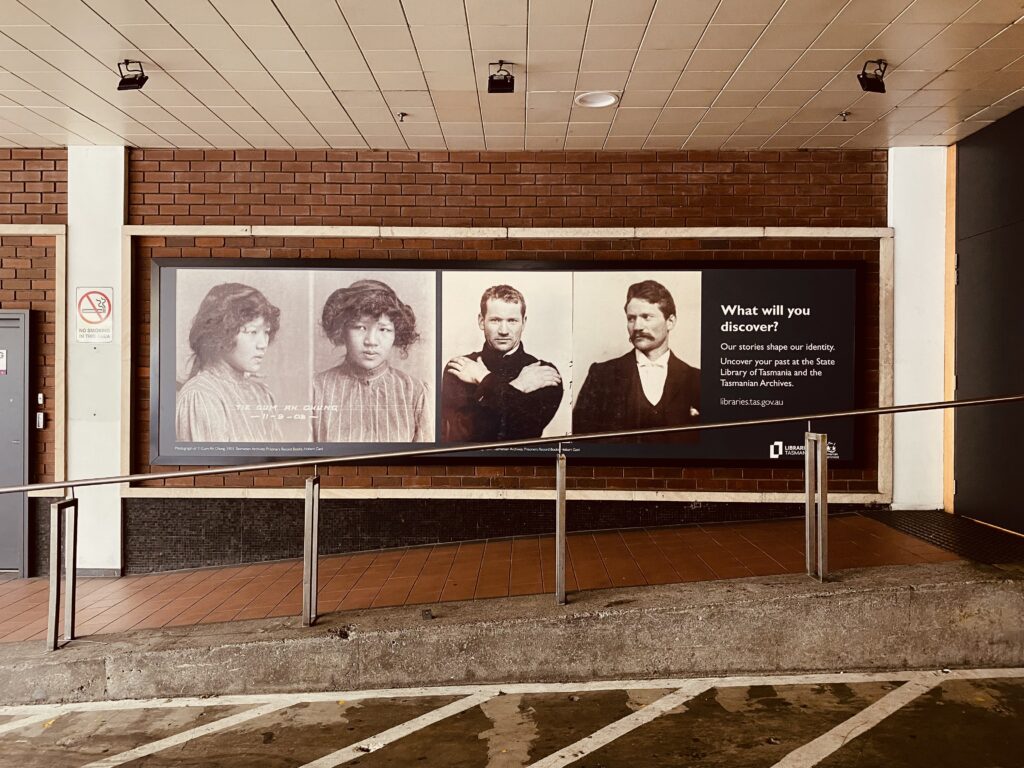
Colour photograph of a red brick wall with a large billboard on which there are old black and white portraits of an Asian woman and a white man, next to text advertising the State Library of Tasmania and the Tasmanian Archives
Billboard in the carpark of the State Library of Tasmania on the corner of Murray and Bathurst streets, Hobart, 7 November 2025. Photograph by Kate Bagnall

In this blog post I want to look into the history of Tie Cum Ah Chung, to see what can be uncovered about her life in Tasmania.


The obvious first place to look for information about Tie Cum Ah Chung is her prisoner record, which can be found through the Tasmanian Names Index (although under a slightly different spelling of her name).

The prisoner record notes that 18-year-old Tie Cum Ah Chung was first imprisoned for a month for larceny in September 1903, and then three months later she was imprisoned for another month for perjury. She was 5 foot 3 inches tall, single, had smallpox scars on her face, worked as a domestic, and apparently could not read nor write. Her native place was recorded as Yokohama, Japan, although the name of the ship that brought her to Tasmania was unknown. (Yokohama had a sizeable Cantonese population and a ‘Chinatown’, and I have come across other records of Chinese in Australia and New Zealand who stated their birthplace as being Yokohama – so this is not impossible!)

The Tasmanian Names Index brings up no other obvious records for Tie Cum, although there are, of course, other records for people with the name ‘Ah Chung’, including naturalisations, births, deaths, marriages and wills. Many of these records relate to the family of Chin Ah Chung and his wife Lily, whose descendants are still in Hobart today.

The next easy place to look for Tie Cum is in the historical newspapers in Trove, to see if there are any reports of her crimes, arrests or trials. ‘Ti Cum Ah Chung’ (in inverted commas) brings up two results, neither of which are what might have been expected – they relate to a shooting in Launceston late one Friday night in February 1906, which Tie Cum witnessed. She had been standing in York Street, near Storrer’s (an undertaker’s), talking to two young men at the time of the shooting, and she reportedly not only saw the victim but was threatened by the shooter and then warned passersby of the danger. Both articles referred to her as ‘Chinese’.

Searching under the variant spelling of her name – “Tie Cum Ah Chung” (in inverted commas) – yields some more results in the historical newspapers, with reports from September and December 1903 about her court hearings, and one further article about the 1906 shooting.

A month after the shooting, Tie Cum gave evidence at the trial, which was held at the Police Court in Launceston on Friday, 2 March 1906. Her evidence was reported under the heading ‘The Chinese Girl’. Tie Cum told the court she was a Christian, and she was sworn on the Bible. There was no mention of an interpreter, and she appears to have given her testimony in fluent English. Her evidence tallied with the earlier press reports of her involvement – she had been standing on the corner of York and St John’s streets with Albert Brooks and Alfred Grant when the events took place; interestingly she also stated that she knew two of the policemen involved in the case, one from her time in Hobart ‘before I came up here’.

What then of her own petty crimes? On Friday, 11 September 1903, the Tasmanian News (Hobart) reported:

A CHARGE of LARCENY. Tie Cum Ah Chung, a young Japanese woman, was again before the Court, charged with stealing 21b of biscuits from Mrs Meredith, of Harrington street. Accused was defended by Mr Davenport Hoggins (Hoggins and Gilmore). After hearing evidence, accused was found guilty and sentenced to a month’s imprisonment. An application by counsel for his client to be treated under the First Offenders Act was refused, Mr Shaw stating that the Act was never intended for persons of accused’s character. She had been before the Court several times under disreputable circumstances, and a short term of imprisonment would perhaps give her time to think over her position and probably—though he was afraid not—lead to her reform. The Court then rose.

Three months later, on Tuesday, 15 December 1903, the Tasmanian News (Hobart) further reported:

PERJURY. Tie Cum Ah Chung pleaded guilty to having committed wilful and corrupt perjury at the City Police Court, Hobart, where, being charged with the larceny of a couple of pounds of biscuits from a shop in Argyle street, she elected to give evidence on her own behalf. Prisoner was defended by Mr C. Davenport Hoggins (Hoggins and Gilmore). Mr Hoggins made a strong appeal for leniency, and said the Salvation Army was prepared to take the woman in hand. His Honor imposed a sentence of a month’s imprisonment.

I also tried searching Trove Newspapers using some other variations of her name (Ti/Tie/Tye/Tei and Come/Chum, as well as just Ah Chung), refining the search using parameters like date range and place, with some further success. My other go-to place for researching Chinese Australians in the early twentieth century is RecordSearch (National Archives of Australia), but no records about her obviously come up under variations of the name Tie Cum Ah Chung.

Most of the other newspaper reports I found about Tie Cum were repeats of the information about her larceny and perjury convictions, and the Launceston shooting, including one that includes a more detailed account of her biscuit theft from Mrs Meredith’s shop. One other that piqued my interest was from the Hobart Mercury in July 1903, three months before the theft:

City Police Court. – On Thursday, before the Police Magistrate (Mr. B. Shaw) and Mr. A. Riddoch, J.P. …Two young women named Elsie Hardwicke and Ti Chum Ah Chung pleaded guilty to disturbing the peace in Elizabeth-street by assuming a pugilistic attitude. The former was fined 25s., and the latter, who was a first offender, 5s.


The circumstances of Tie Cum’s life as recorded in these few easily found records seem really quite remarkable – from what I am learning about Tasmania’s early Chinese community, there are many remarkable stories of women and families to be uncovered!

‘Melbourne Ghost Signs’ researcher Sean Reynolds has delved into Tie Cum’s history, too – she apparently left Tasmania for Victoria not that long after these events – and for her story in later life (as Sean has been able to piece together), you might have a look at his creatively (flamboyantly?) written blog post, Otherwise, Yokahama, or listen to his Royal Historical Society of Victoria podcast episode of the same name (embedded below). Note that I haven’t closely reviewed Sean’s research, but on the surface it seems to largely hold together; it’s just perhaps a little fanciful about her origin story.

What then of Tie Cum’s early life? How and when did she come to Tasmania? Was she really born in Yokohama? And was she connected in any way to the Ah Chung family that I know?

My first tantalising clue has come in the form of a newspaper report in the Hobart Mercury in May 1898, located in a search for ‘Chinese girl’ in Tasmanian newspapers, which reported an accident in Hobart involving a fourteen-year-old Chinese girl named ‘Tarcum’:

Accident. – Yesterday evening, as a butcher’s waggon was being driven along Melville street, a Chinese girl named Tarcum, aged 14, who was playing on the footpath with some other children, ran on to the road, and got on the vehicle. Just then a sudden jerk caused her to fall, and the hind wheel ran over her. She was severely injured, and subsequent to being called to her mother she was conveyed to the hospital and admitted. The extent of her injuries has not been ascertained.

This Chinese girl, ‘Tarcum’, was aged fourteen in 1898, and Tie Cum Ah Chung was aged eighteen in 1903, which broadly tallies. Could they therefore be the same person? I think it’s a real possibility! If so, she was born in about 1884 or 1885.

The 1898 article mentions that Tarcum was called to her mother after being injured, suggesting that she came to Tasmania with her family; if she was Tie Cum Ah Chung, a Tasmanian childhood would account for Tie Cum’s fluency in speaking English (as suggested by her 1906 court testimony).

So, here is my crazy theory, which makes sense with the limited evidence I have to date.

The only ‘Ah Chung’ family with a Chinese mother that I know of in Hobart in the 1890s was that of Chin Ah Chung (carpenter / cabinetmaker, later fancy goods storekeeper) and his wife Kim Wing aka Lingo, later known as Lily. Kim Wing came to Hobart in about 1892, aged in her mid to late teens, and she was known to have had her feet bound in childhood. She was befriended by white women in Hobart who taught her to speak English, and she was remembered as speaking without an accent.

We know that other Chinese wives coming to Tasmania around that time were accompanied by companions or maids (e.g. Lula Mon Chinn and Fanny Lee Fook). Is is possible then that Tie Cum was a mui tsai or maid who accompanied Kim Wing to Tasmania? She would have been perhaps 10 years younger than Kim Wing, although it’s hard to get a firm grip on their exact ages. There is no family memory of Kim Wing having migrated with a maid servant, but information about her early life is also scant. I think this arrangement would have been more likely than her being Kim Wing’s daughter, as the age difference was too close.

I hope that as time goes on I will be able to make more sense of Tie Cum’s early story in Tasmania in the 1890s and early 1900s, and either confirm or disprove my crazy theory. Whatever her story, it seems she was among the earliest, and most intriguing, immigrant Chinese women to call our island state their home.


UPDATE 14 November 2025: There goes that theory! Today I came across a snippet from the Mercury on 9 September 1903 that reads: ‘Tie Come Ah Chung is nothing to do with Ah Chung in Elizabeth-street whatever.’ This was around the time 18-year-old Tie Cum was getting into trouble in Hobart.
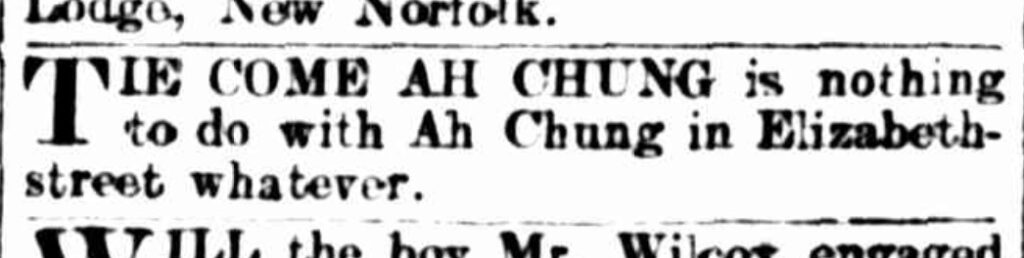
Small classified advertisement from a newspaper that reads TIE COME AH CHUNG is nothing to do with Ah Chung in Elizabeth-street whatever

‘Ah Chung in Elizabeth-street’ is Chin Ah Chung, mentioned above. I guess it is possible that the Ah Chungs were distancing themselves from Tie Cum because of her disreputable behaviour, but I think for now I will put aside my theory that she came to Hobart with Kim Wing.

FURTHER UPDATE later the same day: Ha, I was right after all! Tie Cum was associated to the Ah Chung family of Elizabeth Street, Hobart! I came across another little snippet in the Mercury in August 1900, a classified inserted by Ah Chung, that reads:

MRS. QUIN, late of Garibaldi, having been residing with me for three months, went away on Wednesday night last without any cause, taking with her Tie-Com, my servant. I will not be Responsible for their actions or any debts contracted in my name. AH CHUNG, 102 Elizabeth-street, Hobart.
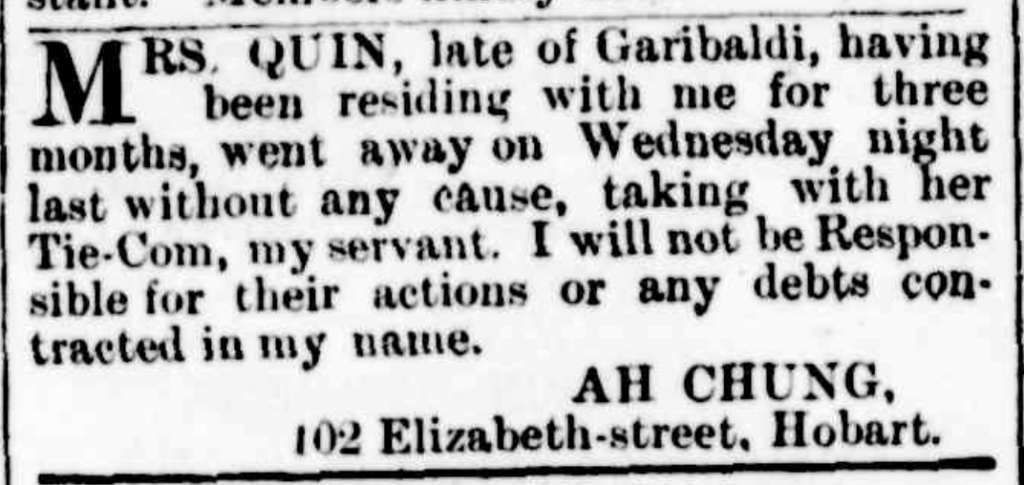
Clipping of a newspaper classified advertisement placed by Ah Chung of Hobart


One final find for today is perhaps less exciting, but it does provide one more little clue about Tie Cum in Tasmania.

In October 1905, the complainant in a maintenance case, Emily Maria Deeks, stated that:

when in Hobart she was living in Harrington-street as the housekeeper of a Mr Lung [and going by the name of Mrs Lung]. There were also in the house Mr Bowring, Mr Spurling, and a Chinese woman.

We know that at the time of her arrest in 1903, Tie Cum was working as a domestic (according to her prisoner record) and also that she was publicly disowned by Ah Chung that same year. So it would make sense for her to be the ‘Chinese woman’ mentioned by Emily Maria Deeks as also residing in the house of Mr Lung, presumably working as a domestic. Again, there is nothing concrete here to say this was Tie Cum, but given the circumstances it is very possible.

AND ONE FURTHER UPDATE: Just to document the last piece of evidence I’ve found so far that is possibly about Tie Cum in Tasmania – a search in Trove Newspapers for ‘Ah Chung’ turned up the report of a fire at Ah Chung’s premises at 162 Elizbeth Street on 21 March 1898. The article noted that at Ah Chung’s house, ‘there were four Chinamen, a woman and a girl’. If this was the right Ah Chung (still to be confirmed), then could the girl be Tie Cum? Bear in mind that by this stage Chin Ah Chung and Kim Wing (later known as Lilian Ah Chung) had two young sons: Royden (born 1894) and Tasman (born 1896). It is also unlike the colonial press not to mention the race of the woman and girl if they too were Chinese.


References

Prisoner record of Ti Cum Ah Chung, 1903, p. 2594, Prisoners Records Books, GD63/1/3 (Book No. 5), Tasmanian Archives, https://libraries.tas.gov.au/Digital/GD63-1-3-P117

‘Outbreak of fire’, Tasmanian News, 21 March 1898, p. 2, http://nla.gov.au/nla.news-article173663941

‘Marshalling of reinforcements’, Mercury (Hobart), 25 May 1898, p. 2, http://nla.gov.au/nla.news-article9422776

‘Advertising, Mercury (Hobart), 4 August 1900, p. 3, http://nla.gov.au/nla.news-article12806313

‘Advertising’, Tasmanian News (Hobart), 4 August 1900, p. 3, http://nla.gov.au/nla.news-article185243364

‘Advertising’, Mercury (Hobart), 9 September 1903, p. 5, http://nla.gov.au/nla.news-article12256286

‘City Police Court’, Tasmanian News (Hobart), 11 September 1903, p. 2, http://nla.gov.au/nla.news-article176656230

‘The Mercury’, Mercury (Hobart), 31 July 1903, p. 5, http://nla.gov.au/nla.news-article12267780

‘Parliamentary notes’, Mercury (Hobart), 9 September 1903, p. 4, http://nla.gov.au/nla.news-article12256346

‘A Jap in trouble’, Examiner (Launceston), 12 September 1903, p. 5, http://nla.gov.au/nla.news-article35563231

‘Tasmania’, Daily Telegraph (Launceston), 12 October 1903, p. 5, http://nla.gov.au/nla.news-article153903661

‘A charge of perjury’, Tasmanian News, 13 October 1903, p. 3, http://nla.gov.au/nla.news-article176658147

‘Second Court’, Tasmanian News (Hobart), 15 December 1903, p. 6, http://nla.gov.au/nla.news-article176661915

‘Criminal Court’, Daily Telegraph (Launceston), 16 December 1903, p. 4, http://nla.gov.au/nla.news-article153902132

‘Criminal Court sitting’, The North Western Advocate and the Emu Bay Times, 16 December 1903, p. 2, http://nla.gov.au/nla.news-article64651150

‘Tasmania’, Zeehan and Dundas Herald, 16 December 1903, p. 4, http://nla.gov.au/nla.news-article83719094

‘Domestic Unhappiness’, Daily Telegraph (Launceston), 28 October 1905, p. 6, http://nla.gov.au/nla.news-article154020620

‘Statement by Jackson’, Examiner (Launceston), 3 February 1906, p. 9, http://nla.gov.au/nla.news-article38071562

‘The shooting sensation’, Daily Telegraph (Launceston), 5 February 1906, p. 5, http://nla.gov.au/nla.news-article151822259

‘The shooting sensation’, Daily Telegraph (Launceston), 3 March 1906, p. 9, http://nla.gov.au/nla.news-article151823245

Sean Reynolds, ‘Otherwise, Yokohama’, Melbourne Ghost Signs [blog], 10 July 2024, https://web.archive.org/web/20251107061531/https://melbourneghostsigns.substack.com/p/otherwise-yokahama
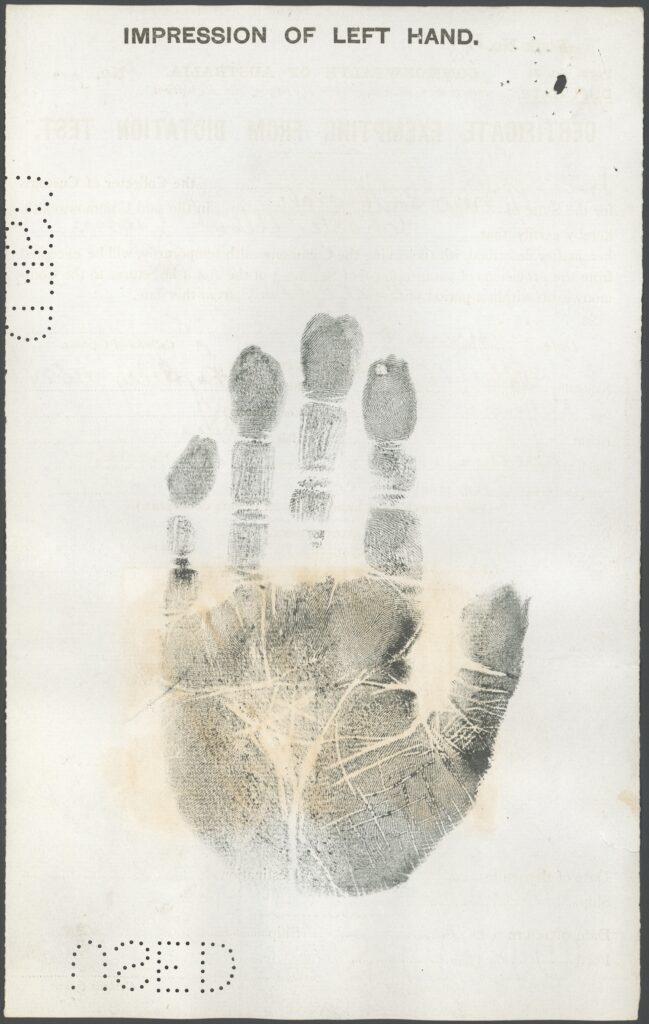
Charlie Allen’s handprint

In this post, I tell the story of the boy whose handprint became an emblem for the Everyday Heritage project. The post was originally published on the Everyday Heritage website on 9 July 2024.

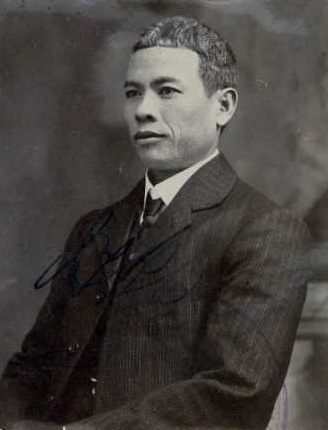
Back of Charlie Allen’s Certificate Exempting from the Dictation Test, which was issued before his departure from Sydney for China in June 1909. National Archives of Australia (Sydney): ST84/1, 1909/22/41-50

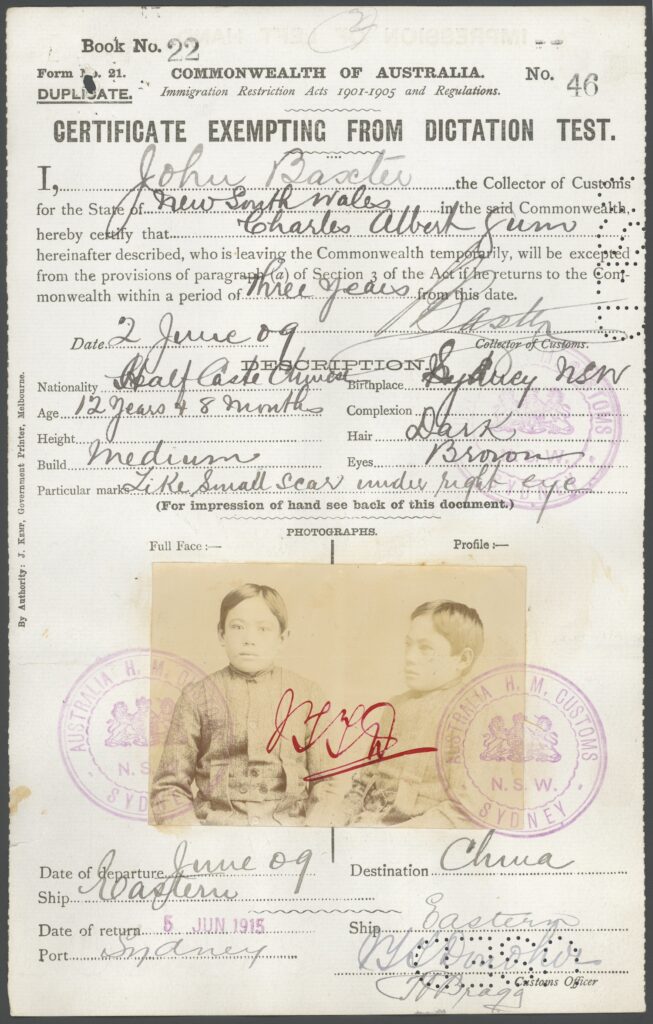
This handprint belongs to a 12-year-old boy called Charles Albert Allen.

Charlie, as he was known, was born in Surry Hills, Sydney, in 1896. His mother was Frances Allen, his father Charlie Gum.

Charlie was raised by his mother, but in 1909, at the age of 13, he was taken ‘home’ to China by his father.

Charlie Gum returned to Sydney soon after, leaving his son in China. Young Charlie lived with relatives in the Cantonese village of Chuk Sau Yuen for 6 years.

Charlie was homesick, but he had no means of getting back to Australia. His mother attempted to enlist the help of the Australian Government but to no avail.

Charlie finally returned in 1915 at the age of 18.

The following year Charlie enlisted in First AIF, the first of three attempts to serve his country. He was discharged as medically unfit each time.

Charlie married Maud Gordon in Surry Hills in 1917, and they had two daughters soon after. Charlie returned to China in 1922 for 7 months.

Charlie Allen died in 1938 as the result of an industrial accident at the Bunnerong Power Station where he worked. He was 41.

Charlie Allen’s handprint is found on the back of an identification document called a Certificate Exempting from the Dictation Test.

The certificate was issued by the New South Wales Collector of Customs in 1909 under Australia’s infamous Immigration Restriction Act. Today it is held in the National Archives of Australia in Sydney.

Front of Charlie Allen’s Certificate Exempting from the Dictation Test. NAA (Sydney): ST84/1, 1909/22/41-50

Charlie’s certificate, with its photographs and handprint, is one of tens of thousands of similar documents that were issued to ‘non-white’ Australians when they travelled overseas in the early twentieth century. These certificates allowed them to return home to Australia without sitting the infamous Dictation Test.

Every one of these certificates could be used to tell a story of how the everyday lives of Australian were affected by the White Australia Policy.

Among these many possibilities, the story of Charlie and his mother, Frances, particularly struck me, and I’ve written about them in an article that draws on methodologies of biography, microhistory, and family history. As well as his 1909 CEDT, the files in the archives include photographs of Charlie, and handwritten letters from him to his mother and from his mother to the Australian Government.

Charlie’s letters home from China are particularly significant. They provide a rare glimpse into the experiences and emotions of an Australian boy living in his own migrant father’s homeland. While many hundreds of young Australians of Chinese descent spent time in China across the late nineteenth and early twentieth centuries, first-hand accounts like Charlie’s are rare.

In 1910 Charlie was homesick and a long way from home. ‘Every minute I think of you, and long for a piece of bread and butter this tucker is not doing me well’, he wrote to his mother, before signing off with a flurry of kisses.

In 1911 Florence was missing her son dearly but was unable to get him back. In a letter to the Australian Government, she wrote: ‘Try and do your best to get my son returned back, to me, to Australia … do your best for his mother as I am nearly heart broken about him’.

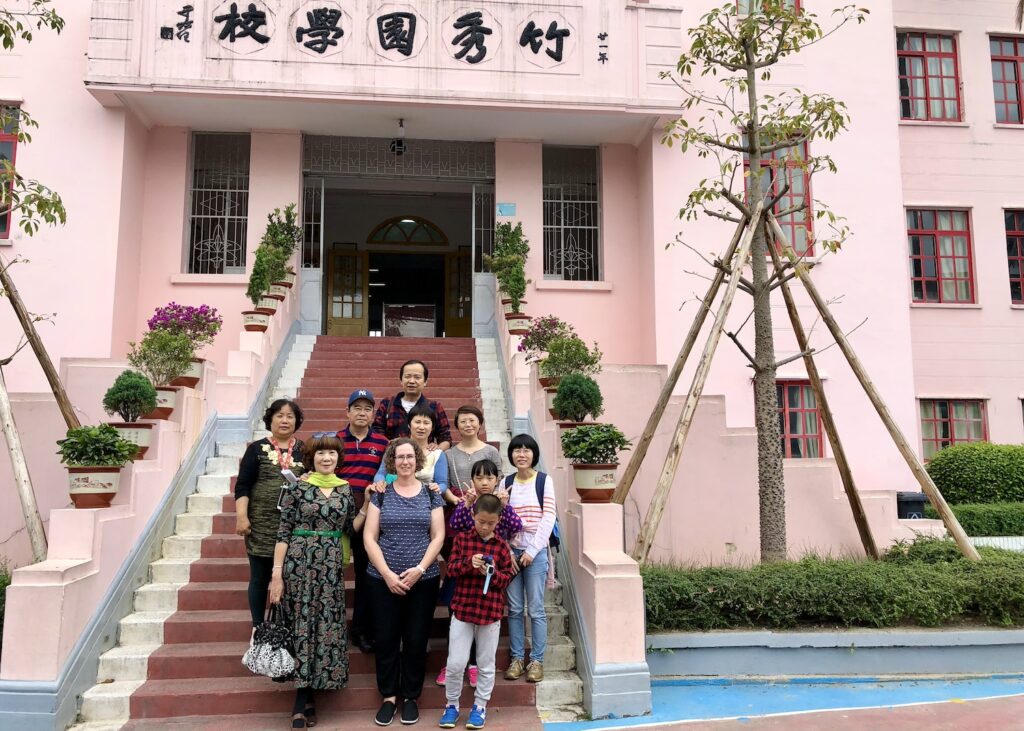
Kate Bagnall and friends on the steps of Chuk Sau Yuen School 竹秀園學校, Chungshan 中山, Kwangtong 廣東, an Australian ‘diaspora-funded school’ built in the early years of the 20th century, March 2019

Beyond the National Archives, I was able to trace the lives of Charlie and his parents, his wife and his children, piecing together fragments of their stories from written records – including birth, death and marriage records; shipping records; war service records; and newspapers – and visiting places significant to their lives, such as Chuk Sau Yuen village where Charlie lived in China, and his grave in Botany Cemetery.

Charlie Allen’s is one of the many ‘small lives’ that can be found in the archives. Telling the stories of lives like his – which are both ordinary and extraordinary – works to counteract dominant narratives – of who belongs and who matters – that continue in our nation’s history and heritage today.

These stories also touch the lives of everyday Australians. Charlie’s great grandson recently told me that memory of Charlie had almost faded within his family. But, having found the archival paper trail and my writing about Charlie’s life, they could now work keep his memory alive.

Further reading

Kate Bagnall, ‘Charlie Allen’s mystery aunt’, The Tiger’s Mouth (blog), 5 January 2021, https://chineseaustralia.org/charlie-allens-mystery-aunt/.

Kate Bagnall, ‘Writing home from China: Charles Allen’s transnational childhood’, in Paul Longley Arthur (ed.), Migrant Lives: Australian Culture, Society and Identity, Anthem Press, London, 2017. Open access version available at: https://zenodo.org/doi/10.5281/zenodo.10846849.

Kate Bagnall, ‘Anglo-Chinese and the politics of overseas travel from New South Wales, 1898 to 1925’, in Sophie Couchman and Kate Bagnall (eds), Chinese Australians: Politics, Engagement and Resistance, Brill, Leiden, 2015. Open access version available at: https://chineseaustralia.org/wp-content/uploads/2021/05/Bagnall_Anglo-Chinese-and-the-Politics-of-Overseas-Travel_Chapter-7.pdf.

Kate Bagnall, ‘ “I am nearly heartbroken about him”: Stories of Australian mothers’ separation from their “Chinese” children’, History Australia, vol. 1, no. 1, 2003, pp. 30–40. Available at: https://doi.org/10.1080/14490854.2003.11828254.

Emma Tear Tack nee Lee Young

In 2011 I wrote a blog post about a photograph of an unknown Chinese Australian family held in the State Library of Victoria collection. With very few details to go on, in my post I wondered whether I would ever find out the family’s identity. In this guest post, New England local historian Gill Oxley shares with us not only the family’s identity, but more about the interesting lives of Emma Tear Tack, nee Lee Young, and her reverend husband Joseph.

On 22 February 1899, an untitled article appeared on page 2 of the Ballarat Star. It conveyed news of the death of the retired ‘Government interpreter’ for the Ararat and Stawell districts of Victoria, Mr Lee Young. The article also served as an informal obituary, giving details of the life of Mr Lee Young, including his earliest days in Australia (following his immigration from Canton in about 1852) and his life on the goldfields of Victoria in the late 1800s. Towards the end of the article, mention was made of Mr Lee Young’s surviving four daughters and two sons. Two of his daughters were named as Mrs the Rev. James Ah Chue and Mrs the Rev. Joseph Tear Tack.

Mrs the Rev. Joseph Tear Tack was Emma, born at Ararat in Victoria in 1865 (Vic BDM reg. no. 19815), the second youngest child of Lee Young and his wife Elizabeth Wright.

Emma Tear Tack, c.1894 (State Library of Victoria H2005.34/103)

The Victorian Registry of Births, Deaths and Marriages gives Emma’s father’s name as Lee Young and her mother’s maiden name as Elizabeth Lyth. The maiden surname ‘Lyth’ is likely to have been either a mistranscription or else a mispronunciation, as Emma’s mother’s maiden name is given as Elizabeth Wright in official records of the births of most of Emma’s siblings. The record for Emma’s youngest sister, Jessie Lee Young, gives a different name again, with their mother’s maiden name given as Elizabeth Light – quite clearly a misinterpretation of ‘Wright’.

Elizabeth Wright was British born and had emigrated to Australia at about 20 years of age, arriving at Geelong on the ship British Empire on 8 March 1853 (PROV, VPRS 14: Register of Assisted British Immigrants 1839–1871).

Elizabeth married (‘John’) Lee Young in Victoria in 1856 (Vic BDM reg. no. 3704) and the couple had two sons and four daughters:

  • William Lee Young, born Ballarat 1859 (Vic BDM reg. no. 7102)
  • Matilda Lee Young, born Ballarat 1860 (Vic BDM reg. no. 2269)
  • Henry Lee Young, born Ballarat 1862 (Vic BDM reg. no. 12268)
  • Alice Lee Young, born Ararat 1864 (Vic BDM reg. no. 6746)
  • Emma Lee Young, born Ararat 1865 (Vic BDM reg. no. 19815)
  • Jessie Lee Young, born Ararat 1869 (Vic BDM reg. no. 20004).

At 20 years of age, in 1885, Emma Lee Young married Chinese-born Joseph Tear Tack (Vic BDM reg. no. 4357).

Joseph Tear Tack’s Victorian naturalisation record of July 1883 gives his native place simply as Canton, his age at the time as 35 years and his occupation as minister.

Memorial for letters of naturalisation for Joseph Tear Tack, 1883 (NAA: A712, 1883/Y7207)

From this we can assume that Joseph Tear Tack was born in Canton in or about 1848. He would therefore have been about 17 years older than Emma at the time of their 1885 marriage. Perhaps it was this age difference that caused the ‘little commotion in Chinese circles’ over their impending marriage, as reported in the Ballarat Star, and other Victorian papers, in May 1885.

‘General news’, Riverine Herald, 5 May 1885, p. 3

After their marriage Emma and Joseph left Victoria and set up home in the tin mining district of Inverell in northern New South Wales. Their first child, Elizabeth Edith Tear Tack, was born there in 1886 (NSW BDM reg. no. 24730). From the beginning of the 1870s, the Inverell district had a very large Chinese population, with Chinese workers being drawn to the area for the rich deposits of alluvial tin that were plentiful there, and for the business opportunities that also presented themselves with the need for fresh vegetables and other supplies in the booming mining district.

Joseph Tear Tack had been sent to Inverell (or more precisely to nearby Tingha) in mid-1884 by the Wesleyan Methodist Church to minister to the resident Chinese population in the area. He was one of the ‘success stories’ of the church’s Chinese mission in Victoria (‘Wesleyan Church, West Maitland‘, Maitland Mercury, 5 June 1884, p. 2).

According to the March–April 1891 edition of the NSW Government Gazette (p. 1892), Rev. Tear Tack was registered at the NSW Registrar General’s Office in Sydney for ‘the celebration of marriages at Tingha’ on 6 March 1891. Joseph Tear Tack and his family of four persons – one male (his eldest son) and three females (Emma and two daughters) – appear as living at Tingha in the 1891 Census (1891 New South Wales Census, Australia). Helen Brown, in her book Tin at Tingha (1982, p. 35), makes mention of the Rev. Joseph Tear Tack being appointed to serve as an ‘assistant Methodist preacher’ at Tingha between 1885 and 1893, and he is also mentioned by Ian Welch in his work on the Methodist Chinese Mission in Australia.

[Family group] [picture] (State Library of Victoria H2005.34/103)
All available evidence points to this lovely family photograph being the Tear Tack family, taken in the Inverell district some time between the years of 1893 and 1896. Although it is difficult to pinpoint the exact location, the photograph is likely to have been taken either at Inverell, Tingha or perhaps at nearby Bundarra. The Tear Tacks’ youngest daughter, Alice Lucy, who does not appear in the photograph, was born at Bundarra in 1896 (NSW BDM reg. no. 2164). Therefore, we can probably assume that the date of the photograph is either 1894 or, at the very latest, early 1895.

To the best of this writer’s current knowledge, the people appearing in the photograph are (left to right):

  • Joseph Henry Tear Tack, born Inverell 1888 (NSW BDM reg. no. 26002)
  • the Rev. Joseph Tear Tack
  • Josiah William Tear Tack, born Inverell 1892 (NSW BDM reg. no. 17560)
  • Emma Tear Tack nee Lee Young
  • Laura Matilda Tear Tack, born Inverell 1890 (NSW BDM reg. no. 16916)
  • Elizabeth Edith Tear Tack, born Inverell 1886 (NSW BDM reg. no. 24730).

The identity of the younger man standing back right is not known at this stage.

After working for some years in the Inverell/Tingha/Bundarra area, where their five children were born, the Rev. Joseph Tear Tack was sent by the church to Darwin in 1896. While living there he, Emma and their children survived a terrible cyclone that destroyed their house (‘Visit of a Chinese missionary to Lithgow‘, Lithgow Mercury, 5 June 1900, p. 2). Joseph was then sent to Cairns just at the turn of the twentieth century. There he was to establish a new mission and undertake Christian missionary work among the Chinese population in far north Queensland. Emma and children did not initially accompany him to Cairns, but shipping news indicated that ‘Mrs Tear Tack and five children’ sailed to Queensland from Sydney aboard the Aramac in November of 1900.

Tragedy struck the Tear Tack family not long after their arrival in Queensland, with Joseph Tear Tack dying of heart failure at Cairns in August 1901 (Qld BDM reg. no. C697). Joseph would have been approximately 53 years of age at the time of his death. Emma Tear Tack was only about 36 when she was widowed with five children. On 11 January 1902, a letter from Emma appeared in The Methodist under the title ‘Acknowledgement’. In it, Emma Tear Tack paid a moving tribute to her husband, Joseph, and thanked their many friends for their support in what she described as her ‘sore and heavy bereavement’.

Emma did not remarry and so remained a widow for the rest of her life. After her husband’s death, she returned to the support of her family of origin in Ballarat, Victoria, some time in 1903. She appears to have raised her five children there, before moving to Burwood, in the inner western suburbs of Sydney, at around 65 years of age (Sydney and New South Wales, Australia, Sands Street Index, 1861-1930).

Emma Tear Tack nee Lee Young died on 28 October 1948 at 83 years of age at her home in Concord (NSW BDM reg. no. 27301). She is buried in the Field of Mars Cemetery at East Ryde in Sydney. A death notice published in the Sydney Morning Herald on 29 October 1948 noted that she was the loving mother of Elizabeth, Henry, Laura, Josiah, Lucy, and adopted daughters Marjorie and Molly.

Death notices for Emma Tack (Sydney Morning Herald, 29 October 1948, p. 14)

I am very grateful to Kate Bagnall for originally posting the photograph of the Tear Tack family on her blog, to my cousin Etty Doyle Lang for pointing me in the direction of Kate’s post, and to the keen eye of Paul Macgregor who was the first to spot and recognise the Rev. Joseph Tear Tack in the photograph. I am also very much indebted to Paul for his encouragement, mentoring, collaboration and fine detective skills, and to our friend and colleague, Juanita Kwok, whom we also consulted in solving some of the mysteries initially presented by this photograph.

Gill Oxley
26 October 2016

Building a DIY Trove list exhibition

One of my projects over the summer has been to create a small online exhibition using Trove lists and a nifty online exhibition framework built by Tim Sherratt.

DIY Trove exhibition screenshot

The list feature in Trove allows registered users to create their own collections of items. They’re a handy thing if you’re researching a particular topic and want to organise the material that you’ve found in Trove, or even if you just want to go back to random stuff that you like. You can keep your Trove lists private, or make them public and share what you’ve found with others.

Tim, who until recently was part of the Trove management team, thought that it would be good to take that sharing to another level — so he’s created a framework that lets you use your Trove lists to create an online exhibition. You can read more about Tim’s thoughts on this process on his blog.

I was keen to give it a try, and decided to make a pictorial exhibition about the Chinese in New South Wales to 1940. I started by making nine lists in Trove, which would serve as topics in my exhibition. Gradually I added a selection of pictures, objects and illustrated newspapers articles to each of my lists. I gave each of my lists a short description and arranged the items in chronological order. Because I’ve included newspaper articles, it would be best if I took the time to correct the OCR text for each one, but I’m impatient and wanted to get onto building the exhibition itself.

Tim’s DIY Trove Exhibition is pretty straightforward to use, particularly if you have some experience (even very basic experience) with web publishing or coding. He’s written clear, step-by-step instructions. The process first involves getting yourself a GitHub account and a Trove API key, and then customising his code to make your exhibition. Customising the code might look scary, but if you follow the instructions carefully you should be okay! There are further ways that you can customise the exhibition — for example, I changed the fonts — but you don’t need to do anything more if you don’t want to.

Once you’ve made the exhibition, you can easily add or take away items, or change your list descriptions, or change the order items appear in a list. Simply make the change to your list in Trove and it will appear in your exhibition after refreshing your browser.

Here’s my exhibition:

The Chinese in New South Wales: A history in pictures to 1940

Hope you like it!

Seeing the women and children

I’ve been thinking further about the possibilities of Tim’s wall of faces as a finding aid, as something to help both locate archival documents and to understand their context.

The series we used in our test (ST84/1) was one in which we knew there was a very high percentage of photographs. Each item contains ten certificates, most of which have both a front and profile portrait attached. There is a small amount of other paperwork included in some files, but not a whole lot. We therefore knew what sorts of things we were going to get back.

But what about if we apply the same facial detection technology to a series in which we aren’t so sure of the photographic content? Unfortunately, Tim’s current laptop isn’t up to the task of doing all the grunt work (donations, anyone?), but here’s what I reckon might happen when we are able to move on to other series.

With series like SP42/1 and B13, which hold applications for CEDTs and similar records, I know that there are photographs in many, even most, of the personal case files. (B13 is complicated because it also contains other Customs files that don’t relate to individuals and don’t relate to the administration of the Immigration Restriction Act.) Because files might hold applications for a family, or a parent and child/ren, or an uncle and nephew, or siblings, you don’t always know from the item title exactly who the file relates to. Also, those who were Australian born did not necessarily apply for CEDTs since they could travel using their birth certificates as proof of their right to return, meaning that they don’t appear in CEDT series like ST84/1.

It was usual practice, though, to supply photographs of each person who was travelling (whether on a CEDT or not), and so by extracting those photographs, you would be able to have a better impression about who files related to. Of course, for files that are digitised (or even not) you could go through each one individually (which I’ve done, believe me…), but think how much more fun it would be to scroll through a wall of beautiful faces!

With B13 it would also be useful because there is no separate series of CEDTs; they are mixed in with the application/case files. Facial detection could be a way of extracting the forms themselves from the larger files.

My main research interest is in families, and women, and children – and we know that women are often hidden in archives because of bureaucratic systems which gave priority to the men in their lives. Although there are many White Australia records which relate to individual women and children, they can be lost in files organised and catalogued under the names of husbands and fathers. But scroll through a wall of mostly male faces, and the women and children just leap out at you!

I’m feeling a bit impatient, really, about running SP42/1 and B13 through Tim’s facial detection script. There are so many, so very interesting possibilities.

The real face of White Australia

In October 1911, the Sydney Morning Herald published a short article under the headline, ‘An indignity: photographs and finger-prints’. The article discussed the situation of Charles Yee Wing, a wealthy and respected Sydney businessman, who had asked to be exempted from having to supply his handprint and photograph as part of the process of being issued a CEDT.

Yee Wing had travelled before and was well-known to Customs officials. In this case, the Customs Department was willing to dispense with the necessity of taking his fingerprints, but Yee Wing was still required to provide his photograph. As the Herald wrote:

Mr Wing is a merchant of some standing, held in high esteem by Europeans and Chinese alike, and it was supposed that in his case the notification would be a purely formal business, and that he would not, since everybody who has business relations with the Chinese community knows him, have to go through the process by which the officials identify on their return Chinese domicilied in Australia who have been for trips to their native land.

Yee Wing’s primary objection was that the officials insisted upon photographing him, in various positions, ‘just like a criminal’.

(This photograph of Charles Yee Wing was taken three years earlier in 1908, when he travelled to Fiji where he had business interests. It was the ‘profile’ photograph attached to his CEDT (Certificate Exempting from Dictation Test). NAA: ST84/1, 1908/301-310.)

Today our images are used to identify us in all sorts of situations—passports, drivers licences, student cards, work ID cards, building swipe cards and even online with sites like Twitter or Facebook. We have varying amounts of control over what images of ourselves are used in these contexts—I know that I have a couple of passports with photographs that I would rather had never seen light of day, and I hope that they aren’t the only images of me that survive for future generations! But we generally accept that these representations of ourselves are necessary. And we certainly don’t think when we head to the post office for a new passport photo that we are being treated ‘like a criminal’. So why did Charles Yee Wing feel that way?

A hundred years ago, few people had formal papers which stated their identity, and the use of photographs on such identity documents was still in its infancy. It wasn’t until World War I, for example, that countries like the United States and Britain developed passports specifically designed with a space for a photograph. But over the second half of the nineteenth-century, authorities had begun to use photographs for administrative purposes, particularly as technologies such as the carte de visite made photographs cheaper and more portable.

In Australia, authorities began using photographs in an ad hoc way to assist in the identification of Chinese entering Australia in the 1890s, perhaps even the 1880s, but by far the most common official use of the photograph at this time was in the photographing of criminals. In New South Wales, for instance, the keeping of gaol photograph description books commenced around 1870. Such mug shots were used by police in identifying and keeping track of criminals and, in fact, the close tie between this form of portrait photography and its criminal subjects led some to criticise its use—because it tainted the practice, and art, of photography more generally.

In 2005, the Public Record Office of Victoria (PROV), together with the Golden Dragon Museum in Bendigo, launched what became a popular travelling exhibition, Forgotten Faces: Chinese and the Law. The exhibition presented large reproductions of gaol photographs of Chinese men imprisoned in Victoria between the 1870s and 1900, accompanied by brief biographical sketches drawn mostly from court and prison records. Dr Sophie Couchman, who knows more about photographs of and by Chinese Australians than any other person alive, was critical of the exhibition for ‘deliberately pulling photographs of Chinese prisoners from the wider prison archive’, thereby presenting the Chinese in colonial Victoria as both criminals and powerless victims of government bureaucracy (Couchman 2009, p. 122). Sophie futher noted that in doing this, the exhibition obscured the fact that Chinese were being treated in the same way as other residents of Victoria. In 2011, the PROV has put a selection of the images from the exhibition in its wiki, encouraging user contributions and plotting the subjects’ place of residence on a Google map.

A wall of faces

As part of our Invisible Australians project, Tim Sherratt has recently been experimenting with facial detection technology to automatically extract and crop photographs from CEDTs. You can read Tim’s discussion of what he’s done over at his blog. After extracting 7,000 photographs from Sydney series ST84/1, about a seventh of which is digitised in RecordSearch, Tim built an interface to display them as an interactive wall of faces. As Tim was putting it all together, I thought of Sophie’s critique of the use of photographs of Chinese people in the Forgotten Faces exhibition and of the way the images had been assembled together in rows as a kind of rogues gallery. I also thought of Charles Yee Wing’s comments a hundred years ago about the indignity of having to provide his photograph for a CEDT.

Could the same kind of criticisms be levelled at our wall of faces as at Forgotten Faces? Are we representing our subjects as more than passive victims of a racist bureaucracy? Are we using their images respectfully and decently? Are their images able to be understood by our contemporary audience? And how should we acknowledge the resistance and opposition of people like Charles Yee Wing?

I have been working with the CEDTs and other associated records (the ‘White Australia records’, for want of a better term) for about 12 years. The photographs are a significant part of what keeps me coming back to them—the photographs and the details about real people that are also found in the records. One of the challenges with writing about the early Chinese community in Australia has been to break through particular stereotypes, and one of the most powerful ways of doing this is through close-grained and detailed studies of individual lives. Yet uncovering those lives can be a difficult and time-consuming enterprise, for they were mostly ‘small lives’ which left only a faint trace scattered across the archive. The White Australia records provide an illumination of those lives, and are now widely used by families to uncover important and unknown information about their forebears.

When I began my research, the CEDTs and case files were not described individually in any catalogue or database, and they were certainly not online; the only ‘finding aids’ were the original handwritten indexes. I used to trek out to the archives, order up box after box after box, and look through the files one by one. In some instances I was the first person to have looked at the records for perhaps decades—the descendants of the men and women whose lives are recorded there knew nothing of the treasures the records held. But putting stuff online and allowing it to be discovered can have really meaningful results.

Since I put my PhD online, for instance, I’ve been contacted by a number of people who cite my research as the catalyst for their own journey of discovery into the families’ Chinese pasts—leading them to the White Australia records, which the National Archives has also done a lot of work on to make them more accessible. As Tim and I would both argue, online technologies and new digital methods really do provide significant and meaningful possibilities in providing access to, and ways of understanding, the lives documented in the White Australia records.

So what of our wall of faces? As Tim has noted, it’s not just an exhibition, it’s a finding aid. To me, this is the key. The wall of faces is another way of seeing into the records and into the lives of the individual men and women, the Australians, who were subject to the indignities of the White Australia Policy. Each image links to a copy of the document it was taken from, which then links to the digitised file in RecordSearch, which then links to other items in the same record series, which then links to other record series created by the same government agency—rich archival context.

But through the Invisible Australians project we also want to provide different links and detail other contexts. For instance, the first experimental version of our wall of faces is based on a small set of records, from Sydney and from the first decade of the 20th century. From this sample, we can see that most of those travelling from Sydney were Chinese men, but there were also non-Chinese and women and family groups. Records from other ports and other decades would produce a different pattern of faces—such as a greater proportion of younger or older people, more women and children, or a different ethnic make-up.

This first effort is certainly not perfect, and we’re already learning from it. We made the decision to leave the images at different sizes, and to widen out the crop so that you can see more than just the person’s face. We hope that this allows for some of the individuality in the images to come through—it’s not so neat perhaps, but maybe it’s also not so prescriptive. As Sophie Couchman has noted, the photographic portraits provided to the authorities by Chinese Australians were far from standardised, and many were studio portraits in which the subjects had a great deal of say in how they were represented. As Sophie has put it, they are ‘not so mug mugshots’. And we want our wall of faces to reflect that.

And now back to Charles Yee Wing

Among the images on our wall are the two portraits of Charles Yee Wing taken before his 1908 trip to Fiji. Those from his 1911 trip, when he made his objections known to both the authorities and the press, aren’t yet digitised. I have done a bit of research into Yee Wing’s family, finding a trove of files about his and his children’s travels over several decades. I don’t think, though, that I had come across this particular CEDT—a typo in the item title means that it doesn’t come up under a keyword search for ‘Yee Wing’. But I did find it browsing through the images in our wall.

Bibliography

Taishan twins

This afternoon I stumbled upon something completely intriguing.

Regular readers will know that one of my research obsessions concerns the mixed race children of Chinese men who went to live in China in the late 19th and early 20th centuries. Most of the people I’ve been researching have white Australian (or New Zealand) mothers and Chinese fathers, but there were certainly children with other backgrounds who similarly went to live in their fathers’ homeland – including Aboriginal-Chinese, Mexican-Chinese and Hawaiian-Chinese.

I know from a range of sources that these children were in China and I have photographs of many of the Australians among them. But images of them actually IN China are a rarity. My afternoon’s find of two photographs is something pretty cool then.

The images are part of the photographic archives of the Maryknoll Fathers and Brothers (Catholic Foreign Mission Society of America, Inc.) made available online through the University of Southern California Digital Library. The Maryknoll Catholic mission in China began in 1918, and was based in Jiangmen (one of the overseas Chinese qiaoxiang districts). Because of copyright restrictions I don’t think I can actually show you the two photographs of interest, but I can tell you about them.

The two photographs were taken at Father McDermott’s mission in Taishan in 1934 and 1935. They show a pair of twin boys, aged around five or six years old. The captions say that the boys are of African-Chinese heritage.

Have a look:

The captions say little else about the boys, no names and nothing about how they came to be at the mission. Were they orphans? Were they the children of a Chinese convert? Did they attend school there? Who was their mother? Where had they been born? How long had they been in China? What became of them?

This last question, at least, can be answered for one of the boys. A poignant note on the back of the later photograph, written in Father McDermott’s hand, notes that the lad ‘went to Heaven on Pentecost Eve’.

Chinese American women: new online exhibit

Via H-Asia, an announcement of a new online exhibition about the history of Chinese American women.

Chinese American Women: A History of Resilience and Resistance explores the lives of Chinese American women during their first one hundred years in the United States. It has been put together by Jean Pfaelzer, author of Driven Out: The Forgotten War Against Chinese Americans (Random House, 2007) for the US National Women’s History Museum.

One of the exhibition’s highlights are the photographs and personal stories of Chinese women in 19th and early 20th century America.