Tag: Launceston

Who was Tie Cum Ah Chung?

If you have wandered past the library on the corner of Murray and Bathurst streets, Hobart, you might have noticed a billboard featuring arresting black-and-white portraits of a young Asian woman in Edwardian dress.

Across the front and side portraits of the woman is an annotation that reads, ‘Tie Cum Ah Chung — 11–9–03 —’.

The caption below the photographs tells us that these 1903 images of Tie Cum Ah Chung come from Hobart Gaol’s Prisoners Records Books, held by Tasmanian Archives.
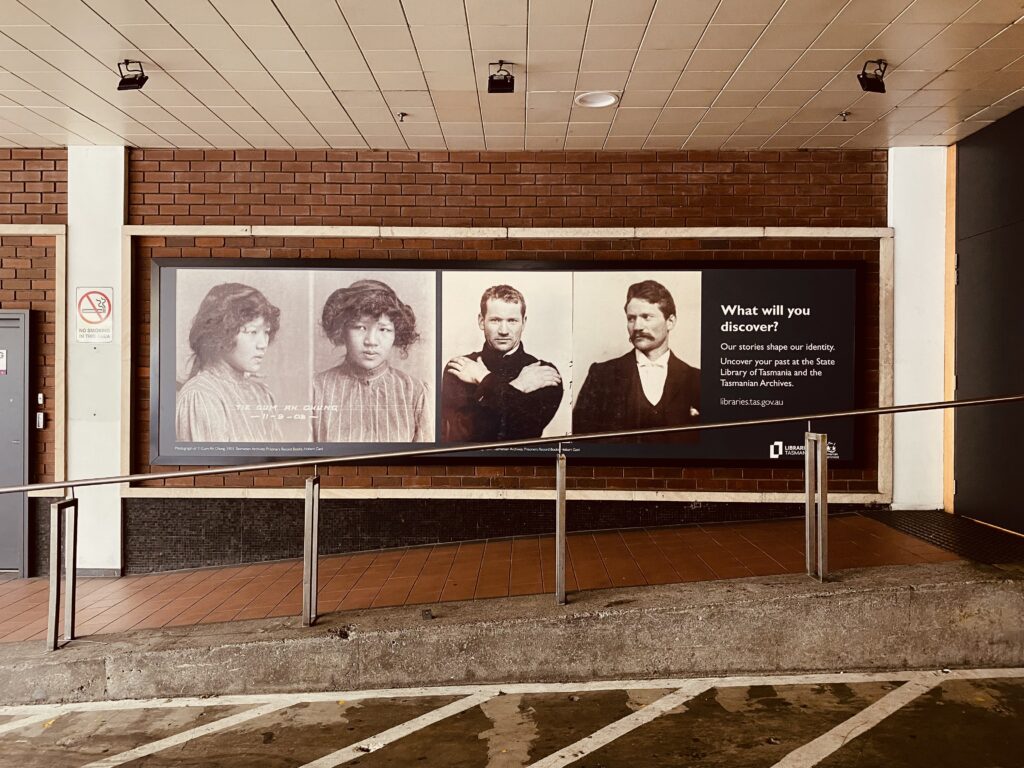
Colour photograph of a red brick wall with a large billboard on which there are old black and white portraits of an Asian woman and a white man, next to text advertising the State Library of Tasmania and the Tasmanian Archives
Billboard in the carpark of the State Library of Tasmania on the corner of Murray and Bathurst streets, Hobart, 7 November 2025. Photograph by Kate Bagnall

In this blog post I want to look into the history of Tie Cum Ah Chung, to see what can be uncovered about her life in Tasmania.


The obvious first place to look for information about Tie Cum Ah Chung is her prisoner record, which can be found through the Tasmanian Names Index (although under a slightly different spelling of her name).

The prisoner record notes that 18-year-old Tie Cum Ah Chung was first imprisoned for a month for larceny in September 1903, and then three months later she was imprisoned for another month for perjury. She was 5 foot 3 inches tall, single, had smallpox scars on her face, worked as a domestic, and apparently could not read nor write. Her native place was recorded as Yokohama, Japan, although the name of the ship that brought her to Tasmania was unknown. (Yokohama had a sizeable Cantonese population and a ‘Chinatown’, and I have come across other records of Chinese in Australia and New Zealand who stated their birthplace as being Yokohama – so this is not impossible!)

The Tasmanian Names Index brings up no other obvious records for Tie Cum, although there are, of course, other records for people with the name ‘Ah Chung’, including naturalisations, births, deaths, marriages and wills. Many of these records relate to the family of Chin Ah Chung and his wife Lily, whose descendants are still in Hobart today.

The next easy place to look for Tie Cum is in the historical newspapers in Trove, to see if there are any reports of her crimes, arrests or trials. ‘Ti Cum Ah Chung’ (in inverted commas) brings up two results, neither of which are what might have been expected – they relate to a shooting in Launceston late one Friday night in February 1906, which Tie Cum witnessed. She had been standing in York Street, near Storrer’s (an undertaker’s), talking to two young men at the time of the shooting, and she reportedly not only saw the victim but was threatened by the shooter and then warned passersby of the danger. Both articles referred to her as ‘Chinese’.

Searching under the variant spelling of her name – “Tie Cum Ah Chung” (in inverted commas) – yields some more results in the historical newspapers, with reports from September and December 1903 about her court hearings, and one further article about the 1906 shooting.

A month after the shooting, Tie Cum gave evidence at the trial, which was held at the Police Court in Launceston on Friday, 2 March 1906. Her evidence was reported under the heading ‘The Chinese Girl’. Tie Cum told the court she was a Christian, and she was sworn on the Bible. There was no mention of an interpreter, and she appears to have given her testimony in fluent English. Her evidence tallied with the earlier press reports of her involvement – she had been standing on the corner of York and St John’s streets with Albert Brooks and Alfred Grant when the events took place; interestingly she also stated that she knew two of the policemen involved in the case, one from her time in Hobart ‘before I came up here’.

What then of her own petty crimes? On Friday, 11 September 1903, the Tasmanian News (Hobart) reported:

A CHARGE of LARCENY. Tie Cum Ah Chung, a young Japanese woman, was again before the Court, charged with stealing 21b of biscuits from Mrs Meredith, of Harrington street. Accused was defended by Mr Davenport Hoggins (Hoggins and Gilmore). After hearing evidence, accused was found guilty and sentenced to a month’s imprisonment. An application by counsel for his client to be treated under the First Offenders Act was refused, Mr Shaw stating that the Act was never intended for persons of accused’s character. She had been before the Court several times under disreputable circumstances, and a short term of imprisonment would perhaps give her time to think over her position and probably—though he was afraid not—lead to her reform. The Court then rose.

Three months later, on Tuesday, 15 December 1903, the Tasmanian News (Hobart) further reported:

PERJURY. Tie Cum Ah Chung pleaded guilty to having committed wilful and corrupt perjury at the City Police Court, Hobart, where, being charged with the larceny of a couple of pounds of biscuits from a shop in Argyle street, she elected to give evidence on her own behalf. Prisoner was defended by Mr C. Davenport Hoggins (Hoggins and Gilmore). Mr Hoggins made a strong appeal for leniency, and said the Salvation Army was prepared to take the woman in hand. His Honor imposed a sentence of a month’s imprisonment.

I also tried searching Trove Newspapers using some other variations of her name (Ti/Tie/Tye/Tei and Come/Chum, as well as just Ah Chung), refining the search using parameters like date range and place, with some further success. My other go-to place for researching Chinese Australians in the early twentieth century is RecordSearch (National Archives of Australia), but no records about her obviously come up under variations of the name Tie Cum Ah Chung.

Most of the other newspaper reports I found about Tie Cum were repeats of the information about her larceny and perjury convictions, and the Launceston shooting, including one that includes a more detailed account of her biscuit theft from Mrs Meredith’s shop. One other that piqued my interest was from the Hobart Mercury in July 1903, three months before the theft:

City Police Court. – On Thursday, before the Police Magistrate (Mr. B. Shaw) and Mr. A. Riddoch, J.P. …Two young women named Elsie Hardwicke and Ti Chum Ah Chung pleaded guilty to disturbing the peace in Elizabeth-street by assuming a pugilistic attitude. The former was fined 25s., and the latter, who was a first offender, 5s.


The circumstances of Tie Cum’s life as recorded in these few easily found records seem really quite remarkable – from what I am learning about Tasmania’s early Chinese community, there are many remarkable stories of women and families to be uncovered!

‘Melbourne Ghost Signs’ researcher Sean Reynolds has delved into Tie Cum’s history, too – she apparently left Tasmania for Victoria not that long after these events – and for her story in later life (as Sean has been able to piece together), you might have a look at his creatively (flamboyantly?) written blog post, Otherwise, Yokahama, or listen to his Royal Historical Society of Victoria podcast episode of the same name (embedded below). Note that I haven’t closely reviewed Sean’s research, but on the surface it seems to largely hold together; it’s just perhaps a little fanciful about her origin story.

What then of Tie Cum’s early life? How and when did she come to Tasmania? Was she really born in Yokohama? And was she connected in any way to the Ah Chung family that I know?

My first tantalising clue has come in the form of a newspaper report in the Hobart Mercury in May 1898, located in a search for ‘Chinese girl’ in Tasmanian newspapers, which reported an accident in Hobart involving a fourteen-year-old Chinese girl named ‘Tarcum’:

Accident. – Yesterday evening, as a butcher’s waggon was being driven along Melville street, a Chinese girl named Tarcum, aged 14, who was playing on the footpath with some other children, ran on to the road, and got on the vehicle. Just then a sudden jerk caused her to fall, and the hind wheel ran over her. She was severely injured, and subsequent to being called to her mother she was conveyed to the hospital and admitted. The extent of her injuries has not been ascertained.

This Chinese girl, ‘Tarcum’, was aged fourteen in 1898, and Tie Cum Ah Chung was aged eighteen in 1903, which broadly tallies. Could they therefore be the same person? I think it’s a real possibility! If so, she was born in about 1884 or 1885.

The 1898 article mentions that Tarcum was called to her mother after being injured, suggesting that she came to Tasmania with her family; if she was Tie Cum Ah Chung, a Tasmanian childhood would account for Tie Cum’s fluency in speaking English (as suggested by her 1906 court testimony).

So, here is my crazy theory, which makes sense with the limited evidence I have to date.

The only ‘Ah Chung’ family with a Chinese mother that I know of in Hobart in the 1890s was that of Chin Ah Chung (carpenter / cabinetmaker, later fancy goods storekeeper) and his wife Kim Wing aka Lingo, later known as Lily. Kim Wing came to Hobart in about 1892, aged in her mid to late teens, and she was known to have had her feet bound in childhood. She was befriended by white women in Hobart who taught her to speak English, and she was remembered as speaking without an accent.

We know that other Chinese wives coming to Tasmania around that time were accompanied by companions or maids (e.g. Lula Mon Chinn and Fanny Lee Fook). Is is possible then that Tie Cum was a mui tsai or maid who accompanied Kim Wing to Tasmania? She would have been perhaps 10 years younger than Kim Wing, although it’s hard to get a firm grip on their exact ages. There is no family memory of Kim Wing having migrated with a maid servant, but information about her early life is also scant. I think this arrangement would have been more likely than her being Kim Wing’s daughter, as the age difference was too close.

I hope that as time goes on I will be able to make more sense of Tie Cum’s early story in Tasmania in the 1890s and early 1900s, and either confirm or disprove my crazy theory. Whatever her story, it seems she was among the earliest, and most intriguing, immigrant Chinese women to call our island state their home.


UPDATE 14 November 2025: There goes that theory! Today I came across a snippet from the Mercury on 9 September 1903 that reads: ‘Tie Come Ah Chung is nothing to do with Ah Chung in Elizabeth-street whatever.’ This was around the time 18-year-old Tie Cum was getting into trouble in Hobart.
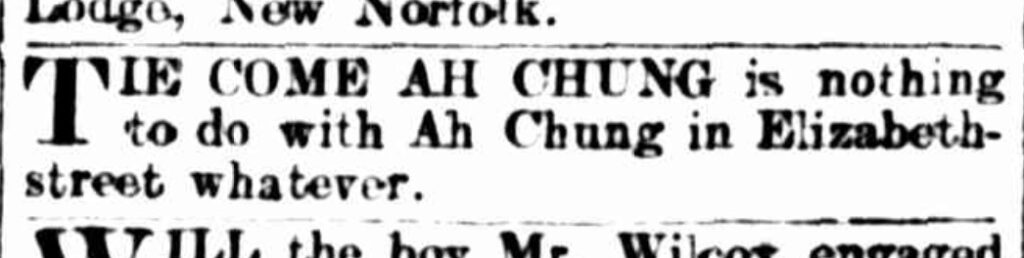
Small classified advertisement from a newspaper that reads TIE COME AH CHUNG is nothing to do with Ah Chung in Elizabeth-street whatever

‘Ah Chung in Elizabeth-street’ is Chin Ah Chung, mentioned above. I guess it is possible that the Ah Chungs were distancing themselves from Tie Cum because of her disreputable behaviour, but I think for now I will put aside my theory that she came to Hobart with Kim Wing.

FURTHER UPDATE later the same day: Ha, I was right after all! Tie Cum was associated to the Ah Chung family of Elizabeth Street, Hobart! I came across another little snippet in the Mercury in August 1900, a classified inserted by Ah Chung, that reads:

MRS. QUIN, late of Garibaldi, having been residing with me for three months, went away on Wednesday night last without any cause, taking with her Tie-Com, my servant. I will not be Responsible for their actions or any debts contracted in my name. AH CHUNG, 102 Elizabeth-street, Hobart.
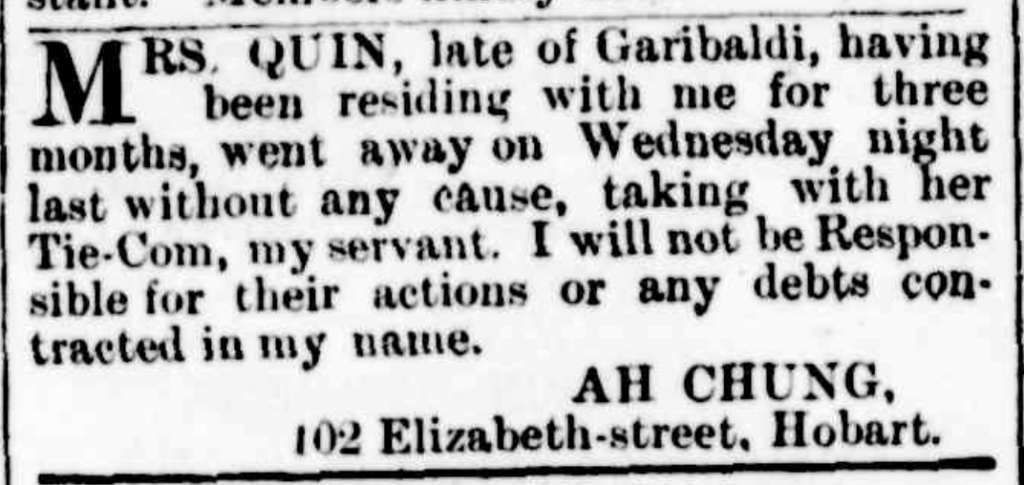
Clipping of a newspaper classified advertisement placed by Ah Chung of Hobart


One final find for today is perhaps less exciting, but it does provide one more little clue about Tie Cum in Tasmania.

In October 1905, the complainant in a maintenance case, Emily Maria Deeks, stated that:

when in Hobart she was living in Harrington-street as the housekeeper of a Mr Lung [and going by the name of Mrs Lung]. There were also in the house Mr Bowring, Mr Spurling, and a Chinese woman.

We know that at the time of her arrest in 1903, Tie Cum was working as a domestic (according to her prisoner record) and also that she was publicly disowned by Ah Chung that same year. So it would make sense for her to be the ‘Chinese woman’ mentioned by Emily Maria Deeks as also residing in the house of Mr Lung, presumably working as a domestic. Again, there is nothing concrete here to say this was Tie Cum, but given the circumstances it is very possible.

AND ONE FURTHER UPDATE: Just to document the last piece of evidence I’ve found so far that is possibly about Tie Cum in Tasmania – a search in Trove Newspapers for ‘Ah Chung’ turned up the report of a fire at Ah Chung’s premises at 162 Elizbeth Street on 21 March 1898. The article noted that at Ah Chung’s house, ‘there were four Chinamen, a woman and a girl’. If this was the right Ah Chung (still to be confirmed), then could the girl be Tie Cum? Bear in mind that by this stage Chin Ah Chung and Kim Wing (later known as Lilian Ah Chung) had two young sons: Royden (born 1894) and Tasman (born 1896). It is also unlike the colonial press not to mention the race of the woman and girl if they too were Chinese.


References

Prisoner record of Ti Cum Ah Chung, 1903, p. 2594, Prisoners Records Books, GD63/1/3 (Book No. 5), Tasmanian Archives, https://libraries.tas.gov.au/Digital/GD63-1-3-P117

‘Outbreak of fire’, Tasmanian News, 21 March 1898, p. 2, http://nla.gov.au/nla.news-article173663941

‘Marshalling of reinforcements’, Mercury (Hobart), 25 May 1898, p. 2, http://nla.gov.au/nla.news-article9422776

‘Advertising, Mercury (Hobart), 4 August 1900, p. 3, http://nla.gov.au/nla.news-article12806313

‘Advertising’, Tasmanian News (Hobart), 4 August 1900, p. 3, http://nla.gov.au/nla.news-article185243364

‘Advertising’, Mercury (Hobart), 9 September 1903, p. 5, http://nla.gov.au/nla.news-article12256286

‘City Police Court’, Tasmanian News (Hobart), 11 September 1903, p. 2, http://nla.gov.au/nla.news-article176656230

‘The Mercury’, Mercury (Hobart), 31 July 1903, p. 5, http://nla.gov.au/nla.news-article12267780

‘Parliamentary notes’, Mercury (Hobart), 9 September 1903, p. 4, http://nla.gov.au/nla.news-article12256346

‘A Jap in trouble’, Examiner (Launceston), 12 September 1903, p. 5, http://nla.gov.au/nla.news-article35563231

‘Tasmania’, Daily Telegraph (Launceston), 12 October 1903, p. 5, http://nla.gov.au/nla.news-article153903661

‘A charge of perjury’, Tasmanian News, 13 October 1903, p. 3, http://nla.gov.au/nla.news-article176658147

‘Second Court’, Tasmanian News (Hobart), 15 December 1903, p. 6, http://nla.gov.au/nla.news-article176661915

‘Criminal Court’, Daily Telegraph (Launceston), 16 December 1903, p. 4, http://nla.gov.au/nla.news-article153902132

‘Criminal Court sitting’, The North Western Advocate and the Emu Bay Times, 16 December 1903, p. 2, http://nla.gov.au/nla.news-article64651150

‘Tasmania’, Zeehan and Dundas Herald, 16 December 1903, p. 4, http://nla.gov.au/nla.news-article83719094

‘Domestic Unhappiness’, Daily Telegraph (Launceston), 28 October 1905, p. 6, http://nla.gov.au/nla.news-article154020620

‘Statement by Jackson’, Examiner (Launceston), 3 February 1906, p. 9, http://nla.gov.au/nla.news-article38071562

‘The shooting sensation’, Daily Telegraph (Launceston), 5 February 1906, p. 5, http://nla.gov.au/nla.news-article151822259

‘The shooting sensation’, Daily Telegraph (Launceston), 3 March 1906, p. 9, http://nla.gov.au/nla.news-article151823245

Sean Reynolds, ‘Otherwise, Yokohama’, Melbourne Ghost Signs [blog], 10 July 2024, https://web.archive.org/web/20251107061531/https://melbourneghostsigns.substack.com/p/otherwise-yokahama

‘Joss and Chinese festivities’ – Weldborough, Tasmania, 1884

Kung hei fat choi! 恭喜發財! Happy new year!

As we enter the Year of the Dragon in 2024, here’s a look back at how the Chinese community in the tin mining settlement of Thomas’ Plains (also known as Weldborough), Tasmania, celebrated New Year in 1884 – one hundred and forty years ago.

The report by ‘Miner’, published in the Hobart Mercury on 6 February, 1884, includes a mention of the joss house at Weldborough. This temple was only newly opened at the time of writing, and it remained in use until 1934. Today, its contents, and those of five other nineteenth-century joss houses from the north-east of Tasmania, make up the Guan Di Temple (關帝廟) at the Queen Victoria Museum & Art Gallery in Launceston.


‘On first pitching my tent within the margin of this sunny oasis of the forest, I little thought eight years hence its echoes would be awakened by the discordant jinglings of a Chinese orchestra; but so it is, and the year 1884 of the Christian era, and the ninth year of the reign of Tsai-Tien, Emperor of China, leave an established epoch in the history of Weldborough.

Wooden plaques either side of the entrance to the Guan Di Temple in Launceston, which originally came from the joss house in Weldborough (QVM.1990.H.0193 and 0195; photograph by Kate Bagnall, September 2020)

Like most mining settlements, we, too, have passed through a series of perplexing ups and downs since the year 1875. So great, indeed, are the changes through which we have entered as to make us often somewhat doubtful of our position. Many who came here as the pioneers of our tin mines have retired from the field, some to rest upon their gains, and others, to toil afresh in pastures new; and some, I regret to think, are numbered with the past. What with births, deaths, and marriages, and earthquakes, we are induced to review the principles of cause and effect.

Both morally and physically we indicate a transition : the Celtic and Saxon blendings are fast yielding to the strongly-marked tendencies of the Mongolian. This is seen in all our public and festive gatherings, but strongly so in the large brood of almond-eyed, olive-cheeked urchins attending our day school. If there is any truth in the tenet advanced by many of our philosophers, touching Nature’s fiat on the ‘surviance of the fittest’, John, here, may be said to be in the ascendant, since he has driven the European from the field, and is now master of his position. …

We are now in the midst of the high festivities of their new year. There is one continual round of feasting, music, fireworks, and Joss ceremonials. There must be fully 300 men congregated within the camp, all living in the highest state of enjoyment, for the time being all things seem to be held in common, even the barbarous European is present again and again to partake of their dainties, consisting of pork, fowls, and rice, with oceans of oil and other celestial condiments.

There is one very noticeable feature brought out in John’s feastings, he does not forget his god. The inevitable pig is roasted whole, and borne as an offering to the altar, amid the burning of incense, the clashing of cymbals, prostrations, prayers, incantations, and a crackling blaze of fireworks, after which it is returned to render a more substantial service, as the sacred tit-bits of another feast.

Whatever may appear the architectural frailties of our Chinese dwelling places, which may be said to consist for the most part of palings, poles, and rice-bags, they have spared no expense in embellishing and decorating their Joss House, which may be said to glitter with adornments. The altar-pieces, and symbolical carvings, and gilding, and painting on glass, show much artistic skill and cleverness; but, alas! to what strange purposes employed. …

Yours, etc., MINER
Thomas’ Plains, February 1, 1884.’

The Hung family of Lefroy, Tasmania

Peter Cox’s local history of the former gold-mining town of Lefroy in north-eastern Tasmania, Lefroy: Tasmania’s Forgotten Gold Town (George Town and District Historical Society, 2016, p. 90), mentions a market gardener named Ah Hung, who with ‘his European wife Jemma’ had a large vegetable and fruit garden to the north of Lefroy, ‘on the old Douglas township site’.

Douglas was a town that never eventuated, about four kilometres east of Lefroy. By contrast, Lefroy was once a substantial town, reputed at one point to have been the fourth largest town in Tasmania. There was a notable Chinese community in Lefroy, including a temple. Today, there are only a few houses remaining.

Chinese miners occupy their own chapter of Cox’s study (Chapter 3, ‘Chinese and Slate’), but Jemma and Ah Hung receive only the one brief, unreferenced mention in Chapter 10 (‘The Peak of the Boom’). On a recent holiday in the East Tamar district, I set out to see what I could find out about them.

Jemima Cox and Ah Hung married in Launceston in 1875. She had come to Tasmania as a small child, after migrating with her family from Hertfordshire, England in 1856. Jemima and Ah Hung had three children, born in the early 1880s, Henry, James and Mary, and they lived on land owned by Jemima at Douglas, near Blanket Creek outside of Lefroy, where they ran a garden. Ah Hung died in 1904, after which time it seems that Jemima moved to Launceston with her eldest son, Henry. They lived in Forster Street, Inveresk, and Henry was a gardener like his father (and Jemima’s father, too). Jemima died in 1923, at age 74, in Broken Hill, New South Wales, where she was living with son Henry – she had been in Broken Hill for four months.

The town of Lefroy, Tasmania (George Town and District Historical Society, GTH_HS0194, https://eheritage.libraries.tas.gov.au/resources/detail0f3f.html?ID=GTH_HS0194)

Below is a chronology of the information I uncovered through Trove Newspapers, the Tasmanian Names Index, the NSW Registry of Births, Deaths and Marriages, Ancestry.com, General Register Office UK, Broken Hill Cemetery website, and maps from the National Library and Libraries Tasmania (thanks to Imogen Wegman for the latter reference). There are many leads that could be followed up about the life of Jemima and Ah Hung and their children, and I’ve noted some of these for future reference!

Chronology

c. 1835–1846: Ah Hung was born.

1850: On 13 September 1850, Jemima Elizabeth Cox was born in at Nancy Bury, Tewin, Hertfordshire, England, the daughter of Daniel Cox and Mary Gregory. Her father was a woodman and her mother signed with an ‘X’.

Birth of Jemima Elizabeth Cox, Oct-Nov-Dec 1850, Hertfordshire, Vol. 6, Page 547, FreeBMD, England & Wales, Civil Registration Birth Index, 1837-1915 [database online], Ancestry.com.

Birth registration of Jemima Elizabeth Cox, December Quarter 1850, Hertford Union, Vol. 6, Page 547, General Register Office, United Kingdom.

1851: The family of Daniel and Mary Cox was listed in the 1851 England Census as living at Nancy Bury, Tewin, in Hertfordshire, England. The household consisted of Daniel (farmer labourer, age 32, born Tewin), Mary (housewife, age 26, born Codicote), Daniel (age 4) and Jemima (age 7 months).

Census record for Daniel Cox and household, Tewin, Hertfordshire, England, Class HO107, Piece 1711, Folio 170, Page 26, 1851 England Census [database online], Ancestry.com.

1856: On 5 February, Daniel and Mary Cox and their children arrived in New South Wales as assisted immigrants on the James Fernie. The Cox children were 7-year-old Daniel, 5-year-old Jemima, 2-year-old Joseph and a male infant born on board.

Assisted immigrants records for Daniel Cox, Mary Cox and Daniel, Jemima and Joseph Cox, arrived on James Fernie, 1856, Assisted Immigrants Index 1839–1896, NSW State Archives and Records.

Passenger list for the James Fernie, arrived Sydney on 5 February 1856, New South Wales, Australia, Assisted Immigrant Passenger Lists, 1828-1896 [database online], Ancestry.com.

1869: Jemima Cox gave evidence in a case about trespass on the land that her father, Daniel Cox, rented in Glen Dhu Street, Launceston.

‘Trespassing on Land’, The Cornwall Chronicle (Launceston), 27 November 1869, p. 5, http://nla.gov.au/nla.news-article65988017.

1875: Jemima Cox and Ah Hung were married at the Wesleyan Church in Patterson Street, Launceston, by the Rev. E.W. Nye. Jemima was incorrectly said to be a native of Tasmania, aged about 25 years old, and she was still living with her parents at Cataract Hill. Ah Hung was described as a ‘middle aged man’.

They were married on 13 May 1875. He was recorded as being aged 29 and she was 25. He was a bachelor and she was a spinster. He was a miner and she was a gardener’s daughter.

‘Another Chinese Benedict’, The Cornwall Chronicle (Launceston), 14 May 1875, p. 2, http://nla.gov.au/nla.news-article66073314.

Reprinted as: ‘Fifty Years Ago’, The Mercury (Hobart), 16 May 1925, p. 12, http://nla.gov.au/nla.news-article23817025.

Tasmanian Names Index, Ah-Hung and Jemima Cox (Marriage), 13 May 1875, Tasmanian Archives, RGD37/1/34 no 503, https://stors.tas.gov.au/RGD37-1-34$init=RGD37-1-34P266.

Tasmanian Names Index, Ah-Hung and Jemima Cox (Marriage), 13 May 1875, Tasmanian Archives, RGD37/1/34 no 503, https://stors.tas.gov.au/RGD37-1-34$init=RGD37-1-34P266.

c. 1880: Henry Charles Hung, son of Jemima Cox and Ah Hung, was born in Tasmania.

c. 1882: James Hung, son of Jemima Cox and Ah Hung, was born in Tasmania.

c. 1884: Mary Hung, daughter of Jemima Cox and Ah Hung, was born in Tasmania.

1889: The premises of Ah Hung at Lefroy were robbed on Tuesday, 3 September 1889, and £75 in gold and silver was stolen. The theft was not discovered until 5 September. The main suspect was another Chinese man.

‘Tasmanian News’, The Tasmanian (Launceston), 7 September 1889, p. 25, http://nla.gov.au/nla.news-article200288906.

1892: Jemima Hung was recorded as the owner of 2 acres, 0 roods and 31 perches of land on the main road from Lefroy to Back Creek, close to Blanket Creek.

A 1973 Tasmanian Department of Mines map of Lefroy still noted that the land is owned by J. Hung.

‘Map – Douglas D32’ (AF819-1-82), Printed Town Charts (AF819), Land and Surveys Department, Tasmanian Archives, https://stors.tas.gov.au/AI/AF819-1-82.

‘Lefroy’, Tasmania mineral chart series, Tasmania Department of Mines, Hobart 1973, http://nla.gov.au/nla.obj-668738343.

Detail of 1892 map of Douglas, Tasmania, showing Jemima Hung’s land on what is now Douglas Road (Tasmanian Archives AF819-1-82)

1901: An article in April about ‘Crown Land Sales’, under the heading ‘Town Lands’, mentioned land in the town of Douglas ‘fronting on the road to Back Creek, opposite land purchased by H. Ah Hung’.

‘Crown Land Sales’, Daily Telegraph (Launceston), 15 April 1901, p. 4, http://nla.gov.au/nla.news-article153962637.

1904: James Hung, ‘a Chinese gardener’, went missing from his home near Lefroy at the beginning of February and had still not been found several days later.

‘Launceston’, The North Western Advocate and the Emu Bay Times, 4 February 1904, p. 3, http://nla.gov.au/nla.news-article65130652.

1904: James Hung returned home on Thursday, 4 February; he had been reported missing from Blanket Creek near Lefroy. He was said to be in a weak state.

‘Current Topics: Returned Home’, Examiner (Launceston), 6 February 1904, p. 4, http://nla.gov.au/nla.news-article35790680.

This land on Douglas Road at Lefroy, near Blanket Creek, was owned and occupied by the Hung family in the late nineteenth century. On the land there are two old fruit trees, possibly apples. (Photograph by Kate Bagnall, October 2020)

1904: On 6 February 1904, Mr and Mrs Hung of Lefroy placed a notice in the Launceston newspaper to thank people for searching for their son, James, who was lost in the bush.

‘Family Notices’, Daily Telegraph (Launceston), 10 February 1904, p. 1, http://nla.gov.au/nla.news-article153921840.

Google Earth satellite image showing the boundary of Jemima Hung’s property at Douglas, Tasmania (Created by Tim Sherratt, October 2020)

1904: Ah Hung, aged 69, died at his home at Lefroy on 23 October 1904 after a long and painful illness. He was the ‘dearly beloved husband’ of Jemima Ah Hung.

‘Family Notices’, Daily Telegraph (Launceston), 25 October 1904, p. 1, http://nla.gov.au/nla.news-article153825631.

‘Family Notices’, Daily Telegraph (Launceston), 25 October 1904, p. 1, http://nla.gov.au/nla.news-article153825631.

1910: Mrs J. Hung of Melbourne Street, South Launceston, won the ‘Robur’ Tea Ticket Collecting Competition for February 1910 and her name was listed in a Launceston newspaper (under ‘3/6 Rewards’ in the first column).

‘Advertising’, Examiner (Launceston), 26 March 1910, p. 9, http://nla.gov.au/nla.news-article50412200.

1913: Mrs Jemima Hung was listed in the Post Office Directory as living at Forster Street, Inveresk, on the righthand side from Invermay Road after Goderich Street.

Tasmania Post Office Directory for 1913–14, H. Wise and Co., Hobart, p. 154, Ancestry.com. Australia, City Directories, 1845-1948 [database on-line]. Provo, UT, USA: Ancestry.com Operations, Inc., 2015.

1914: Mrs Jemima Hung (domestic duties) and Henry Charles Hung (gardener) were living in Forster Street, Inveresk.

Electoral Roll, Tasmania, 1914, Bass, Launceston North, p. 25, Ancestry.com. Australia, Electoral Rolls, 1903-1980 [database on-line]. Provo, UT, USA: Ancestry.com Operations, Inc., 2010.

1915: Mrs Jemima Hung was listed in the Post Office Directory as living at Forster Street, Inveresk, on the righthand side from Invermay Road after Goderich Street.

Tasmania Post Office Directory for 1915–16, H. Wise and Co., Hobart, p. 152, Ancestry.com. Australia, City Directories, 1845-1948 [database on-line]. Provo, UT, USA: Ancestry.com Operations, Inc., 2015.

1922: Jemima Hung (domestic duties) and Henry Charles Hung (gardener) were living in Forster Street, Inveresk.

Electoral Roll, Tasmania, 1922, Bass, Launceston North, p. 31, Ancestry.com. Australia, Electoral Rolls, 1903-1980 [database on-line]. Provo, UT, USA: Ancestry.com Operations, Inc., 2010.

1923: Jemima Hung died at Broken Hill, New South Wales (father Daniel, mother Mary).

New South Wales Registry of Birth, Death and Marriage, death of Jemima Hung, 3771/1923.

Death registration of Jemima Hung, Broken Hill, New South Wales, 10 January 1923 (NSW Registry of Birth, Death and Marriage, death of Jemima Hung, 3771/1923)

1923: On 11 January 1923, Jemima Hung was buried at Broken Hill Cemetery in the Methodist section.

Broken Hill Cemetery Records Navigator, Burial Number 30291, Methodist Section (METH M4 Row 23A Plot 15), Buried 11 January 1923, http://www.bhcemetery.com.au/.

1923: Probate record for Jemima Hung, late of Broken Hill, New South Wales.

Tasmanian Names Index, Jemima Hung (Wills), 1923, Tasmanian Archives, AD963-1-4 (Will no. 3880), https://stors.tas.gov.au/AD963-1-4-3880$init=AD963-1-4-3880-1.

1947: ‘Half-caste Chinese’ James Hung, age 65, died. He was the brother of Henry Charles Hung of 53 Charles Street, Launceston. James Hung’s body was found at the bottom of a cliff in the Gorge on Saturday, 1 February 1947.

‘Body Over Cliff’, Examiner (Launceston), 3 February 1947, p. 2, http://nla.gov.au/nla.news-article60998659.

Things to follow up

  • Birth certificate of Jemima Elizabeth Hung ordered from the GRO.
  • Assisted immigrant record for Daniel and Mary Cox and family, 1856, ordered from NSW State Archives.
  • Passenger record for Cox family from Sydney to Tasmania, probably in mid-late 1850s.
  • Land purchase records for Jemima Hung’s land at Douglas near Lefroy, before 1892, and any other land purchase by the family.
  • Death registration for Ah Hung, 1904.
  • Marriage of Mary Frances Hung and James Quong in Tasmania in 1905 (1905/852) – is this Jemima’s daughter Mary, who was listed on her death certificate in 1923?
  • Birth of Edna Elizabeth Florence Quong, in Hobart on 13 October 1906 to James and Mary Frances Quong.
  • Reason for Henry Hung, and his elderly mother Jemima Hung, to have moved in c. 1922 from Launceston to Broken Hill.
  • Inquest record for the death of James Hung in Launceston in 1947.


Celebrating the birthdays of venerable elders

It’s the Year of the Tiger, and today’s my birthday. Four of us in my little family are tigers, born 1962, 1974, 1998 and 2010 (I’ll leave you to guess which year I was born).

With birthday thoughts in mind, here are a three stories celebrating the long lives of some early Chinese Australians.

George Moo-hong of Young

Market gardener George Moo-hong of Young celebrated his 104th birthday on 29 July 1954. He was born in around 1850 and arrived in Australia from China at the age of 25 (c.1875). In 1954 it was reported that he’d been living in the Young area for about 70 years.

Sydney Morning Herald, 30 July 1954

James Chung Gon of Launceston

Tasmanian patriarch James Chung Gon celebrated his 96th birthday on 23 July 1950; he was born c.1854. Chung Gon had started his life in Australia almost 70 years earlier, working as a tin miner then orchardist. He married in China, but his wife joined him in Tasmania and the couple had 11 children. The Tasmanian press noted the family’s celebration of the occasion, as it had each year since his 90th birthday.

Mercury, 22 July 1950

Willie Chung Sing of Hobart

Hobart resident Willie Chung Sing celebrated his 82nd birthday in late December 1945. Born in around 1863, he arrived in Tasmania as a young man in 1887, working for Ah Ham & Co. in Hobart, then running his own businesses in Launceston and Wellington (New Zealand), then once again returning to work as general manager at Ah Ham & Co. for 36 years. He made regular trips back to China, where his wife and children remained, and in 1946 was heading back again to rejoin his family.

Mercury, 3 January 1946