Category: Real Face of White Australia

Charlie Allen’s handprint

In this post, I tell the story of the boy whose handprint became an emblem for the Everyday Heritage project. The post was originally published on the Everyday Heritage website on 9 July 2024.
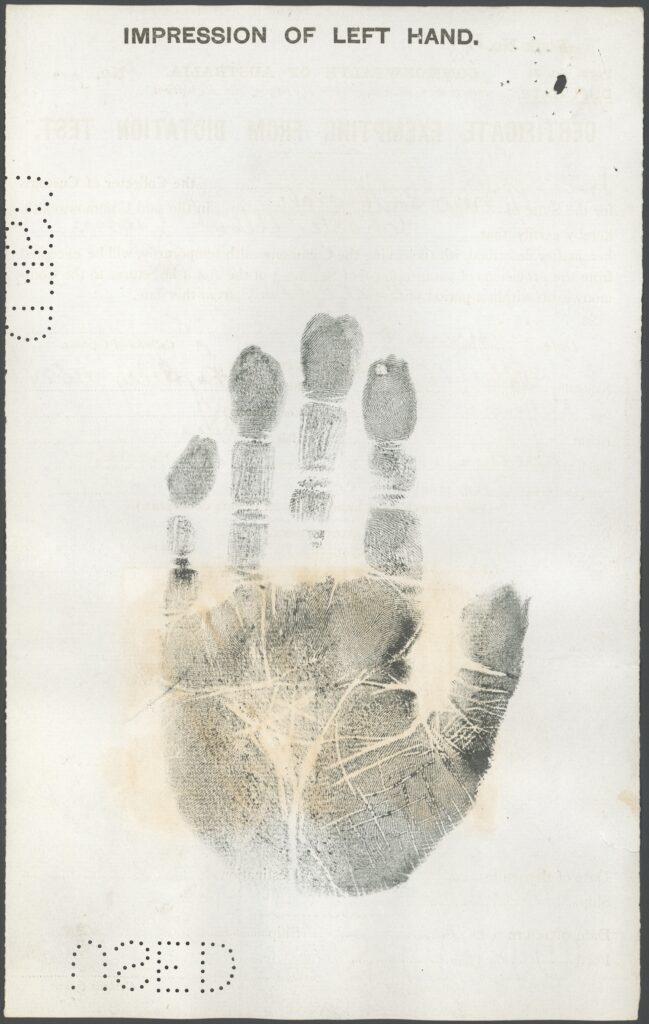
Back of Charlie Allen’s Certificate Exempting from the Dictation Test, which was issued before his departure from Sydney for China in June 1909. National Archives of Australia (Sydney): ST84/1, 1909/22/41-50

This handprint belongs to a 12-year-old boy called Charles Albert Allen.

Charlie, as he was known, was born in Surry Hills, Sydney, in 1896. His mother was Frances Allen, his father Charlie Gum.

Charlie was raised by his mother, but in 1909, at the age of 13, he was taken ‘home’ to China by his father.

Charlie Gum returned to Sydney soon after, leaving his son in China. Young Charlie lived with relatives in the Cantonese village of Chuk Sau Yuen for 6 years.

Charlie was homesick, but he had no means of getting back to Australia. His mother attempted to enlist the help of the Australian Government but to no avail.

Charlie finally returned in 1915 at the age of 18.

The following year Charlie enlisted in First AIF, the first of three attempts to serve his country. He was discharged as medically unfit each time.

Charlie married Maud Gordon in Surry Hills in 1917, and they had two daughters soon after. Charlie returned to China in 1922 for 7 months.

Charlie Allen died in 1938 as the result of an industrial accident at the Bunnerong Power Station where he worked. He was 41.

Charlie Allen’s handprint is found on the back of an identification document called a Certificate Exempting from the Dictation Test.

The certificate was issued by the New South Wales Collector of Customs in 1909 under Australia’s infamous Immigration Restriction Act. Today it is held in the National Archives of Australia in Sydney.
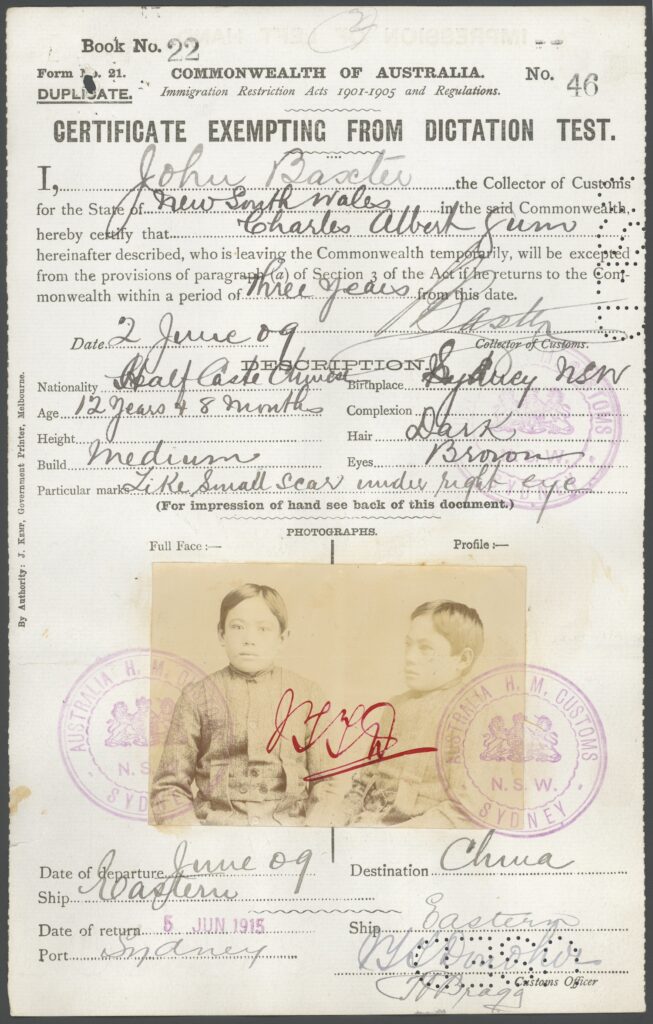
Front of Charlie Allen’s Certificate Exempting from the Dictation Test. NAA (Sydney): ST84/1, 1909/22/41-50

Charlie’s certificate, with its photographs and handprint, is one of tens of thousands of similar documents that were issued to ‘non-white’ Australians when they travelled overseas in the early twentieth century. These certificates allowed them to return home to Australia without sitting the infamous Dictation Test.

Every one of these certificates could be used to tell a story of how the everyday lives of Australian were affected by the White Australia Policy.

Among these many possibilities, the story of Charlie and his mother, Frances, particularly struck me, and I’ve written about them in an article that draws on methodologies of biography, microhistory, and family history. As well as his 1909 CEDT, the files in the archives include photographs of Charlie, and handwritten letters from him to his mother and from his mother to the Australian Government.

Charlie’s letters home from China are particularly significant. They provide a rare glimpse into the experiences and emotions of an Australian boy living in his own migrant father’s homeland. While many hundreds of young Australians of Chinese descent spent time in China across the late nineteenth and early twentieth centuries, first-hand accounts like Charlie’s are rare.

In 1910 Charlie was homesick and a long way from home. ‘Every minute I think of you, and long for a piece of bread and butter this tucker is not doing me well’, he wrote to his mother, before signing off with a flurry of kisses.

In 1911 Florence was missing her son dearly but was unable to get him back. In a letter to the Australian Government, she wrote: ‘Try and do your best to get my son returned back, to me, to Australia … do your best for his mother as I am nearly heart broken about him’.
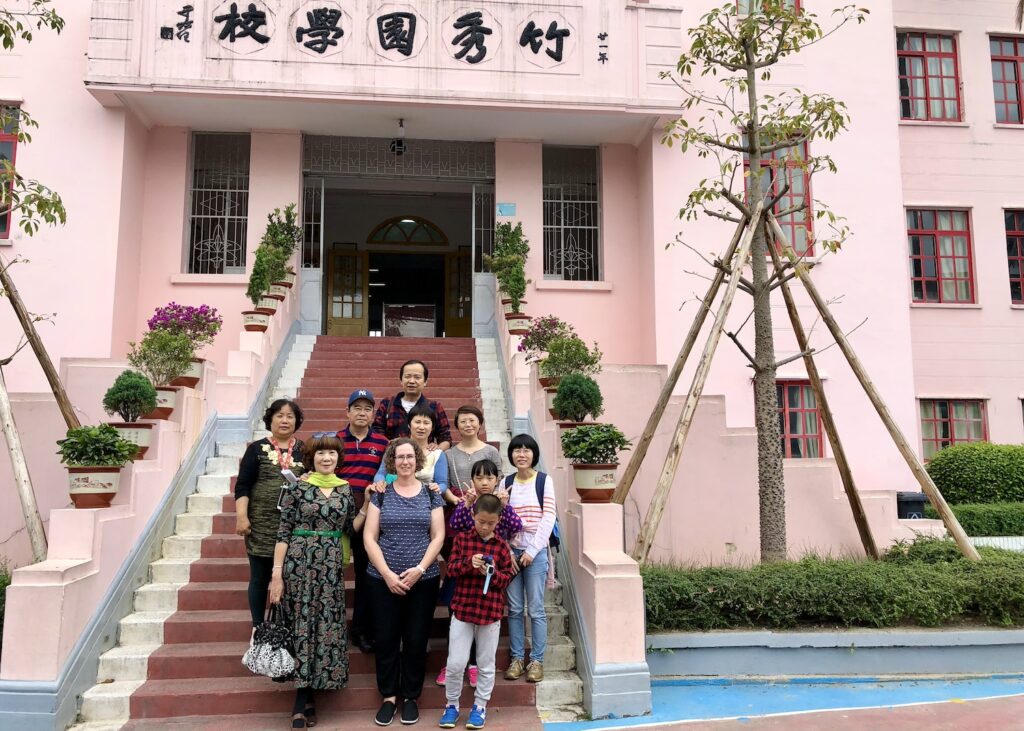
Kate Bagnall and friends on the steps of Chuk Sau Yuen School 竹秀園學校, Chungshan 中山, Kwangtong 廣東, an Australian ‘diaspora-funded school’ built in the early years of the 20th century, March 2019

Beyond the National Archives, I was able to trace the lives of Charlie and his parents, his wife and his children, piecing together fragments of their stories from written records – including birth, death and marriage records; shipping records; war service records; and newspapers – and visiting places significant to their lives, such as Chuk Sau Yuen village where Charlie lived in China, and his grave in Botany Cemetery.

Charlie Allen’s is one of the many ‘small lives’ that can be found in the archives. Telling the stories of lives like his – which are both ordinary and extraordinary – works to counteract dominant narratives – of who belongs and who matters – that continue in our nation’s history and heritage today.

These stories also touch the lives of everyday Australians. Charlie’s great grandson recently told me that memory of Charlie had almost faded within his family. But, having found the archival paper trail and my writing about Charlie’s life, they could now work keep his memory alive.

Further reading

Kate Bagnall, ‘Charlie Allen’s mystery aunt’, The Tiger’s Mouth (blog), 5 January 2021, https://chineseaustralia.org/charlie-allens-mystery-aunt/.

Kate Bagnall, ‘Writing home from China: Charles Allen’s transnational childhood’, in Paul Longley Arthur (ed.), Migrant Lives: Australian Culture, Society and Identity, Anthem Press, London, 2017. Open access version available at: https://zenodo.org/doi/10.5281/zenodo.10846849.

Kate Bagnall, ‘Anglo-Chinese and the politics of overseas travel from New South Wales, 1898 to 1925’, in Sophie Couchman and Kate Bagnall (eds), Chinese Australians: Politics, Engagement and Resistance, Brill, Leiden, 2015. Open access version available at: https://chineseaustralia.org/wp-content/uploads/2021/05/Bagnall_Anglo-Chinese-and-the-Politics-of-Overseas-Travel_Chapter-7.pdf.

Kate Bagnall, ‘ “I am nearly heartbroken about him”: Stories of Australian mothers’ separation from their “Chinese” children’, History Australia, vol. 1, no. 1, 2003, pp. 30–40. Available at: https://doi.org/10.1080/14490854.2003.11828254.

Charlie Allen’s mystery aunt

In letters that Charlie Allen wrote to his mother from China in 1911, he mentioned his ‘uncle’s wife’, who was, like him, trying to get home to Australia. Charlie had gone to live in Chuk Sau Yuen 竹秀園 near Shekki 石岐 in Heungshan 香山 in mid-1909, at the age of twelve, leaving behind his mother and siblings in Sydney. His father, Charley Gum, had taken him to China but had then returned to work in Sydney. His parents were no longer together and Charlie’s mum, Frances Allen, had not wanted her son to go to China.

I’ve written elsewhere about Charlie, his mum and the letters he wrote to her from China. They are a poignant account of Charlie’s loneliness and homesickness – he was a boy far from home and family, living in an unfamiliar place and learning a new language, with no easy way to leave. One hopeful thread in two of the letters, written in 1911, was the thought of returning to Sydney with his ‘uncles’ wife’ and her children.

He wrote about this idea in a letter dated 11 April 1911:

My uncle’s wife got a letter to-day from her sister say that if she wanted money to write & ask for it so she is going to send for 40 pound & she is going to pay my fare to sydney, & when we get to sydney she wants you to pay her back, & wants to know do you like this or not. so write back & tell me so I am now writing to custom house & sending photo & asking him for my paper to go back.

Extract of a letter from Charlie Allen to his mother, Frances Allen, 11 April 1911, NAA: SP42/1, C1922/4449

In a subsequent letter, written when Charlie had been in Chuk Sau Yuen for nearly two years (so perhaps around June 1911), he wrote:

My uncles’ wife said that she will pay my fare back to Sydney when I get there for you to give back my fare to her, or send Sam for me, & she told me to ask you would you like it or not you can please your self, mother I am very unhappy here.

And later in the same letter:

My uncle is going back to Sydney soon & as soon as he goes his wife is going to sneak away, she has 4 children & she would have a lot of trouble with them so I ask her to pay my fare back to & I would help her with her children & luggage & when we get back for you to pay her back my fare so I am writing this letter to ask you weather you like it or not, when she gets there she will stay at your place until she writs to her parents saying that she is home & tell them what to do.

I have long wondered who Charlie’s ‘uncle’s wife’ and her four children were, but without a name I thought it unlikely that I’d ever be able to establish their identity.

I’ve tried to solve a similar mystery in the case of another Sydney boy in China, Richard Lee, who, in newspaper reports, gave the name of a white Australian woman (‘Mrs Gee Chong’) that he knew and spent time with while living in his father’s village in Heungshan (the village was ‘Chuk-to-in’, which may or may not be the same village Charlie Allen lived in – another long-term, as-yet-unsolved puzzle!). In Richard Lee’s case, despite some substantial digging, I haven’t been able to identify who ‘Mrs Gee Chong’ was, even with a name, and so with Charlie’s ‘uncle’s wife’ I had given up any hope of identifying her.

A serendipitous breakthrough!

Recently, though, I’ve had a serendipitous breakthrough. Tim has been doing some updates to our Real Face of White Australia project, re-harvesting and processing the portrait photographs from NAA: ST84/1. As he does so, we’ve been looking through the images to see if we can spot any ‘new’ women and children – and one of those Tim spotted was this little poppet in her distinctive frilly bonnet:

Alice Yin, 1909, NAA: ST84/1, 1909/33/51-60

The certificate to which the photographs are attached – a 1909 CEDT for Charlie Yin – reveals that she is Alice Yin, aged one year and six months, and that she was leaving Sydney with her father and siblings. Her elder brother, Norman (aged three years and four months), and sister, Alma (aged 5 years and four months), were issued with their own CEDTs. Norman and Alma were both recorded as being ‘half-caste Chinese’ born in Mungindi, New South Wales. The family left Sydney on the Empire in October 1909; Charlie Yin returned to Sydney on the Empire on 16 August 1911 while the children returned three years later, on 30 October 1914 on the Eastern.

Further investigation revealed that a ‘C’ file in series SP42/1 still exists for the family, and it was here that I struck gold.

The file revealed that Alma, Norman and Alice Yin were the children of Charlie and Annie Yin, and had been born at Bumbalar, Mungindi in 1904, 1906 and 1908. Their father Charlie, a gardener, was from Canton while their mother, Annie (née Campbell), was also born at Mungindi. Charlie and Annie had married at Bumbalar on 16 July 1903, when Annie was aged 18 and Charlie was 29.

NSW birth certificate of Alice Yin, 1908, NAA: SP42/1, C1914/6345

Charlie had applied for CEDTS for himself and for the children to travel to China in 1909, and as noted, he had returned to Australia in 1911. In 1912, he wrote to the Collector of Customs, through Wing On & Co., requesting an extension of the children’s CEDTs ‘as they have not yet completed their schooling’. Charlie was then living at Eastern Road, Turramurra in Sydney. The extension was granted, providing the fee of £1 each was paid. Charlie then applied for another CEDT for himself in February 1914, and he departed Sydney for Hong Kong on the Taiyuan on 20 March 1914.

The next document in the file is a two-page letter addressed to the ‘Commissioner of Customs, Sydney’ from the Archdeacon of Hong Kong, dated 8 October 1914, requesting attention to the case of Mrs Yin née Campbell. The letter stated that after travelling together to China:

her husband himself returned to Sydney leaving his wife and family in the Heung Shan district, about one day’s journey from Hongkong. Subsequently he came back to China and died on June 2nd last. … Another son, Hubert (Huey) was born on 11th June 1911.

She holds no papers for this child of three years but as it is impossible for her as an Australian woman to live in China now that her husband is dead without suffering untold hardships, she is most anxious to return to her own people at Moree.

… this woman has been most harshly dealt with since her husband’s death as is unfortunately too often the custom in such cases. By careful manoeuvring she has managed to escape from her husband’s village with the children, and to return there would be fatal.

(On the experiences of Australian wives of Chinese in China, see my ‘Crossing oceans and cultures’ chapter in Australia’s Asia – details in References below.)

When the family arrived back in Sydney at the end of October 1914, Annie Yin and her three Australian-born children were allowed to land without question. Little Huey’s case, however, was referred to the Secretary of the Department of External Affairs for decision, as he was born in China; ten days later, permission was granted for him to remain in the Commonwealth.

Do the facts match?

Alice Yin née Campbell had travelled with her three children and husband to her husband’s village in Heungshan in 1909 and gave birth to a fourth child there in June 1911, after which time her husband returned to Australia (in August that year). Charlie Allen wrote, in around June 1911, that his ‘uncle’s wife’ was keen to return to Australia with her four children and that her husband was soon to return to Australia. So, they were in China at the same time, there were the right number of children, but were they in the same village?

Charlie Allen’s father, Charley Gum was a Gock / Kwok / Goq 郭 from Chuk Sau Yuen, and it was here that Charlie spent his time in China. On Alice Yin’s 1908 birth certificate, her father’s name was given as Charlie Gock Yin, and he corresponded with the Collector of Customs through Wing On & Co., which was run by members of the Gock family. Some poking about in Ancestry.com revealed a family tree (never the best source, but still!) that named Charlie as ‘Charlie Kwok Yin’ and listed his birthplace as ‘Jook So Yuen’.

Based on that, it seems very likely to me that both men, Charley Gum and Charlie Yin, were Gocks from Chuk Sau Yuen, and that it was here they took their children in 1909. And therefore that Annie Yin and Alma, Norman, Alice and Herbert were Charlie Allen’s ‘uncle’s wife’ and four children!

References

NAA: ST84/1, 1909/33/51-60 [7461089], Edward OYoung, Kee Sum, Mar Chin, Ah Mee, Charlie Yet, Charlie Yin, Norman Yin, Alma Yin and Marm Fong [Certificate Exempting from Dictation Test – includes left hand impression and photographs] [box 31], 1909

NAA: SP42/1, C1914/6345 [7537383], Children of Charlie Yin [includes photographs of Charlie Yin and birth certificates of Norman Yin, Alma Yin and Alice Yin; Customs Sydney restricted migration file], 1909–1914

Kate Bagnall, ‘Writing home from China: Charles Allen’s transnational childhood‘, in Paul Longley Arthur (ed.), Migrant Nation: Australian Culture, Society and Identity, Anthem Press, London, 2017.

Kate Bagnall, ‘Crossing oceans and cultures’, in Agnieszka Sobocinska and David Walker (eds.), Australia’s Asia: Reviewing Australia’s Asian Pasts, University of Western Australia Press, 2012.