If you have wandered past the library on the corner of Murray and Bathurst streets, Hobart, you might have noticed a billboard featuring arresting black-and-white portraits of a young Asian woman in Edwardian dress.
Across the front and side portraits of the woman is an annotation that reads, ‘Tie Cum Ah Chung — 11–9–03 —’.
The caption below the photographs tells us that these 1903 images of Tie Cum Ah Chung come from Hobart Gaol’s Prisoners Records Books, held by Tasmanian Archives.
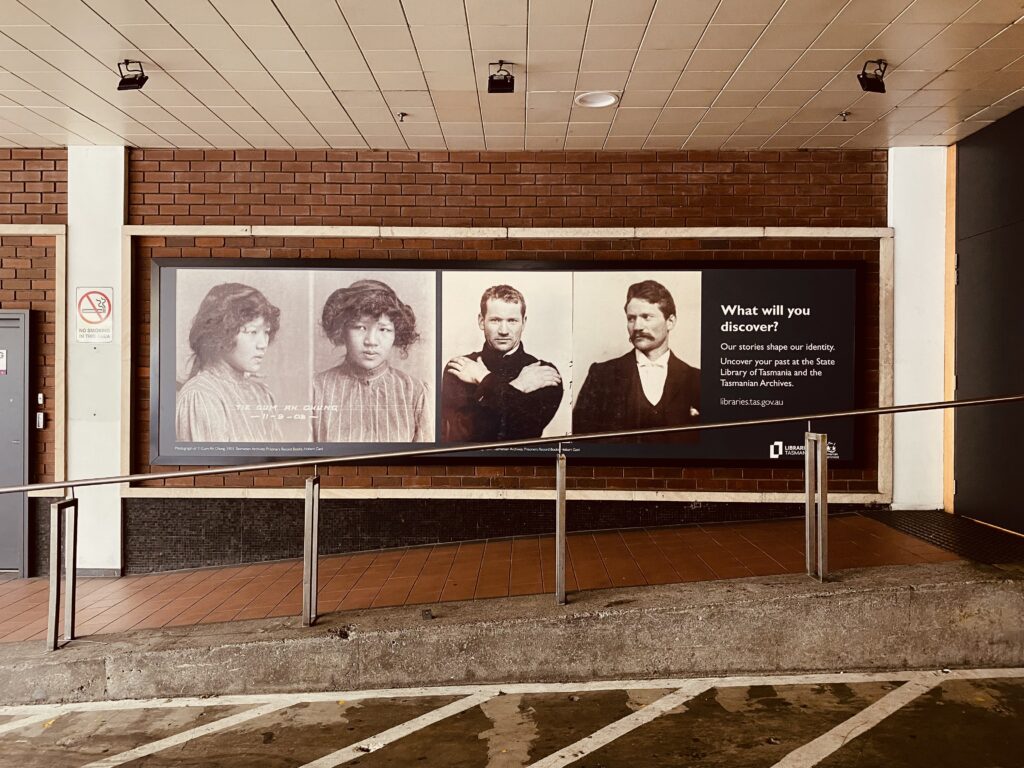
In this blog post I want to look into the history of Tie Cum Ah Chung, to see what can be uncovered about her life in Tasmania.
The obvious first place to look for information about Tie Cum Ah Chung is her prisoner record, which can be found through the Tasmanian Names Index (although under a slightly different spelling of her name).
The prisoner record notes that 18-year-old Tie Cum Ah Chung was first imprisoned for a month for larceny in September 1903, and then three months later she was imprisoned for another month for perjury. She was 5 foot 3 inches tall, single, had smallpox scars on her face, worked as a domestic, and apparently could not read nor write. Her native place was recorded as Yokohama, Japan, although the name of the ship that brought her to Tasmania was unknown. (Yokohama had a sizeable Cantonese population and a ‘Chinatown’, and I have come across other records of Chinese in Australia and New Zealand who stated their birthplace as being Yokohama – so this is not impossible!)
The Tasmanian Names Index brings up no other obvious records for Tie Cum, although there are, of course, other records for people with the name ‘Ah Chung’, including naturalisations, births, deaths, marriages and wills. Many of these records relate to the family of Chin Ah Chung and his wife Lily, whose descendants are still in Hobart today.
The next easy place to look for Tie Cum is in the historical newspapers in Trove, to see if there are any reports of her crimes, arrests or trials. ‘Ti Cum Ah Chung’ (in inverted commas) brings up two results, neither of which are what might have been expected – they relate to a shooting in Launceston late one Friday night in February 1906, which Tie Cum witnessed. She had been standing in York Street, near Storrer’s (an undertaker’s), talking to two young men at the time of the shooting, and she reportedly not only saw the victim but was threatened by the shooter and then warned passersby of the danger. Both articles referred to her as ‘Chinese’.
Searching under the variant spelling of her name – “Tie Cum Ah Chung” (in inverted commas) – yields some more results in the historical newspapers, with reports from September and December 1903 about her court hearings, and one further article about the 1906 shooting.
A month after the shooting, Tie Cum gave evidence at the trial, which was held at the Police Court in Launceston on Friday, 2 March 1906. Her evidence was reported under the heading ‘The Chinese Girl’. Tie Cum told the court she was a Christian, and she was sworn on the Bible. There was no mention of an interpreter, and she appears to have given her testimony in fluent English. Her evidence tallied with the earlier press reports of her involvement – she had been standing on the corner of York and St John’s streets with Albert Brooks and Alfred Grant when the events took place; interestingly she also stated that she knew two of the policemen involved in the case, one from her time in Hobart ‘before I came up here’.
What then of her own petty crimes? On Friday, 11 September 1903, the Tasmanian News (Hobart) reported:
A CHARGE of LARCENY. Tie Cum Ah Chung, a young Japanese woman, was again before the Court, charged with stealing 21b of biscuits from Mrs Meredith, of Harrington street. Accused was defended by Mr Davenport Hoggins (Hoggins and Gilmore). After hearing evidence, accused was found guilty and sentenced to a month’s imprisonment. An application by counsel for his client to be treated under the First Offenders Act was refused, Mr Shaw stating that the Act was never intended for persons of accused’s character. She had been before the Court several times under disreputable circumstances, and a short term of imprisonment would perhaps give her time to think over her position and probably—though he was afraid not—lead to her reform. The Court then rose.
Three months later, on Tuesday, 15 December 1903, the Tasmanian News (Hobart) further reported:
PERJURY. Tie Cum Ah Chung pleaded guilty to having committed wilful and corrupt perjury at the City Police Court, Hobart, where, being charged with the larceny of a couple of pounds of biscuits from a shop in Argyle street, she elected to give evidence on her own behalf. Prisoner was defended by Mr C. Davenport Hoggins (Hoggins and Gilmore). Mr Hoggins made a strong appeal for leniency, and said the Salvation Army was prepared to take the woman in hand. His Honor imposed a sentence of a month’s imprisonment.
I also tried searching Trove Newspapers using some other variations of her name (Ti/Tie/Tye/Tei and Come/Chum, as well as just Ah Chung), refining the search using parameters like date range and place, with some further success. My other go-to place for researching Chinese Australians in the early twentieth century is RecordSearch (National Archives of Australia), but no records about her obviously come up under variations of the name Tie Cum Ah Chung.
Most of the other newspaper reports I found about Tie Cum were repeats of the information about her larceny and perjury convictions, and the Launceston shooting, including one that includes a more detailed account of her biscuit theft from Mrs Meredith’s shop. One other that piqued my interest was from the Hobart Mercury in July 1903, three months before the theft:
City Police Court. – On Thursday, before the Police Magistrate (Mr. B. Shaw) and Mr. A. Riddoch, J.P. …Two young women named Elsie Hardwicke and Ti Chum Ah Chung pleaded guilty to disturbing the peace in Elizabeth-street by assuming a pugilistic attitude. The former was fined 25s., and the latter, who was a first offender, 5s.
The circumstances of Tie Cum’s life as recorded in these few easily found records seem really quite remarkable – from what I am learning about Tasmania’s early Chinese community, there are many remarkable stories of women and families to be uncovered!
‘Melbourne Ghost Signs’ researcher Sean Reynolds has delved into Tie Cum’s history, too – she apparently left Tasmania for Victoria not that long after these events – and for her story in later life (as Sean has been able to piece together), you might have a look at his creatively (flamboyantly?) written blog post, Otherwise, Yokahama, or listen to his Royal Historical Society of Victoria podcast episode of the same name (embedded below). Note that I haven’t closely reviewed Sean’s research, but on the surface it seems to largely hold together; it’s just perhaps a little fanciful about her origin story.
What then of Tie Cum’s early life? How and when did she come to Tasmania? Was she really born in Yokohama? And was she connected in any way to the Ah Chung family that I know?
My first tantalising clue has come in the form of a newspaper report in the Hobart Mercury in May 1898, located in a search for ‘Chinese girl’ in Tasmanian newspapers, which reported an accident in Hobart involving a fourteen-year-old Chinese girl named ‘Tarcum’:
Accident. – Yesterday evening, as a butcher’s waggon was being driven along Melville street, a Chinese girl named Tarcum, aged 14, who was playing on the footpath with some other children, ran on to the road, and got on the vehicle. Just then a sudden jerk caused her to fall, and the hind wheel ran over her. She was severely injured, and subsequent to being called to her mother she was conveyed to the hospital and admitted. The extent of her injuries has not been ascertained.
This Chinese girl, ‘Tarcum’, was aged fourteen in 1898, and Tie Cum Ah Chung was aged eighteen in 1903, which broadly tallies. Could they therefore be the same person? I think it’s a real possibility! If so, she was born in about 1884 or 1885.
The 1898 article mentions that Tarcum was called to her mother after being injured, suggesting that she came to Tasmania with her family; if she was Tie Cum Ah Chung, a Tasmanian childhood would account for Tie Cum’s fluency in speaking English (as suggested by her 1906 court testimony).
So, here is my crazy theory, which makes sense with the limited evidence I have to date.
The only ‘Ah Chung’ family with a Chinese mother that I know of in Hobart in the 1890s was that of Chin Ah Chung (carpenter / cabinetmaker, later fancy goods storekeeper) and his wife Kim Wing aka Lingo, later known as Lily. Kim Wing came to Hobart in about 1892, aged in her mid to late teens, and she was known to have had her feet bound in childhood. She was befriended by white women in Hobart who taught her to speak English, and she was remembered as speaking without an accent.
We know that other Chinese wives coming to Tasmania around that time were accompanied by companions or maids (e.g. Lula Mon Chinn and Fanny Lee Fook). Is is possible then that Tie Cum was a mui tsai or maid who accompanied Kim Wing to Tasmania? She would have been perhaps 10 years younger than Kim Wing, although it’s hard to get a firm grip on their exact ages. There is no family memory of Kim Wing having migrated with a maid servant, but information about her early life is also scant. I think this arrangement would have been more likely than her being Kim Wing’s daughter, as the age difference was too close.
I hope that as time goes on I will be able to make more sense of Tie Cum’s early story in Tasmania in the 1890s and early 1900s, and either confirm or disprove my crazy theory. Whatever her story, it seems she was among the earliest, and most intriguing, immigrant Chinese women to call our island state their home.
UPDATE 14 November 2025: There goes that theory! Today I came across a snippet from the Mercury on 9 September 1903 that reads: ‘Tie Come Ah Chung is nothing to do with Ah Chung in Elizabeth-street whatever.’ This was around the time 18-year-old Tie Cum was getting into trouble in Hobart.
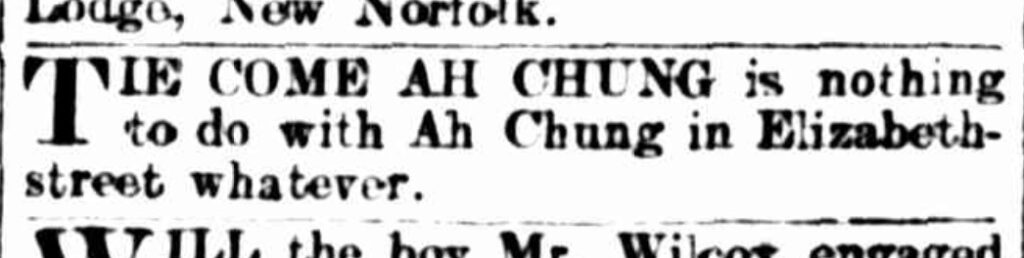
‘Ah Chung in Elizabeth-street’ is Chin Ah Chung, mentioned above. I guess it is possible that the Ah Chungs were distancing themselves from Tie Cum because of her disreputable behaviour, but I think for now I will put aside my theory that she came to Hobart with Kim Wing.
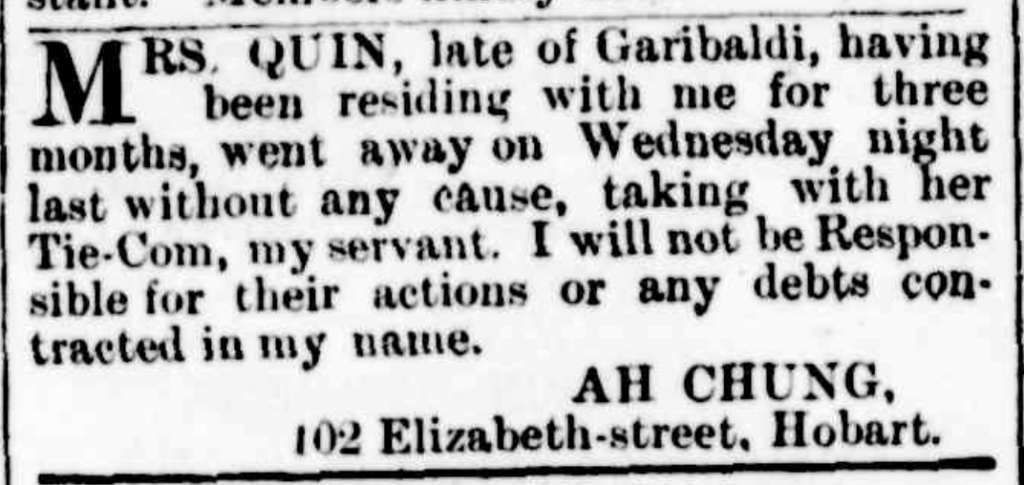
FURTHER UPDATE later the same day: Ha, I was right after all! Tie Cum was associated to the Ah Chung family of Elizabeth Street, Hobart! I came across another little snippet in the Mercury in August 1900, a classified inserted by Ah Chung, that reads:
MRS. QUIN, late of Garibaldi, having been residing with me for three months, went away on Wednesday night last without any cause, taking with her Tie-Com, my servant. I will not be Responsible for their actions or any debts contracted in my name. AH CHUNG, 102 Elizabeth-street, Hobart.
One final find for today is perhaps less exciting, but it does provide one more little clue about Tie Cum in Tasmania.
In October 1905, the complainant in a maintenance case, Emily Maria Deeks, stated that:
when in Hobart she was living in Harrington-street as the housekeeper of a Mr Lung [and going by the name of Mrs Lung]. There were also in the house Mr Bowring, Mr Spurling, and a Chinese woman.
We know that at the time of her arrest in 1903, Tie Cum was working as a domestic (according to her prisoner record) and also that she was publicly disowned by Ah Chung that same year. So it would make sense for her to be the ‘Chinese woman’ mentioned by Emily Maria Deeks as also residing in the house of Mr Lung, presumably working as a domestic. Again, there is nothing concrete here to say this was Tie Cum, but given the circumstances it is very possible.
AND ONE FURTHER UPDATE: Just to document the last piece of evidence I’ve found so far that is possibly about Tie Cum in Tasmania – a search in Trove Newspapers for ‘Ah Chung’ turned up the report of a fire at Ah Chung’s premises at 162 Elizbeth Street on 21 March 1898. The article noted that at Ah Chung’s house, ‘there were four Chinamen, a woman and a girl’. If this was the right Ah Chung (still to be confirmed), then could the girl be Tie Cum? Bear in mind that by this stage Chin Ah Chung and Kim Wing (later known as Lilian Ah Chung) had two young sons: Royden (born 1894) and Tasman (born 1896). It is also unlike the colonial press not to mention the race of the woman and girl if they too were Chinese.
References
Prisoner record of Ti Cum Ah Chung, 1903, p. 2594, Prisoners Records Books, GD63/1/3 (Book No. 5), Tasmanian Archives, https://libraries.tas.gov.au/Digital/GD63-1-3-P117
‘Outbreak of fire’, Tasmanian News, 21 March 1898, p. 2, http://nla.gov.au/nla.news-article173663941
‘Marshalling of reinforcements’, Mercury (Hobart), 25 May 1898, p. 2, http://nla.gov.au/nla.news-article9422776
‘Advertising, Mercury (Hobart), 4 August 1900, p. 3, http://nla.gov.au/nla.news-article12806313
‘Advertising’, Tasmanian News (Hobart), 4 August 1900, p. 3, http://nla.gov.au/nla.news-article185243364
‘Advertising’, Mercury (Hobart), 9 September 1903, p. 5, http://nla.gov.au/nla.news-article12256286
‘City Police Court’, Tasmanian News (Hobart), 11 September 1903, p. 2, http://nla.gov.au/nla.news-article176656230
‘The Mercury’, Mercury (Hobart), 31 July 1903, p. 5, http://nla.gov.au/nla.news-article12267780
‘Parliamentary notes’, Mercury (Hobart), 9 September 1903, p. 4, http://nla.gov.au/nla.news-article12256346
‘A Jap in trouble’, Examiner (Launceston), 12 September 1903, p. 5, http://nla.gov.au/nla.news-article35563231
‘Tasmania’, Daily Telegraph (Launceston), 12 October 1903, p. 5, http://nla.gov.au/nla.news-article153903661
‘A charge of perjury’, Tasmanian News, 13 October 1903, p. 3, http://nla.gov.au/nla.news-article176658147
‘Second Court’, Tasmanian News (Hobart), 15 December 1903, p. 6, http://nla.gov.au/nla.news-article176661915
‘Criminal Court’, Daily Telegraph (Launceston), 16 December 1903, p. 4, http://nla.gov.au/nla.news-article153902132
‘Criminal Court sitting’, The North Western Advocate and the Emu Bay Times, 16 December 1903, p. 2, http://nla.gov.au/nla.news-article64651150
‘Tasmania’, Zeehan and Dundas Herald, 16 December 1903, p. 4, http://nla.gov.au/nla.news-article83719094
‘Domestic Unhappiness’, Daily Telegraph (Launceston), 28 October 1905, p. 6, http://nla.gov.au/nla.news-article154020620
‘Statement by Jackson’, Examiner (Launceston), 3 February 1906, p. 9, http://nla.gov.au/nla.news-article38071562
‘The shooting sensation’, Daily Telegraph (Launceston), 5 February 1906, p. 5, http://nla.gov.au/nla.news-article151822259
‘The shooting sensation’, Daily Telegraph (Launceston), 3 March 1906, p. 9, http://nla.gov.au/nla.news-article151823245
Sean Reynolds, ‘Otherwise, Yokohama’, Melbourne Ghost Signs [blog], 10 July 2024, https://web.archive.org/web/20251107061531/https://melbourneghostsigns.substack.com/p/otherwise-yokahama