Tag: gravestones

What’s in a name?

Historical Chinese Australian names throw up all sorts of challenges – from the ubiquity of ‘Ah’ to confusion of name order – but in my recent research on Chinese Tasmanian history, it’s the challenge of matching Chinese and English versions of people’s names that’s been puzzling me.

As part of our Everyday Heritage Linkage project, we have compiled a list of the Chinese names of more than 950 people connected to Tasmania, dating from 1901 to 1936, taken from historical newspapers digitised in Trove.
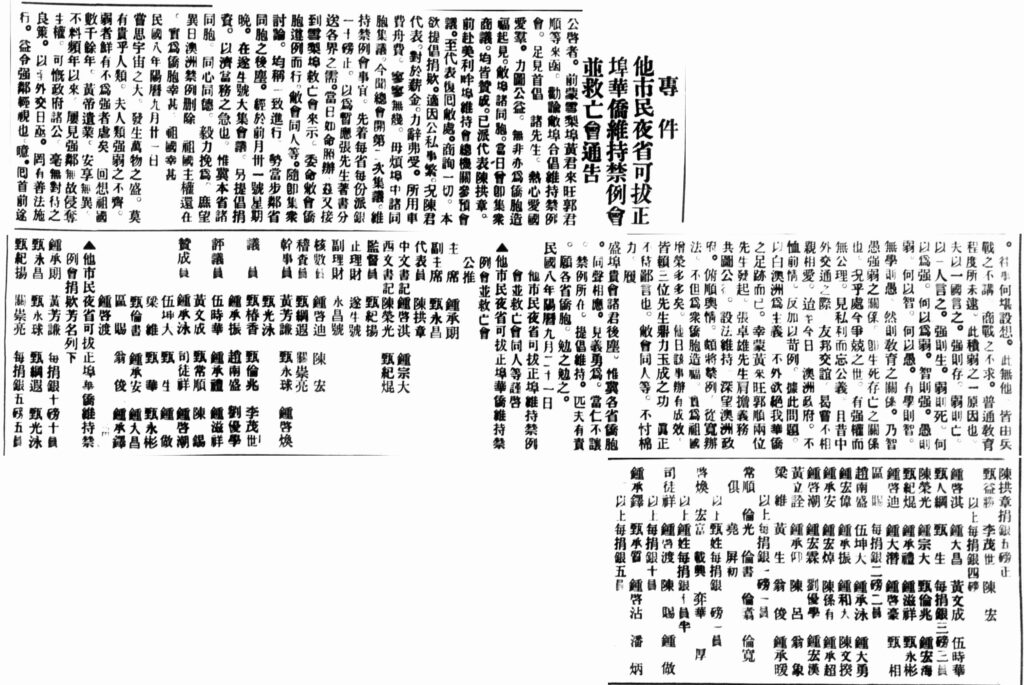
A black and white copy of a newspaper article written in Chinese
“專 件 [Special Report]”, Tung Wah Times (Sydney), 18 October 1919, p. 6, http://nla.gov.au/nla.news-article227016320 – this newspaper article, about the establishment of a Tasmanian branch of the Chinese Anti-Discriminatory and Patriotic Association, includes the Chinese name of Claude Nam Shing
To do this, researcher Brian Tseng located 82 relevant newspaper articles in four newspapers: Chinese Republic News, Chinese Times, Chinese Australian Herald, and the Tung Wah News/Times. Many of these articles are newspaper subscription notices, society membership lists, or lists of philanthropic donations.

We began this newspaper search by consulting the English-language Tung Wah Newspaper Index, which was originally created as part of the Chinese Heritage of Australian Federation project back in 2000 and is currently maintained online by Tim Sherratt. It’s a very handy reference, particularly if you’re not able to read Chinese, or, in our case, if you are looking for information about a particular place (Tasmania).

In time, our list of names, and the newspaper articles they came from, will be included in our forthcoming Chinese Tasmanian Stories 塔華舊事* website. But for now, they are one of the sources we’re using in researching the stories of Chinese individuals, businesses and places.

One of the individuals we’ve been looking into is Claude Nam Shing.

Claude (or Claudie) Nam Shing, greengrocer / fruiterer / market gardener, left a small but meaningful trace in the written archive in Tasmania, including English-language newspaper reports, post office directory entries (between 1907 and 1936), reports in the police gazette, and an alien registration record.

Given his long residence in Hobart and Glenorchy, we would expect that he also appeared at least once in the donation and subscription lists that we uncovered in the Chinese-language newspapers – but how do we work out what his name is in Chinese characters, beyond an educated / lucky guess?
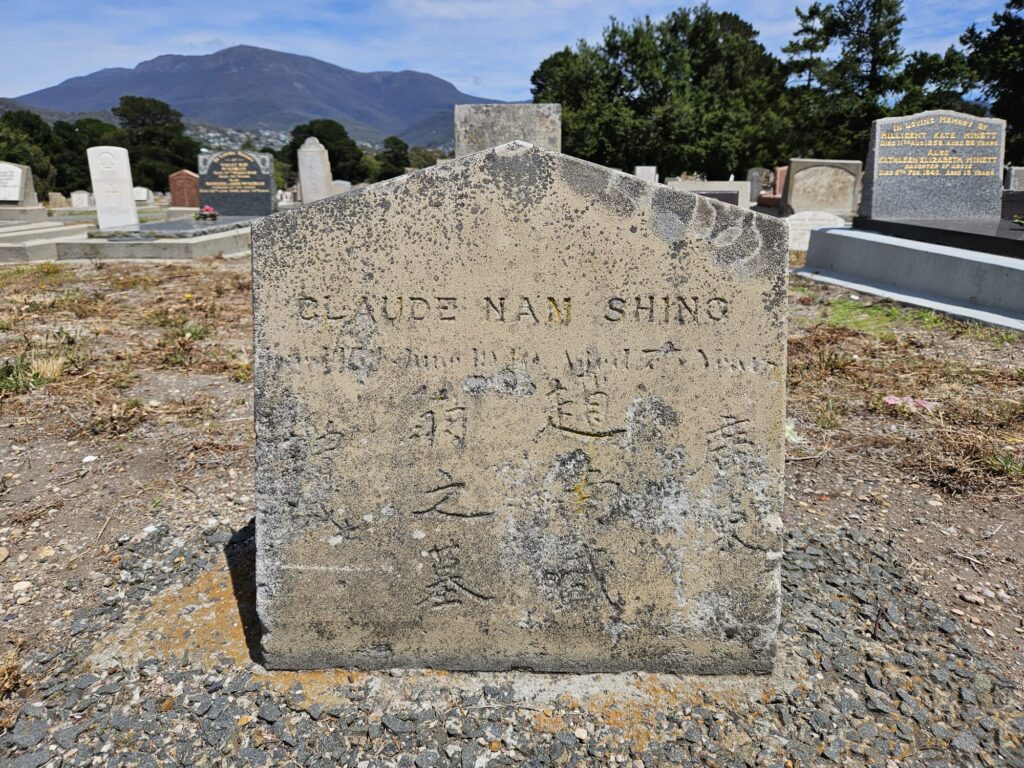
Colour photograph of a weathered stone headstone, with trees and mountains and blue sky in the background. There is English and Chinese writing on the headstone, but it is hard to read.
Claude Nam Shing’s grave in the Cornelian Bay Cemetery, Hobart, January 2026

Luckily, Claude Nam Shing is buried in the Cornelian Bay Cemetery here in Hobart, and, even luckier, the headstone includes an inscription in Chinese. I was alerted to this fact by photographs of the grave in the Find a Grave website. The headstone is much weathered, as many of the old Chinese headstones in Cornelian Bay are, but it is possible to make out some of what it says from these online photographs.

Imogen Wegman and I also payed Nam Shing’s grave a visit to see if it would be easier to read in real life, with the help of rubbings. After some tricky deciphering, I am pretty confident that this is what it says:

CLAUDE NAN SHING

Died 15 June 1940 Aged 76 Years

增城     翁之墓    趙南成 (or another ‘sing’ character such as 盛)     廣東

Tsangshing [his native county] | grave of |  Jiuh Nàahm Sìhng [his name] | Kwangtung [his native province]

Armed with these characters for his name, I then looked in our list of Chinese Tasmanians from the Chinese-language newspapers, and, lo and behold, there were half a dozen articles that mentioned 趙南盛 – lists of donations to famine, disaster and food relief, and membership of the Tasmanian branch of a Chinese-Australian community association – dating between 1908 and 1920.

Claude Nam Shing is just one of the hundreds of Chinese people who lived in Tasmania in the nineteenth and early twentieth century. We’re making a start at bringing their stories out of the archives, but as Claude’s case demonstrates, the biographical data that is found in Chinese headstone inscriptions is a critical piece of the puzzle of understanding both the Chinese and the Tasmanian sides of their lives. Enough remained of the inscription on Claude Nam Shing’s headstone to make it possible to read it, but this isn’t the case with others, and who knows, in a few years’ time, maybe Nam Shing’s headstone will be similarly illegible.

Transcription of some Tasmanian Chinese headstones was undertaken by researcher Kok Hu Jin some years ago, but perhaps we in Tasmania might look to the model of CAFHOV’s wonderful database of Chinese Graves at Melbourne Chinese Cemetery as an example of what is possible when it comes to documenting this precious aspect of Chinese Tasmanian heritage.

* For those of you who don’t read Chinese, 塔華舊事 is pronounced taap wàh gauh sih in Cantonese and tǎ húa jiù shì in Mandarin, and it means 塔 Tasmanian 華 Chinese 舊事 stories from long ago / echoes of history / traces of the past – you get the gist!

The Everyday Heritage: Chinese Tasmanian Stories project team is made up of me, Annaliese Claydon, Imogen Wegman and Tim Sherratt, with Chinese-language research assistance by Brian Tseng.

Finding a connection to China

On 13 September 2008, I spoke at a gathering of the Chinese Australian Historical Society in Sydney. The workshop was called ‘Stepping ashore: How to research your Chinese family history’. It was attended by about 30 people – some just embarking on their family research, some struggling with particular research problems, some well into it and perhaps more knowledgeable than the speakers! Here’s what I talked about, with links and references as promised.

Most people doing Chinese family and community history research start in Australia, with what they know from families and from Australian records. But the lives and journeys of Chinese ancestors began before they stepped ashore here. While not without their challenges, Australian sources can help us find connections back to China – from clues in how Chinese names were romanised to working out what’s written on a Chinese headstone…

The talk focused mostly on how Chinese personal and place names appear in Australian records. Because there was no standard form for romanising Chinese until the 20th century, and because people spoke in different dialects, there is lots of variation in how personal and place names are recorded in English-language sources. Only rarely are Chinese characters included.

These romanised versions of personal and place names can tell us helpful things however. For instance, personal names written with a ‘sl’ or ‘shl’ sound at the beginning (like Dang Bown Sluey or Slit Schin) suggest that these people were likely to be from Taishan, as this sound is particular to Taishanhua rather than Cantonese. Or, a woman’s name that includes a ‘See’ or ‘Shee’ usually gives their father’s family name, and indicates that the woman was married. Ham See, for example, would be a married woman who was born into the Ham family – Ham would be her father’s, not her husband’s, surname.

The native place of many, many Chinese is recorded in Australian records as Canton – which usually means the province of Guangdong, not the city Guangzhou. More occasionally county or city or town or even village names are recorded: Sunning, Sun Wui, Heung Shan, Amoy, Shekki, Kongmoon, Lee Yuan, Bak Shek… Sometimes it’s easy to identify these places, sometimes it’s not. The smaller the place, the harder it can be to identify.

Finding Chinese characters for personal and place names can be like looking for the proverbial needle in a haystack, but is very helpful if the goal is to locate and visit an ancestral village in China. There are Chinese-language sources, such as newspapers and clan or association records, that could provide these details; Chinese characters are also often found on gravestones and in certain types of government records.

The following are some websites, articles and books that might provide more clues to understanding personal and place names, or might help in locating Chinese characters.

Personal names

Chinese personal names, as they appear in English-language sources, are slippery things. They were written down in many different ways, often with the one person’s name recorded with multiple spellings or multiple variations.

American Emma Woo Louie has written on Chinese American names, much of which applies in the Australian context. Her book is Chinese American Names: Tradition and Transition (McFarland & Company, 2008). A preview of the book is available from Google Book Search. She has also published articles on the subject in the Chinese Historical Society of America’s journal Chinese America: History and Perspectives.

Also see:

Chinese names on the Chinese-Canadian Genealogy website

Kate Bagnall, Golden Shadows on a White Land, PhD thesis, University of Sydney, 2006 – Section 4: Belonging (starts on p. 196)

Janis Wilton, Golden Threads: The Chinese in Regional New South Wales 1850–1950, New England Regional Art Museum, 2004

Places

Like personal names, Chinese place names were written down in various ways. The trick is to be able to ‘translate’ back from the romanised version to how a place is known today. Today’s Jiangmen, for instance, might have been written Quong Moon, Kong Mun, Kongmoon.

The Chinese Genealogy forum is an excellent place to read up on locating and visiting ancestral villages.

You can also browse or search the Surname and Village Database, which provides access to information from the Index of Clan Names By Villages published by the American Consulate General in Hong Kong in the 1970s.

Have a look at Google Maps, or if you’ve got Chinese characters for the place name and can read a bit of Chinese, you can look for it in the online map at ditu.sogou.com. Smaller villages aren’t likely to be there, though.

Gravestones

Headstones in cemeteries can be a great place to find Chinese characters for personal names and native villages. Work on transcribing and interpreting Chinese headstones is happening more and more.

Doris Jones’ Reading Chinese gravestones, on the Golden Threads website, is an excellent introduction to understanding the information written on Chinese headstones.

Also see:

Doris Jones, Remembering the Forgotten: Chinese Gravestones in Rookwood Cemetery 1917–1949, Invenet, Sydney, 2003

Linda Brumley, Liu Bingquan and Zhao Xueru, Fading links to China: Ballarat’s Chinese Gravestones and Associated Records 1854–1955, on the Chinese Heritage of Australian Federation website

and

Kok Hu Jin’s numerous books describing and translating Chinese gravestones around Australia, published by the Golden Dragon Museum at Bendigo