Tag: cemeteries

What’s in a name?

Historical Chinese Australian names throw up all sorts of challenges – from the ubiquity of ‘Ah’ to confusion of name order – but in my recent research on Chinese Tasmanian history, it’s the challenge of matching Chinese and English versions of people’s names that’s been puzzling me.

As part of our Everyday Heritage Linkage project, we have compiled a list of the Chinese names of more than 950 people connected to Tasmania, dating from 1901 to 1936, taken from historical newspapers digitised in Trove.
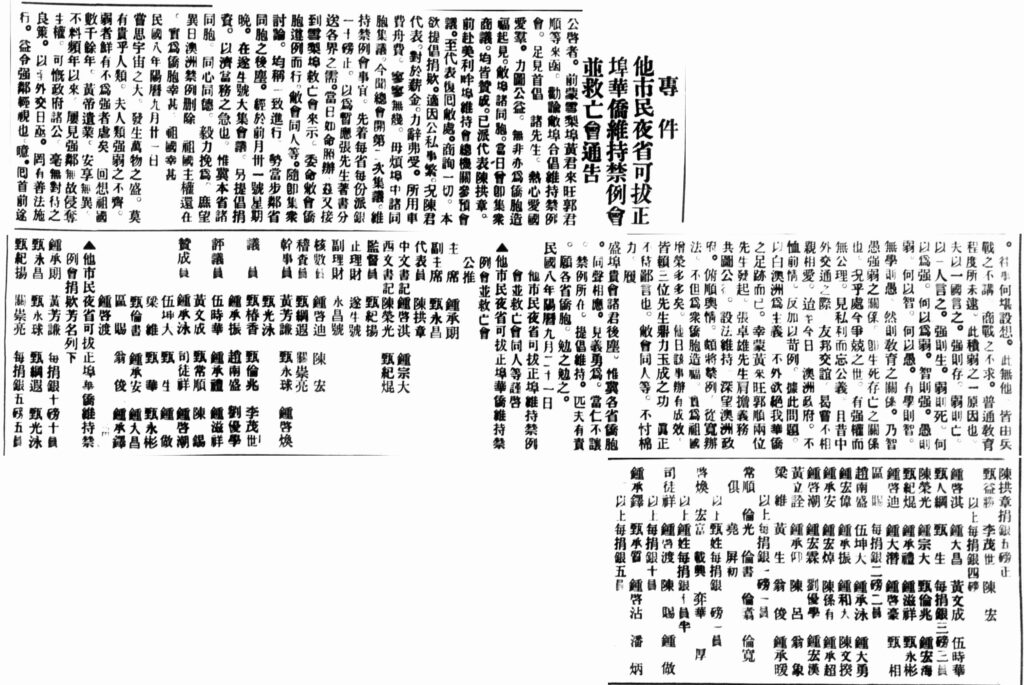
A black and white copy of a newspaper article written in Chinese
“專 件 [Special Report]”, Tung Wah Times (Sydney), 18 October 1919, p. 6, http://nla.gov.au/nla.news-article227016320 – this newspaper article, about the establishment of a Tasmanian branch of the Chinese Anti-Discriminatory and Patriotic Association, includes the Chinese name of Claude Nam Shing
To do this, researcher Brian Tseng located 82 relevant newspaper articles in four newspapers: Chinese Republic News, Chinese Times, Chinese Australian Herald, and the Tung Wah News/Times. Many of these articles are newspaper subscription notices, society membership lists, or lists of philanthropic donations.

We began this newspaper search by consulting the English-language Tung Wah Newspaper Index, which was originally created as part of the Chinese Heritage of Australian Federation project back in 2000 and is currently maintained online by Tim Sherratt. It’s a very handy reference, particularly if you’re not able to read Chinese, or, in our case, if you are looking for information about a particular place (Tasmania).

In time, our list of names, and the newspaper articles they came from, will be included in our forthcoming Chinese Tasmanian Stories 塔華舊事* website. But for now, they are one of the sources we’re using in researching the stories of Chinese individuals, businesses and places.

One of the individuals we’ve been looking into is Claude Nam Shing.

Claude (or Claudie) Nam Shing, greengrocer / fruiterer / market gardener, left a small but meaningful trace in the written archive in Tasmania, including English-language newspaper reports, post office directory entries (between 1907 and 1936), reports in the police gazette, and an alien registration record.

Given his long residence in Hobart and Glenorchy, we would expect that he also appeared at least once in the donation and subscription lists that we uncovered in the Chinese-language newspapers – but how do we work out what his name is in Chinese characters, beyond an educated / lucky guess?
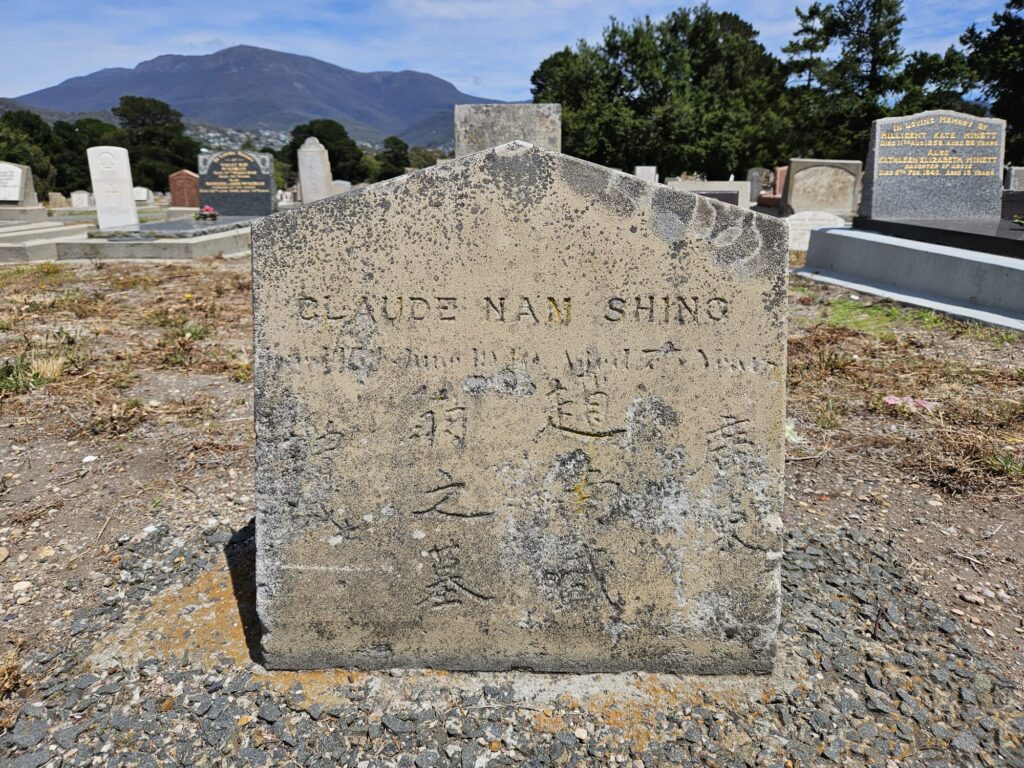
Colour photograph of a weathered stone headstone, with trees and mountains and blue sky in the background. There is English and Chinese writing on the headstone, but it is hard to read.
Claude Nam Shing’s grave in the Cornelian Bay Cemetery, Hobart, January 2026

Luckily, Claude Nam Shing is buried in the Cornelian Bay Cemetery here in Hobart, and, even luckier, the headstone includes an inscription in Chinese. I was alerted to this fact by photographs of the grave in the Find a Grave website. The headstone is much weathered, as many of the old Chinese headstones in Cornelian Bay are, but it is possible to make out some of what it says from these online photographs.

Imogen Wegman and I also payed Nam Shing’s grave a visit to see if it would be easier to read in real life, with the help of rubbings. After some tricky deciphering, I am pretty confident that this is what it says:

CLAUDE NAN SHING

Died 15 June 1940 Aged 76 Years

增城     翁之墓    趙南成 (or another ‘sing’ character such as 盛)     廣東

Tsangshing [his native county] | grave of |  Jiuh Nàahm Sìhng [his name] | Kwangtung [his native province]

Armed with these characters for his name, I then looked in our list of Chinese Tasmanians from the Chinese-language newspapers, and, lo and behold, there were half a dozen articles that mentioned 趙南盛 – lists of donations to famine, disaster and food relief, and membership of the Tasmanian branch of a Chinese-Australian community association – dating between 1908 and 1920.

Claude Nam Shing is just one of the hundreds of Chinese people who lived in Tasmania in the nineteenth and early twentieth century. We’re making a start at bringing their stories out of the archives, but as Claude’s case demonstrates, the biographical data that is found in Chinese headstone inscriptions is a critical piece of the puzzle of understanding both the Chinese and the Tasmanian sides of their lives. Enough remained of the inscription on Claude Nam Shing’s headstone to make it possible to read it, but this isn’t the case with others, and who knows, in a few years’ time, maybe Nam Shing’s headstone will be similarly illegible.

Transcription of some Tasmanian Chinese headstones was undertaken by researcher Kok Hu Jin some years ago, but perhaps we in Tasmania might look to the model of CAFHOV’s wonderful database of Chinese Graves at Melbourne Chinese Cemetery as an example of what is possible when it comes to documenting this precious aspect of Chinese Tasmanian heritage.

* For those of you who don’t read Chinese, 塔華舊事 is pronounced taap wàh gauh sih in Cantonese and tǎ húa jiù shì in Mandarin, and it means 塔 Tasmanian 華 Chinese 舊事 stories from long ago / echoes of history / traces of the past – you get the gist!

The Everyday Heritage: Chinese Tasmanian Stories project team is made up of me, Annaliese Claydon, Imogen Wegman and Tim Sherratt, with Chinese-language research assistance by Brian Tseng.

Remembering Coohey Fue

CONTENT WARNING: This blog post mentions suicide.

Coohey Fue (c. 1875–1920) worked as a market gardener in Devonport in northern Tasmania. He died by suicide on 10 April 1920 (Advocate, 12 April, p. 2; Tasmanian Archives SC195/1/86 Inquest 14257) and was buried by his compatriots in the Latrobe General Cemetery on 12 April (Advocate, 12 April 1920, p. 2; 13 April 1920, p. 2). Coohey Fue was said to have a wife and three or four children in China at the time of his death.

Coohey Fue’s life and passing are connected to two white marble monuments in the Latrobe General Cemetery – but as these memorials only have inscriptions in Chinese there is nothing obviously linking them to ‘Coohey Fue’.

A old cemetery with trees and scattered headstones in the background, and in the foreground among the long brown grass are two white headstones, one of which is lying on the ground
The two white marble monuments to Coohey Fue in the Latrobe General Cemetery, Latrobe (near Devonport), Tasmania (Photo by Kate Bagnall, December 2022)

The monuments

The two monuments appear to have been made from the same materials at the same time, although one is in somewhat poorer condition than the other. The text on them differs only in the deceased’s name, and I believe they were both erected following the death of the man known in English as Coohey Fue.

Searching the Chinese-language newspapers in Trove brings up a few articles that mention the names given on the monuments:

  • 林舉富 (Lam Kui Fu): ‘美利濱中華公會捐賑廣東水災彙録’, Tung Wah Times, 21 August 1915, p. 8, http://nla.gov.au/nla.news-article226737771 [list of Melbourne donors to Guangdong flood relief; includes 林舉富 and another man who is presumably a brother/cousin 林舉羨]
  • 林舉章 (Lam Kui Cheung):

The text on the monuments includes a number of Chinese cultural terms that are difficult to translate directly into English, including: 公 (Cantonese: gūng, honorific, for a male person), 府君 (Cantonese: fú gwān, honorific, for a person who has died), 庚申 (Cantonese: gāng sān, one of the 60-year cycle/stem-branch cycle).

TAMIOT (the Tombstone and Memorial Inscriptions of Tasmania database) provides the following details about the monuments:

  • LAM Kui Cheung. Native of: Guangdong Taishun Chung Fa Tsui Village. Monument erected in 1920 – LATROBE CEMETERY, GENERAL SECTION – LATROBE – DEVONPORT – LT04/0865
  • LAM Kui Fu. Native of: Guangdong Taishun Chung Fa Tsui Village. Monument erected in 1920 – LATROBE CEMETERY, GENERAL SECTION – LATROBE – DEVONPORT – LT04/0866
LAM Kui Cheung 林舉章

廣東台山縣松花咀村
民國特贈舉章林公府君坟墓
192千歲次庚申年吉月吉日立

This headstone is in memory of Kui Cheung Lam, of Chung Fa Tsui, Toishan, Kwangtung.

Erected on a lucky day and a lucky month, 1920, Gang San Year, during the era of the Republic of China.

A white stone gravestone, which has Chinese writing on it, standing on a concrete plinth in a country cemetery
Monument for Lam Kui Cheung, Latrobe General Cemetery, Tasmania (Photo by Kate Bagnall, December 2022)
LAM Kui Fu 林舉富

廣東台山縣松花咀村
民國特贈舉富林公府君坟墓
192千歲次庚申年吉月吉日立

This headstone is in memory of Kui Fu Lam, of Chung Fa Tsui, Toishan, Kwangtung.

Erected on a lucky day and a lucky month, 1920, Gang San Year, during the era of the Republic of China.

A cracked white stone gravestone, with Chinese writing on it, lying on the ground
Monument for Lam Kui Fu, Latrobe General Cemetery, Tasmania (Photo by Kate Bagnall, December 2022)

Coohey Fue’s ancestral village

Coohey Fue’s family name was Lam (林) and he came from Chung Fa Tsui, a Lam village in Toishan, Kwangtung, China. Chung Fa Tsui (or Songhuaju in Mandarin) is about 25 kilometres south-west of the county capital of Taicheng 台城 and about the same distance to the north-west of the coastal town of Guanghai 廣海.

廣東省 / Kwangtung / Guangdong (province)
台山縣 / Toishan / Taishan (county)
新安鄉 / Sun On / Xin’an (village)
松花咀村 / Chung Fa Tsui / Songhuaju (hamlet)

Acknowledgements

I would like to thank Lyn Phillips, and Kelli Schultz, who alerted me to these two Chinese monuments in the Latrobe General Cemetery. Kelli pointed me to a query from Lyn about the memorials that Lyn posted on the ‘Tasmanians Finding their Past – Genealogy Group’ on Facebook on 21 October 2022. I used Lyn’s photographs to transcribe and translate the text; my thanks to Mei-fen Kuo (Macquarie University) and my UTAS colleague Lucy Li (and her father) for their assistance in teasing out the nuances of the text’s meaning. I’d also like to acknowledge that the information above from TAMIOT was posted by Suzanne Griffin in response to Lyn’s post to the Tasmanians Finding their Past Facebook group. In October 2022 I did some initial digging in Trove and the Tasmanian Names Index to identify who Lam Kui Cheung / Lam Kui Fu might be, and I was able to stop off in Latrobe just before Christmas to photograph the headstones for myself.

In memoriam

On 18 June 1888, the following in memoriam notice appeared in the Newcastle Morning Herald:

LABBAYU.—In loving memory of my dear mother, Mary Ann Labbayu, who departed this life June 17, 1887, after a long and painful illness; aged 43 years.

It is just twelve months ago to-day
Since my dear mother passed away,
Since I stood by my mother’s side
And saw her breathe her last.

She faded like some southern flower
Parched by cruel rays;
And now beneath the dark, cold sod,
My dear mother lays.

Inserted by her loving daughter, Aggie Hop War, Newcastle.

According to her death certificate (NSW BDM 11450/1887), Mary Ann Labbayu, age 42, died at Watt Street, Newcastle, after suffering cancer of the uterus for three years. She was buried in the Catholic section of Sandgate Cemetery at Newcastle (Portion Catholic 1, Section D Com, Plot 389).

Mary Ann’s death left her two daughters, Sarah and Mary Agnes (Aggie), aged 21 and 19, parentless.

Four years earlier, on 6 September 1883, they had lost their father, Thomas Labbayu, in a riding accident near their home at Greta. Thomas’s accident and the subsequent inquest received a long write-up in the local Matiland newspaper. Thomas was buried at Branxton Cemetery, with a handsome headstone erected by his daughter Aggie and her husband. Mary Ann inherited her husband’s estate.

Thomas Labbayu’s death certificate (NSW BDM 8600/1883) gives some interesting particulars about his life. It says he was aged 46 at the time of his death (meaning he would have been born around 1837), he was originally from China, and had been in New South Wales for 20 years (so would have arrived around 1863). He had worked as a contractor.

But this information doesn’t quite tally with the details given at the time of his naturalisation a decade earlier, in January 1874, and it’s these earlier details that are probably more accurate.

Thomas’s naturalisation certificates states that he was from Armoa, China (presumably Amoy), that he arrived in New South Wales in 1853, and that he was aged 30 in 1874 (meaning he would have been born around 1844). In 1874 he working as a carpenter and fencer at Greta, near Branxton, and had purchased land (NSW Certificate of Naturalization No. 74/12, in the name Thomas Labbayn).

Mary Ann Coyle and Thomas Labbayu married in the manse at St Stephen’s Presbyterian Church, East Maitland, on 17 February 1868 (NSW BDM 2561/1868). At the time of their marriage they were living at Buttai and Thomas was working as a woodsplitter. Mary Ann had given birth to a daughter, Sarah, two years earlier (NSW BDM 10383/1866, registered under surname Coyle), and in the year of her marriage to Thomas, they had another daughter, Mary Agnes (Aggie) (NSW BDM 11567/1868). 

When their mother died in 1887, Sarah and Aggie Labbayu were both already married. They had married young: Aggie was sixteen when she married James Sydney Hop War, and Sarah was eighteen when she married James J.H. Ah Chee, both marriages taking place at Greta in 1883.

Sarah married again in 1886, presumably after the death of her first husband, to a man named William Coulton — it was ‘Sara J. Coulton, daughter of the deceased’ who was listed as informant on her mother’s death certificate.

With William Coulton, Sarah had two children, Herbert and Mary, born in 1887 and 1888 (NSW BDMs 30336/1887 and 31671/1888). I haven’t immediately located the birth of any children with her first husband, James Ah Chee, but an immigration file from 1909 mentions a ‘half-caste Chinese’ man named Ah Chee who was the nephew of Aggie Hop War (NAA: SP42/1, C1909/2915).

View down Watt Street, Newcastle (Cultural Collections, University of Newcastle)

More can be discovered about the Hop War family. James Hop War was a successful cabinetmaker in Newcastle, where he and Aggie established a home in Watt Street. They had four daughters: twins Eveline and Florence (b. 1884), Agnes Amy (b. 1887) and Gertrude (b. 1889). James Hop War was naturalised in 1882. His naturalisation certificate stated that he had arrived in New South Wales on the Isle of France in 1870 at the age of 17. In a letter to the newspaper in 1891, after certain accusations were made against him, James Hop War declared, ‘I have been a resident of Newcastle for 17 years, have a wife and four children dependent on me for support’. He appears to have been a prominent presence in the local Chinese community and acted as government interpreter.

Birth certificate of Gertrude Hop War, Newcastle, 1889 (NAA: SP42/1, C1909/2915)

James, Aggie and their children left New South Wales for Hong Kong in 1892. Some time after, James and Aggie’s marriage fell apart and James returned to Sydney in January 1904 while the rest of the family remained overseas (NAA: SP42/1, C1909/2915).

Versions of the family name that appear in the records are: Labbayu, Labbayue, Labbayn, Labayu, Labbayer, Lavyu.