This guest post was written by Parker Bagnall, aged seven. Parker attended our Real Face of White Australia transcribe-a-thon weekend at Old Parliament House on 9–10 September 2017, and became interested in the photograph of a little girl, Dolly Denson, that she found when transcribing. You can see more photographs of the Denson family in NAA: ST84/1, 1909/23/71-80.
On this website you transcribe. I’ll explain what transcribing is. Transcribing is when you take words from old immigration documents and type them out. On the old documents there are pictures of the person who owns the certificate. When I was transcribing I came across a two year old girl called Dolly. She was very cute and had chubby cheeks. My mum helped me find more about Dolly from the archives.
Me transcribing at Old Parliament House.
Dolly was born in Sydney 1907. That was 110 years ago. Dolly died probably at least 20 or 30 years ago, but my mum said it would have been interesting to meet someone who you were studying. Dolly’s mum’s name was Jang See and her dad’s name was Mew Denson. She had six siblings – five sisters, one brother. Her oldest sister, Mary, was born in China in 1895. The rest of her siblings were born in Sydney. There names were William, Amy, Ivy, Ruby, Mabel. Ruby died when she was a baby.
Photos of Dolly Denson and her mum’s handprint (NAA: ST84/1, 1909/23/71-80).
In 1909 the family went on a trip to China. The ship they travelled on was called the Eastern. Before they left they got identification documents called CERTIFICATE EXEMPTING FROM DICTATION TEST. These are the documents I was transcribing.🇨🇳 Dolly was too little to have her own certificate, so she’s on the back of her mum’s certificate.
Transcribing is fun but tricky. It’s tricky because the old handwriting is a bit hard to read. The writing is very curly, some letters are weird. The more you do it the easier it gets. There’s also some funny things on the certificates. One funny thing is they measure height in boots.
Some weird curly writing (NAA: ST84/1, 1909/23/71-80).
In March 2017, we – Kate Bagnall and Sophie Couchman – hosted our inaugural Chinese Australian Hometown Heritage Tour to Hong Kong and Guangdong. The tour ran for ten days, from 22 March to 31 March 2017, and visited Hong Kong, Jiangmen, Kaiping, Taishan, Xinhui, Zhongshan and Zhuhai.
We were joined on the tour by sixteen guests, from New South Wales, the ACT, Victoria, Queensland, Tasmania and New Zealand – most of whom were descended from early Cantonese migrants to Australia. The tour was guided by Stony Xiao from China Adventure Tours, with arrangements and bookings coordinated by Active Travel in Canberra.
Afternoon walking tour of old Pokfulam village, including the Tung Wah Coffin Home, with Jason Wordie – the tour introduced the history of Hong Kong and some its of overseas Chinese connections
Dinner at Gold Mui Seafood Stall restaurant in Tsim Sha Tsui, with a talk by Dr Catherine Ladds (Hong Kong Baptist University) on the history of Eurasians in Hong Kong and treaty-port China
Accommodation at Stanford Hillview Hotel, Tsim Sha Tsui
The group outside Douglas Castle, now University Hall at the University of Hong Kong, on our Pokfulam walking tour (photo: Jonathan O’Donnell)
Day 3: Hong Kong 香港 – Jiangmen 江門
Friday, 24 March 2017
Ferry to Jiangmen (3 hours) – arriving in Guangdong by river boat we got a sense of the way overseas Chinese travelled in the 19th century and early 20th century
Lunch at Wuyi Kitchen restaurant in the Yucca Hotel mall in Jiangmen – where we got our first taste of local Jiangmen cuisine
Visit to the Wuyi Overseas Chinese Museum with Dr Selia Tan from Wuyi University – in this bilingual museum we were introduced to the broader history of overseas migration from the Wuyi (previously Siyi or See Yup) area of Guangdong, including migration to Australia
Visit to the Overseas Chinese Culture Research Centre at Wuyi University – where Dr Selia Tan told us about ongoing research at Wuyi University on overseas Chinese history
Dinner at leisure – most of us ate in one of the restaurants in the glossy shopping mall attached to the Yucca Hotel
At the Wuyi Overseas Chinese Museum in Jiangmen (photo: Kate Bagnall)
Day 4: Jiangmen 江門 – Kaiping 開平
Saturday, 25 March 2017
Visit to Cangdong village, Tangkou, Kaiping led by Dr Selia Tan – the Cangdong Heritage Education Centre, run by Selia, is working with local villagers to restore and revitalise the village of Cangdong; Cangdong is the ancestral village of Sydney-born Chinese revolutionary James Ah See or Tse Tsan-tai
Lunch at Cangdong village – lunch was a traditional village meal prepared by women from Cangdong in the communal kitchen, which we ate sitting in one of the restored ancestral halls
Visit to Li Yuan mansions and garden – built as a private home by Chinese American Xie Weili in the 1920s and 1930s, Li Yuan’s residences and garden were restored in the early 2000s and opened as a tourist site, which now also features a museum
Cultural activities at Cangdong village – we listened to performances of traditional folk music, watched calligraphy, paper flower-making and toy-making, and sampled some traditional Cangdong village sweets
Dinner at Lingzhiyuan restaurant in Tangkou, Kaiping – Lingzhiyuan’s menu is based around the lingzhi mushroom (Ganoderma lucidum), a ‘magic fungus’ formerly credited with miraculous powers and considered a symbol of good luck!
View from the top of the diaolou (watchtower) in Cangdong village, Kaiping (photo: Jonathan O’Donnell)
Day 5: Kaiping 開平
Sunday, 26 March 2017
Visit to Fengcai Tang (Yee Ancestral Hall) in Dihai with Dr Selia Tan – Fengcai Tang, now the site of a secondary school, is a magnificent example of the Western-influenced Chinese architecture of the early 20th century; one of our tour guests is a descendent of the Yee clan from Dihai, so it was an extra-special visit for her
Visit to Chikan town – a riverside market town built with overseas remittances mainly in 1920s to 1930s
Visit to Zili village – a magnificent example of the Kaiping’s tower mansions, which have been inscribed on the UNESCO World Heritage list
Lunch at Youzhiming restaurant in the countryside in Sanbu, Kaiping – Youzhiming specialises the local Kaiping delicacy, goose!
Visit to a cluster of Poon villages in Qiaotou, Yueshan, Kaiping – Kate has been researching one of the Poon families from Victoria, so brought everyone to visit the Poon ancestral villages; one of our tour members is a descendent of the Poon clan, most likely from this same cluster of villages
Afternoon tea in the market town of Yueshan – Yueshan is renowned for its streetside stalls, selling a range of afternoon tea treats each day from three o’clock; we enjoyed chatting, and resting our legs, while munching down freshly baked egg tarts and other delights
Visit Longtian village in Lechong, Kaiping – we visited the ancestral home of the mother of one of our tour guests
Dinner at leisure in Kaiping city
Accommodation at the Pan Tower International Hotel, Kaiping
And yes, this was a super busy day!
Diaolou (watchtowers) in the World Heritage listed village of Zili, Kaiping (photo: Kate Bagnall)
Day 6: Kaiping 開平 – Taishan 台山
Monday, 27 March 2017
Visit to Meijia Dayuan (Moy Family Compound), in Duanfen, Taishan – an interesting example of a market square built by overseas Chinese, perhaps best known today as the set for the 2010 action comedy film, Let the Bullets Fly
Visit to Longtengli, Shandi, Duanfen – here we saw the sadly delapidated home of famous Sydney merchant, Quong Tart, which he built for his parents in the late nineteenth century
Lunch at Qianmanyuan restaurant – this charming private restaurant is located in the grounds of the Taishan Library, surrounded by its own vegetable garden (arguably the most delicious meal of the trip!)
Visit to Taishan No. 1 Middle School – Taishanese people overseas contributed greatly to education in their home county and many of the school buildings were funded by overseas Chinese contributions, particularly from Canada
Free afternoon and evening in Taicheng (Taishan city) – the old part of the city, with narrow streets, shop houses, two historic churches and old-style shops is fun to explore
Stalls selling snacks and local products at the Mei Family Compound, Dingjiang, Taishan (photo: Kate Bagnall)
Day 7: Taishan 台山 – Xinhui 新會 – Zhongshan 中山
Tuesday, 28 March 2017
Visit to the Xinhui Fan Palm Museum – Xinhui is known for its fan palm trees, and the museum gave an interesting insight into some of the local crafts made using fan palms
Lunch at Yutai Temple, Guifeng Mountain Park, Xinhui – here we had the opportunity to visit a Buddhist temple, located at the top of a lush mountain park, and sample the temple’s vegetarian cuisine
Visit to Shiquli village, Luokeng town, Xinhui – Kate has been researching the Australian connections of Shiquli; the first men from Shiquli arrived in Victoria in the 1850s and migration continued up to the 1950s
Visit to Chen Chong village, Luokeng town, Xinhui – the grave of a man from this village is one of the few Chinese headstones in the Old Chiltern Cemetery in Victoria
Dinner at Shiqilao restaurant in Zhongshan – a fabulously kitsch (!) restaurant specialising in local Zhongshan cuisine
The group outside the rundown 1920s school in Shiquli village, Luokeng, Xinhui (photo: Jonathan O’Donnell)
Day 8: Zhongshan 中山
Wednesday, 29 March 2017
Morning yumcha at Rongguang Guoyan Hotel, Zhongshan – a traditional Cantonese breakfast of tea and dimsum
Visit to the Xiangshan Commercial Culture Museum, Zhongshan – a museum dedicated to telling the story of the town of Shekki (now part of Zhongshan city), where the top floor highlights the Cantonese history of the ‘Big Four’ department stores of Nanjing Lu, Shanghai, all of which were started by Cantonese Australians from Shekki
Free time to have lunch, wander and explore around the Sunwen West Road pedestrian walking street, the historic heart of Shekki where there are shops, restaurants, a hillside park, temple, more museums and lots of interesting little backstreets to explore
Dinner at Time 1912 restaurant, Sanxi village, Zhongshan – Sanxi is a historic village tucked away in the centre of Zhongshan city, and has been converted into heritage zone with restaurants and galleries and a nice little pub
After dinner some of us took the opportunity to do admire the lights along the river and do some night-time shopping along Sunwen West Road
Accommodation at Sheraton Hotel, Zhongshan
Evening view over the Shiqi River, Zhongshan, looking north (photo: Kate Bagnall)
Day 9: Zhongshan 中山 – Zhuhai 珠海
Thursday, 30 March 2017
Visit to the Museum of the Former Residence of Sun Yat-sen and the Zhongshan Folklore Culture Museum in Cuiheng – we saw Sun Yat-sen’s ancestral home and village houses furnished to show how they would have looked at different points in the 19th and 20th centuries
Lunch at the Shi Shen seafood restaurant, Tangjiawan, Zhuhai
Visit to Waisha village, Tangjiawan, Zhuhai – we saw the home and ancestral hall of Choy Hing and Choy Chong of the Dah Sun Company department store, as well as the primary school they built; one of our tour members has been researching the Choy family history (his wife’s family) and made valuable connections with local officials
Dinner at De Yue Fang restaurant, Xiangzhou, Zhuhai – here we experienced some of the splendour and spectacle of modern China at a famous local seafood restaurant for our final night together; De Yue Fang is in a ‘boat’ off Yeli Island, with a view over the lightshow at the new Zhuhai Opera House
Exploring Choy family history in Waisha village, Tangjiawan, Zhuhai (photo: Kate Bagnall)
Day 10: Zhuhai 珠海 – Hong Kong 香港
Friday, 31 March 2017
Breakfast in the revolving restaurant atop the Guangdong Hotel – alas, we only got glimpses of the view through the fog and misty rain!
Ferry to Hong Kong (1 hour) – a leisurely return by boat that gave us time to reflect on the trip and say farewell to other tour members before going our separate ways
View over Gongbei, Zhuhai, from the top of the Guangdong Hotel (photo: Kate Bagnall)
In June 1857, four Chinese men from Melbourne – named Sun Tring, Yun Peng, Sun Woee and Hoy Peng – applied for naturalisation. Their memorials for naturalisation give basic details about them:
Sun Tring of Melbourne, 29 years, merchant, arrived on the Annie Bailie in 1852, desires to purchase and hold land
Yun Peng, of Melbourne, 30 years, merchant, arrived on the Challenge in 1854, desires to purchase and hold land
Sun Woee, of Melbourne, 35 years, merchant, arrived on the Cornwall in January 1857, desires to purchase and hold land
Hoy Peng, of Melbourne, 30 years, merchant, arrvied on the Liverpool in 1854, desires to purchase and hold land.
The memorials for naturalisation were each signed by the same six witnesses who knew them and attested to their good character and reputation.
The men were granted their naturalisation certificates on 2 July 1857. They were four of the eight Chinese men granted naturalisation in Victoria in 1857 – the others were Louis Ah Mouy, John Affoo, William Tsze Hing and Abu Mason.
Looking at the signatures on the memorials for naturalisation, I realised something odd about these four men. Their names are the same as those of the Sze Yup (四邑) or Four Counties districts:
Confirmation that the men were granted naturalisation is found in Ancestry.com’s Victoria, Australia, Index to Naturalisation Certificates, 1851-1928 (original data: Chief Secretary’s Department. Index to Naturalization Certificates (1851–1922), VPRS 4396. Public Record Office Victoria).
Over the first few years of the 20th century, Form 21 (Certificate of Domicile, then Certificate Exempting from Dictation Test) went through various iterations as the procedures for administering the Immigration Restriction Act were bedded down. After 1906, the CEDT form remained basically the same until the Dictation Test was abolished in the late 1940s.
The certificates below are the first example of each iteration of the certificate found in the records of the NSW Collector of Customs in the National Archives in Sydney. Certificates of Domicile and CEDTs issued in Sydney are held in series ST84/1, except for those issued in 1902 which are held in SP11/6.
1902 – First Certificate of Domicile
The first Certificate of Domicile issued in New South Wales is found in a volume of certificates from 1902 in NAA: SP11/6, CERTIFICATE DOMICILE MISCELLANEOUS PASSENGERS 1909-1926. More about SP11/6 in an earlier post.
Certificate of Domicile of Yaw Foon, 3 February 1902 (NAA: SP11/6, CERTIFICATE DOMICILE MISCELLANEOUS PASSENGERS 1909-1926)
Front of Certificate of Domicile of Ah Shooey, 31 December 1902 (ST84/1, 1903/1-10)Back of Certificate of Domicile of Ah Shooey, 31 December 1902 (ST84/1, 1903/1-10)
1903 – First Certificate of Domicile with photographs on reverse
Front of Certificate of Domicile of Ah Chong, 4 August 1903 (ST84/1, 1903/161-170)Back of Certificate of Domicile of Ah Chong, 4 August 1903 (ST84/1, 1903/161-170)
1904 – First Certificate of Domicile with photographs on front
Front of Certificate of Domicile of Lee Too, 23 March 1904 (ST84/1, 1904/71-80)Back of Certificate of Domicile of Lee Too, 23 March 1904 (ST84/1, 1904/71-80)
1906 – First Certificate Exempting from Dictation Test (CEDT)
Front of CEDT of Chun Low, 15 February 1906 (ST84/1, 1906/01-10)Back of CEDT of Chun Low, 15 February 1906 (ST84/1, 1906/01-10)
1908 – First CEDT with new numbering system
Front of CEDT of King Yow, 20 October 1908 (NAA: ST84/1, 1908/11/1-10)
Next month I will be giving a paper on Chinese women in colonial New South Wales at the International Conference on Chinese Women in World History at Academia Sinica in Taipei. My paper will focus on the early period of Cantonese migration to Australia, from the 1850s to 1880, and present short biographical sketches of four Chinese women who arrived in New South Wales in the 1860s – Ah Happ, Ah Fie, Kim Linn and Sam Kue. Before 1881 there were no legislative limits on the entry of Chinese women to New South Wales.
I was particularly interested in these four women because of their early arrival in the colony, and their rarity among the colonial Chinese population, but there are others I’ve come across whose lives I’d also like to know more about. One of those is Chin Sheng Geong, the wife of the fabulously named missionary and interpreter George Graham Mackie Ah Len.
Chin Sheng Geong (born c. 1856) married George Ah Len (born c. 1837) in Canton in about 1876, while he was on a visit home from Australia. They seem to have arrived back in Australia together in 1877 (along with a female Chinese servant who accompanied Chin Sheng Geong). They lived in the Rocks, which was then Sydney’s Chinatown, in Queen Street, a laneway that ran off Essex Street between George and Harrington streets. There Chin Sheng Geong gave birth to and raised her family of six: Jane (b. 1877), Mary (b. 1879), Ada (b. 1882), James (b. 1886), and twins Peter and Thomas (b. 1888). The children were all baptised. George Ah Len died in 1889, after which time Chin Sheng Geong returned to China with her children.
Birth certificate of James Ah Len, born in Queen Street, Sydney, 1886 (NAA: SP42/1, C1904/71)
George Ah Len coincidentally also features in my naturalisation research. He was naturalised as a British subject in 1878 (No. 78/206), and in 1882 was registered as a ‘person known to Government whose endorsement is considered sufficient’ on applications for naturalisation. From 1882 to 1888 he endorsed the naturalisation applications of more than 60 Chinese in New South Wales.
Typically, there is much more to be found about husband than wife, but within his story we can find traces of her. The following brief chronology about George Ah Len and Chin Sheng Geong in Australia is compiled from historical newspapers, government gazettes, naturalisation records, Sands Directories, BDM records and immigration files.
1868
Early in the year Ah Lin was baptised at Maryborough, Victoria, and later, as George Ah Lin, he began his training as an evangelist under Rev. William Mathew in Melbourne.
In August, George Ah Len, together with several others including Chen Ateak and On Chong, wrote to the Sydney Morning Herald on the ‘Chinese Question’.
In October, three Chinese women (one perhaps being Chin Sheng Geong?) were in the congregation at the baptism of six Chinese men by the Rev. Dr Steel, assisted by George Ah Len, at St Stephen’s Church.
In December, George Ah Len was part of a deputation of Chinese merchants to the Colonial Secretary regarding aggressions against the Chinese in Sydney.
In February, George Ah Len was part of a deputation of Chinese merchants to the Colonial Secretary about vice and immorality among the lower classes of Chinese in the colony.
Birth of Mary Ah Len, to George and Sheen Geong, Sydney (NSW BDM 1907/1879 and 1089/1879 V18791089 46)
1882
On 7 March 1882, birth of Ada Ah Len, to George and Ching Sheeng Chung, Queen Street, Sydney (NSW BDM 1882/1167; NAA: SP42/1, C1902/2210). Birth attended by Mrs Strange (nurse) and Mrs Morrison.
Birth certificate of Ada Ah Len, born in Queen Street, Sydney, 1882 (NAA: SP42/1, C1902/2210)
1883
George ‘Ah Lenn’, ‘Chinese interpreter’, lived at Queen Street.
Sands Sydney Suburban Directory 1876, p. 268 (Ancestry.com, Sands Directories: Sydney and New South Wales, Australia, 1858–1933, 2010.)
1885
In December, George Ah Len was presented to His Excellency Baron Carrington, Governor of New South Wales, at a levée held at Government House.
On 16 June 1886, birth of James Ah Len, to George and Sheng C, 11 Queen Street, Sydney (NSW BDM 2324/1886 and 1314/1886 V18861314 46; NAA: SP42/1, C1904/71). Birth was attended by Mrs Strange (nurse) and Mrs Morrison.
1888
Birth of twins, Peter and Thomas Ah Len, to George and Shenn, Sydney (NSW BDM 1748/1888 and 1356/1888 V18881356 46 and V18881356 47; 1749/1888 and 1357/1888 V18881357 46)
1889
In January, there was an unclaimed letter at the General Post Office, Sydney, for Mr Ah Len, Queen Street.
1889 ‘No. 32. LIST OF LETTERS RETURNED FROM THE BRANCH AND SUBURBAN OFFICES, AND NOW LYING AT THE GENERAL POST OFFICE, UNCLAIMED’, New South Wales Government Gazette, 2 January, p. 25, http://nla.gov.au/nla.news-article224311037
On 23 April, George Ah Len died at 4 Queen Street, Sydney, aged 52 (NSW BDM 717/1889)
During World War I, young Percy Sam of West Wyalong applied for both a CEDT and an Emigration Certificate before travelling with his father to China – at the same time as his older brothers were away fighting in the AIF. It’s a story that illustrates the contradictory ways that Australians of part-Chinese descent were treated by government authorities in the early twentieth century. For more on that see my earlier blog post and my Inside History article. Alastair Kennedy’s Chinese Anzacs book also discusses the Sam brothers.
Five documents about the Sam family are featured the National Archives exhibition:
a police report about father William Flood Sam that accompanied his CEDT application (NAA: SP42/1, C1915/4058)
photographs of father William and son Percy Sam that accompanied their CEDT applications (NAA: SP42/1, C1915/4058; SP42/1, C1915/4032 )
a letter from mother Jane Sam giving permission for son Percy to travel overseas with his father (NAA: C1915/4032)
an attestation paper for elistment in the AIF for son James Sam (NAA: B2455: Sam James Francis).
The display is behind glass in a drawer, so it’s a bit hard to photograph. The main text reads:
At the outbreak of World War I the Sam brothers, like many young Australian men, were eager to represent their country. Two of the brothers – James and Norman – enlisted in November 1914 and went on to serve at Gallipoli in 1915. Over the remainder of that year, three more brothers – Henry, George and Tom – also enlisted.
Also in 1915 their father William and younger brother Percy wanted to travel to China, William’s birth country. While some family members were considered ‘sufficiently European’ to serve overseas in the Australian Imperial Force, William and Percy had to apply for a Certificate of Exemption from the dictation test before they could travel due to their part-Chinese heritage.
Alas, there are a couple of problems with this short account.
First, only four Sam brothers enlisted (a fifth, Tom, was said to have gone off to war, but there is no record of him actually having served – a check of B2455 would have shown that); two Sam grandsons, with the surname Loolong, did also enlist though.
Second, a Certificate of Exemption (from the dictation test) was different from a Certificate Exempting from the Dictation Test, which is what William and Percy applied for and were granted.
Third, William Sam did not have ‘part-Chinese’ heritage as the caption implies – he was ‘full’ Chinese.
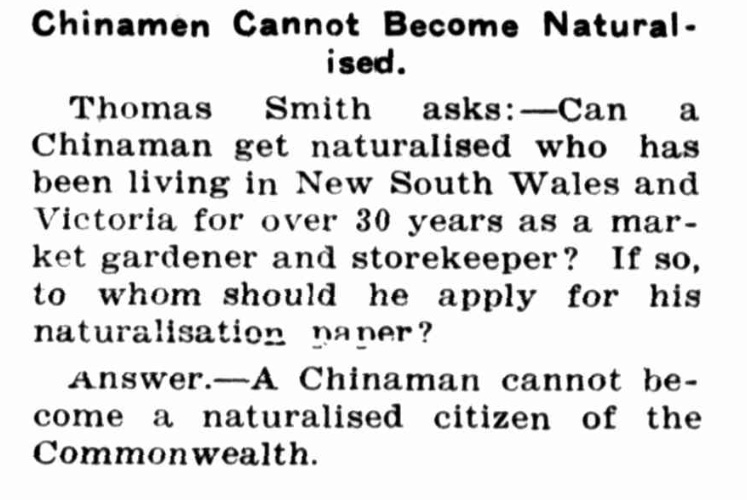
On 6 November 1925, the Land newspaper featured the following on its ‘Answers to Questions’ page.
The Land was indeed correct in its answer. In 1925, Chinese aliens (non-British subjects) could not be naturalised in Australia, no matter how long they had lived here.
Five years earlier the Nationality Act 1920 had replaced the Naturalization Act 1903, removing the racial barrier to the naturalisation of Asians. However, after 1920 the Australian government continued with its policy of preventing Asians from being naturalised. This did not change until 1956 when concessions were brought in for long-term residents.
For Australians whose Chinese ancestors arrived in the nineteenth and early twentieth centuries, tracing the family history back to China can be a real puzzle.
Whether you’re simply curious about your Chinese origins or are wanting to visit your ancestral village in China, there are two things you need to know – your Chinese ancestor’s name in Chinese characters and their village and county of origin.
Here you will find some suggestions for using Australian records to find these critical pieces of information.
Most Chinese who arrived in Australia in the nineteenth and early twentieth centuries came from the rural Pearl River Delta region of Guangdong province, south of the provincial capital of Guangzhou, north of Macau and inland from Hong Kong. A smaller number of Chinese migrants came from other parts of Guangdong province and from Fujian province (through the port of Xiamen, known historically as Amoy), as well as from other places such as Shanghai.
This post concentrates on Cantonese migrants who came from the Pearl River Delta.
Cantonese migrants came from a number of different areas in the Pearl River Delta, including:
Sam Yup (Sanyi, meaning the ‘three districts’): Namhoi (Nanhai), Poonyu (Panyu) and Shuntak (Shunde)
Heungshan (Xiangshan), later known as Chungshan (Zhongshan)
Tongkun (Dongguan)
Changshing, Tsengshing (Zengcheng)
Koyiu (Gaoyao) and Koming (Gaoming)
Sze Yup (Siyi, meaning the ‘four districts’): Sunwui (Xinhui), Sunning (Xinning) or Toishan (Taishan), Hoiping (Kaiping) and Yanping (Enping).
The Cantonese migrants spoke a range of dialects including: standard Cantonese, Cantonese variations such as Shekki dialect, Longdu (Zhongshan Min) dialect, Sze Yup dialects such as Taishanese, and Hakka. The earlier Amoy Chinese spoke Hokkien.
Source: Him Mark Lai Digital Archive, https://himmarklai.org/roots-program-lecture-notes/
The big stumbling block
To successfully track your family back to China you ideally need your ancestor’s name and their village and district of origin in Chinese characters. If your family migrated to Australia more recently and this information is known within the family, you have a tremendous advantage. If you don’t have this information, you will need to try and work it out from records available in Australia. This can be very tricky.
Until the twentieth century there was no standard way of romanising the various Chinese languages and dialects. Because of this, and because Chinese in Australia spoke different sorts of Cantonese, there is a lot of variation in how personal and place names are recorded in Australian English-language sources. Only rarely are Chinese characters to be found. The discrepancies in how Chinese names were written down in colonial Australia are not necessarily an indication of racist or uncaring attitudes toward the Chinese, but more a reflection of the fact that nobody, including the Chinese themselves, knew how to spell the names ‘properly’ in English.
Personal names
Chinese personal names usually comprise three characters, with one being the family name and two being the given name – for example, 譚梅玲 Tam Moyling. A few Chinese family names comprise two characters (e.g. O’Young, Seeto), and sometimes a given name comprises only one character.
Although the characters remain the same, the pronunciation of a name changes depending of the dialect spoken. For example, the two-character surname 司徒 is pronounced Situ in Mandarin, Seeto in Cantonese and Soohoo in Sze Yup. The common family name 陳 is pronounced Chen in Mandarin, Chan/Chun in Cantonese, Chin in Hakka, and Tan in Hokkien.
Chinese personal names were recorded in many different ways in Australian records and, in the nineteenth and early twentieth centuries at least, rarely was a name written down ‘correctly’. A person’s name might have been recorded with multiple spelling variations – for example, one early Sydney resident was recorded as Man Sue Bach, Mum Shou Pac, John Ah Shue Bach, John A. Sue Bach, John Ah Sue and John a Shue.
Because of the different word order (surname first in Chinese but last in English), many Chinese given names came to be used as surnames in English – for example, Wong Chun Bun might became known as Jimmy Chun Bun and his children registered under the surname Bun.
Many, many Chinese personal names also include ‘Ah’ or ‘A’. This represents the character 阿, which is a prefix added to a given name as a familiar or informal form of address, much like adding ‘ie’ or ‘y’ to the end of a name in English (Ann to Annie, Tom to Tommy).
Petition of Chinese residents of Melbourne, 1857. Source: PROV VPRS 1189/P0, unit 482, http://wiki.prov.vic.gov.au/index.php/Chinese_Language_Records_at_PROV
While sometimes confusing, romanised versions of personal and place names can tell us helpful things. For example, personal names written with a ‘sl’ or ‘shl’ or ‘thl’ sound at the beginning (like Dang Bown Sluey or Slit Schin) suggest that these people were likely to be from Taishan, as this sound is particular to Sze Yup sub-dialects rather than standard Cantonese.
Or, a woman’s name that includes a ‘See’ or ‘Shee’ (氏) usually gives her father’s family name and indicates that the woman was married – a bit like the term née. Ham See, for example, would be a married woman who was born into the Ham (譚) family – Ham would be her father’s, not her husband’s, surname.
Emma Woo Louie has written on Chinese American names, much of which applies in the Australian context. Her book is Chinese American Names: Tradition and Transition (McFarland & Company, 2008). A preview of the book is available from Google Books. She has also published articles on the subject in the Chinese Historical Society of America’s journal Chinese America: History and Perspectives.
Janis Wilton, Golden Threads: The Chinese in Regional New South Wales 1850–1950, New England Regional Art Museum, 2004
Jon Kehrer, ‘Who was “John Chinaman”’, The Ancestral Searcher, vol. 24, no. 4, December 2001, pp. 201–205
Jon Kehrer, ‘Honourable ancestors: My search for the Chinese connection’, The Ancestral Searcher, vol. 27, no. 4 December 2004, pp. 328–333
Gary Presland, ‘Some difficulties in researching Chinese ancestry’, in From Gold to Federation: Papers from the Fourth Victoria Family State Conference, ed. Noelle Oke, Penfolk Publishing, Melbourne, 2001.
Place names
The native place of many Chinese is recorded in Australian sources as Canton – which variably refers to the province of Guangdong or the capital city of Guangzhou. However, most migrants came from the rural counties outside the capital, rather than the city itself. Unfortunately if ‘Canton’ is all the information you can find about your ancestor’s origins you will probably not be able to progress your research much further.
More occasionally county, city, town or even village names are recorded: Sunning, Sun Wui, Heung Shan, Amoy, Shekki, Kongmoon, Lee Yuan, Chuk Sau Yuen or Bak Shek, for example. Sometimes it’s easy to identify these places, sometimes it’s not. The smaller the place, the harder it can be to identify, but the more useful it will be if you eventually work out where it is.
The trick is to be able to translate from the old romanised version of a place name to how it is known today. The Cantonese city known in Mandarin today as Jiangmen (江門), for instance, might have been written Quong Moon, Kong Mun, or Kongmoon.
There are several words that often appear as the last syllable in village names that it can be useful to recognise:
choon or toon – 村 cun, meaning ‘village’
g. 南潮村 Nam Chew Toon
lee or lay – 里 li, meaning ‘village’
g. 南勝里 Nam Sing Lay
yuen – 園 yuan, meaning ‘garden’
g. 竹秀園 Chuk Sau Yuen.
You can use clues you find in other records, such as distance from a larger town or physical characteristics of the place, to help narrow down your search for your particular village. If you know your ancestor’s surname you can also cross-check village names with the surname. The following database of village names is useful for this purpose:
The ‘Location, location, location’ section of the Chinese Genealogy forum (http://siyigenealogy.proboards.com/) is an excellent place to read up how others have gone about identifying and locating their ancestral villages.
If your ancestor came from Taishan, Xinhui or Zhongshan counties, you might find relevant information in the material produced by a project undertaken by the Asian Library at the University of British Columbia that identified the village and town of origin of Chinese migrants to Canada. Many migrants to Australia came from the same places as those who went to Canada. See:
http://asian.library.ubc.ca/special-projects/mapping-the-villages-and-towns-recorded-in-the-register-of-chinese-immigration-to-canada-from-1885-to-1949/. [link no longer working 24 February 2025]
Chinese graves in the old Chiltern cemetery, Victoria
Birth, death and marriage records
You should obtain Australian marriage and death certificates for the original Chinese ancestor, as well as birth certificates for their children and death certificates if the children died young. Sometimes a Chinese groom or father will have signed his name in Chinese characters and the birthplace will be more specific than just ‘Canton’ or ‘China’.
Immigration, travel and alien registration records
Immigration and travel records, as well as alien registration records, might contain details of people’s place of origin and their name in Chinese. Twentieth-century travel documents issued to Chinese Australians under the Immigration Restriction Act and related records are held by the National Archives of Australia. ‘Aliens’ (people who were not British subjects) were required to register with the government from World War I. These records are also held by the National Archives and can contain Chinese signatures, information about place of birth and so on.
Paul Jones, Chinese–Australian Journeys: Records on Travel, Migration, and Settlement, 1860–1975, National Archives of Australia, Canberra, 2005, http://guides.naa.gov.au/chinese-australian-journeys/ (pdf available online for free).
Naturalisation records
Some Chinese migrants became naturalised British subjects in the colonial period, and their application forms and certificates can include details such as place of origin and their original signature in Chinese. Naturalisation applications, rejected applications and cancelled and confiscated naturalisation certificates are found in state archives and in the National Archives of Australia.
Chinese newspapers
From the 1890s, Australia’s Chinese communities had their own Chinese-language newspapers, including the Chinese Australian Herald and the Tung Wah Times. The Tung Wah Times has been indexed in English, which allows you to search without knowing Chinese. The index can be helpful in identifying articles that might include an ancestor’s name in Chinese.
The major early Australian Chinese-language newspapers are also available through the National Library of Australia’s discovery service, Trove. If you have located names in Chinese characters you can search the newspapers even if you only have basic Chinese language skills. See:
In the early twentieth century, young Chinese were allowed to come to Australia to study. Most who came were the children or relatives of people already living here. These students were issued with special Chinese student passports that included their name and place of origin in Chinese characters as well as in English. Many of these passports are held in immigration files in the National Archives of Australia. On how you might be able to use these passports to identify your ancestor’s village of origin, see:
Application for a Chinese student passport for Wong Ching Hung, 1923. NAA: A1, 1927/2279, http://recordsearch.naa.gov.au/scripts/AutoSearch.asp?O=I&Number=1506455
In 2011 I wrote a blog post about a photograph of an unknown Chinese Australian family held in the State Library of Victoria collection. With very few details to go on, in my post I wondered whether I would ever find out the family’s identity. In this guest post, New England local historian Gill Oxley shares with us not only the family’s identity, but more about the interesting lives of Emma Tear Tack, nee Lee Young, and her reverend husband Joseph.
On 22 February 1899, an untitled article appeared on page 2 of the Ballarat Star. It conveyed news of the death of the retired ‘Government interpreter’ for the Ararat and Stawell districts of Victoria, Mr Lee Young. The article also served as an informal obituary, giving details of the life of Mr Lee Young, including his earliest days in Australia (following his immigration from Canton in about 1852) and his life on the goldfields of Victoria in the late 1800s. Towards the end of the article, mention was made of Mr Lee Young’s surviving four daughters and two sons. Two of his daughters were named as Mrs the Rev. James Ah Chue and Mrs the Rev. Joseph Tear Tack.
Mrs the Rev. Joseph Tear Tack was Emma, born at Ararat in Victoria in 1865 (Vic BDM reg. no. 19815), the second youngest child of Lee Young and his wife Elizabeth Wright.
Emma Tear Tack, c.1894 (State Library of Victoria H2005.34/103)
The Victorian Registry of Births, Deaths and Marriages gives Emma’s father’s name as Lee Young and her mother’s maiden name as Elizabeth Lyth. The maiden surname ‘Lyth’ is likely to have been either a mistranscription or else a mispronunciation, as Emma’s mother’s maiden name is given as Elizabeth Wright in official records of the births of most of Emma’s siblings. The record for Emma’s youngest sister, Jessie Lee Young, gives a different name again, with their mother’s maiden name given as Elizabeth Light – quite clearly a misinterpretation of ‘Wright’.
Elizabeth married (‘John’) Lee Young in Victoria in 1856 (Vic BDM reg. no. 3704) and the couple had two sons and four daughters:
William Lee Young, born Ballarat 1859 (Vic BDM reg. no. 7102)
Matilda Lee Young, born Ballarat 1860 (Vic BDM reg. no. 2269)
Henry Lee Young, born Ballarat 1862 (Vic BDM reg. no. 12268)
Alice Lee Young, born Ararat 1864 (Vic BDM reg. no. 6746)
Emma Lee Young, born Ararat 1865 (Vic BDM reg. no. 19815)
Jessie Lee Young, born Ararat 1869 (Vic BDM reg. no. 20004).
At 20 years of age, in 1885, Emma Lee Young married Chinese-born Joseph Tear Tack (Vic BDM reg. no. 4357).
Joseph Tear Tack’s Victorian naturalisation record of July 1883 gives his native place simply as Canton, his age at the time as 35 years and his occupation as minister.
Memorial for letters of naturalisation for Joseph Tear Tack, 1883 (NAA: A712, 1883/Y7207)
From this we can assume that Joseph Tear Tack was born in Canton in or about 1848. He would therefore have been about 17 years older than Emma at the time of their 1885 marriage. Perhaps it was this age difference that caused the ‘little commotion in Chinese circles’ over their impending marriage, as reported in the Ballarat Star, and other Victorian papers, in May 1885.
‘General news’, Riverine Herald, 5 May 1885, p. 3
After their marriage Emma and Joseph left Victoria and set up home in the tin mining district of Inverell in northern New South Wales. Their first child, Elizabeth Edith Tear Tack, was born there in 1886 (NSW BDM reg. no. 24730). From the beginning of the 1870s, the Inverell district had a very large Chinese population, with Chinese workers being drawn to the area for the rich deposits of alluvial tin that were plentiful there, and for the business opportunities that also presented themselves with the need for fresh vegetables and other supplies in the booming mining district.
Joseph Tear Tack had been sent to Inverell (or more precisely to nearby Tingha) in mid-1884 by the Wesleyan Methodist Church to minister to the resident Chinese population in the area. He was one of the ‘success stories’ of the church’s Chinese mission in Victoria (‘Wesleyan Church, West Maitland‘, Maitland Mercury, 5 June 1884, p. 2).
According to the March–April 1891 edition of the NSW Government Gazette (p. 1892), Rev. Tear Tack was registered at the NSW Registrar General’s Office in Sydney for ‘the celebration of marriages at Tingha’ on 6 March 1891. Joseph Tear Tack and his family of four persons – one male (his eldest son) and three females (Emma and two daughters) – appear as living at Tingha in the 1891 Census (1891 New South Wales Census, Australia). Helen Brown, in her book Tin at Tingha (1982, p. 35), makes mention of the Rev. Joseph Tear Tack being appointed to serve as an ‘assistant Methodist preacher’ at Tingha between 1885 and 1893, and he is also mentioned by Ian Welch in his work on the Methodist Chinese Mission in Australia.
[Family group] [picture] (State Library of Victoria H2005.34/103)All available evidence points to this lovely family photograph being the Tear Tack family, taken in the Inverell district some time between the years of 1893 and 1896. Although it is difficult to pinpoint the exact location, the photograph is likely to have been taken either at Inverell, Tingha or perhaps at nearby Bundarra. The Tear Tacks’ youngest daughter, Alice Lucy, who does not appear in the photograph, was born at Bundarra in 1896 (NSW BDM reg. no. 2164). Therefore, we can probably assume that the date of the photograph is either 1894 or, at the very latest, early 1895.
To the best of this writer’s current knowledge, the people appearing in the photograph are (left to right):
Joseph Henry Tear Tack, born Inverell 1888 (NSW BDM reg. no. 26002)
the Rev. Joseph Tear Tack
Josiah William Tear Tack, born Inverell 1892 (NSW BDM reg. no. 17560)
Emma Tear Tack nee Lee Young
Laura Matilda Tear Tack, born Inverell 1890 (NSW BDM reg. no. 16916)
Elizabeth Edith Tear Tack, born Inverell 1886 (NSW BDM reg. no. 24730).
The identity of the younger man standing back right is not known at this stage.
After working for some years in the Inverell/Tingha/Bundarra area, where their five children were born, the Rev. Joseph Tear Tack was sent by the church to Darwin in 1896. While living there he, Emma and their children survived a terrible cyclone that destroyed their house (‘Visit of a Chinese missionary to Lithgow‘, Lithgow Mercury, 5 June 1900, p. 2). Joseph was then sent to Cairns just at the turn of the twentieth century. There he was to establish a new mission and undertake Christian missionary work among the Chinese population in far north Queensland. Emma and children did not initially accompany him to Cairns, but shipping news indicated that ‘Mrs Tear Tack and five children’ sailed to Queensland from Sydney aboard the Aramac in November of 1900.
Tragedy struck the Tear Tack family not long after their arrival in Queensland, with Joseph Tear Tack dying of heart failure at Cairns in August 1901 (Qld BDM reg. no. C697). Joseph would have been approximately 53 years of age at the time of his death. Emma Tear Tack was only about 36 when she was widowed with five children. On 11 January 1902, a letter from Emma appeared in The Methodist under the title ‘Acknowledgement’. In it, Emma Tear Tack paid a moving tribute to her husband, Joseph, and thanked their many friends for their support in what she described as her ‘sore and heavy bereavement’.
Emma did not remarry and so remained a widow for the rest of her life. After her husband’s death, she returned to the support of her family of origin in Ballarat, Victoria, some time in 1903. She appears to have raised her five children there, before moving to Burwood, in the inner western suburbs of Sydney, at around 65 years of age (Sydney and New South Wales, Australia, Sands Street Index, 1861-1930).
Emma Tear Tack nee Lee Young died on 28 October 1948 at 83 years of age at her home in Concord (NSW BDM reg. no. 27301). She is buried in the Field of Mars Cemetery at East Ryde in Sydney. A death notice published in the Sydney Morning Herald on 29 October 1948 noted that she was the loving mother of Elizabeth, Henry, Laura, Josiah, Lucy, and adopted daughters Marjorie and Molly.
Death notices for Emma Tack (Sydney Morning Herald, 29 October 1948, p. 14)
I am very grateful to Kate Bagnall for originally posting the photograph of the Tear Tack family on her blog, to my cousin Etty Doyle Lang for pointing me in the direction of Kate’s post, and to the keen eye of Paul Macgregor who was the first to spot and recognise the Rev. Joseph Tear Tack in the photograph. I am also very much indebted to Paul for his encouragement, mentoring, collaboration and fine detective skills, and to our friend and colleague, Juanita Kwok, whom we also consulted in solving some of the mysteries initially presented by this photograph.